Related: Best Dash Cam for Night Driving: What the Footage Has to Prove
A dash cam buying guide usually starts with a resolution chart and ends with a number. That gets it backwards. The camera on your windshield has exactly one job, and it is not looking good on a phone screen. It is being a witness.
I drove rideshare in Phoenix for six years, about 40,000 miles a year on I-10 and the 101, most of it after dark when the surge pricing kicked in. I got rear-ended twice. The first time, a red-light runner told the officer I ran the light, and with no footage it turned into a three-month he-said-she-said fight that raised my premium anyway. The second time I had a camera on the glass, and the claim settled in nine days. That difference is the whole reason I keep doing this.
So this is not a spec-sheet tour. It is the short list I would hand a friend who wants a camera that still turns on in August, plus the cheap piece of film most people skip and then blame the camera for falling off the windshield.
What actually matters
Four things, in order.
Night footage at speed. Accidents do not happen at noon in perfect light. They happen at 9:40 p.m. on a six-lane road with headlights washing out half the frame. A camera that reads a plate at 40 mph in the dark is worth more than a camera with three extra features you will never open.
Heat tolerance. This is where cheap cameras die quietly. A parked dashboard in Phoenix can hit 180°F. A lithium battery in that environment swells, and a swollen battery means a camera that shuts off, corrupts a card, or both. A supercapacitor is the heat-proof cousin of the lithium battery, and it is the only power source I trust on a dashboard in a hot climate.
The mount. A camera you cannot keep on the glass is a camera you stop using. Suction cups let go in the heat. Adhesive pads fail on a dirty or pitted windshield. This is a five dollar problem that ruins a two hundred dollar purchase.
The card. The SD card is the most important part of the system and the part people spend the least on. Constant recording plus heat equals corruption, and corruption always shows up on the one clip you needed. High endurance is the rating you want, verified on the card itself, not on the listing.
Everything else, the cloud app, the voice control, the lane departure beeps, is decoration. Some of it is nice decoration. None of it is the reason you buy the camera.
Best overall for front and rear coverage: ROVE R2-4K Dual
Two cameras, one purchase, one card slot to manage. That is the appeal here, and for most drivers it is the right call. Rear coverage is not a luxury. Half the claims I have heard about from drivers in the rideshare groups started with somebody hitting them from behind, and a rear camera answers the only question that matters in that argument: who was where, and when.
The STARVIS 2 sensor is the part I would point at first. Sensor quality is what separates a camera that produces usable night footage from a camera that produces a dark smear with bright headlights in it. Resolution is the number on the sticker. The sensor and the bitrate are the numbers that decide whether you can read a plate.
It also ships with a 128GB card in the box, which saves you a trip and one more decision. Do check the endurance rating on whatever card ends up in it, and replace it with a high endurance card when it wears out. Cards are consumables. Cameras are not.
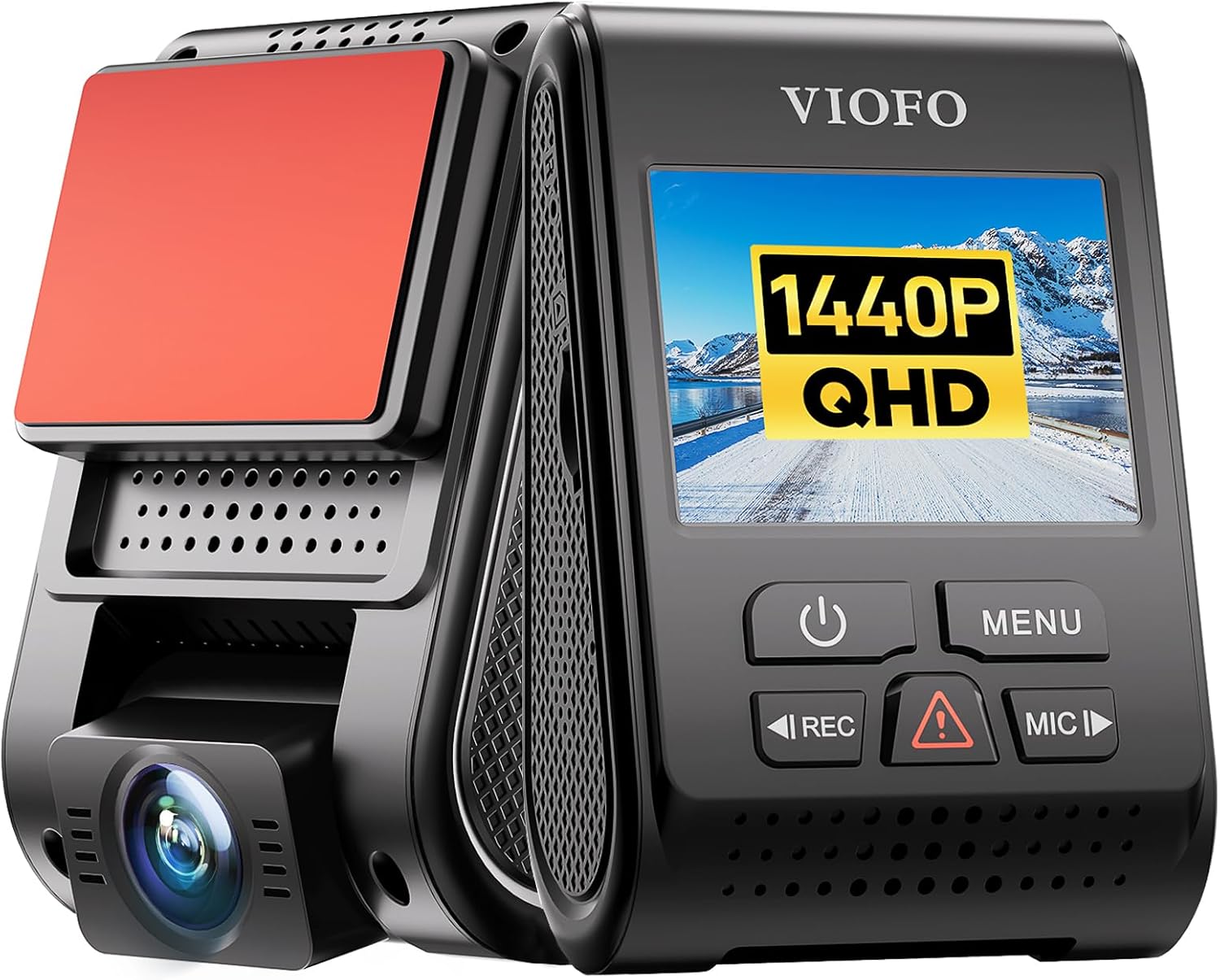
Best single-channel: VIOFO A119 V3
If you want one camera, pointed forward, with nothing to troubleshoot, this is the shape of that decision. A single channel install means no cable running through the headliner, no trim panel to pull, and no second camera to wonder about. You stick it up, you plug it in, you forget it exists until you need it.
2K front recording, GPS, and true HDR. HDR is the feature that earns its keep at night, because it is what keeps a bright plate from blowing out into a white rectangle when headlights are pointed at you. GPS means the footage carries speed and location data, and an adjuster who can see a timestamp and a location is an adjuster who stops asking whether the clip is from that day.
This is also the camera I would hand to somebody who has never owned one. No app required to get your own footage off the card, no subscription, no cloud account. Pull the card, put it in a reader, done. That sounds like a low bar. It is not, and you will appreciate it the first time you need a clip at 11 p.m.
Best for rideshare and delivery: COOAU D30S
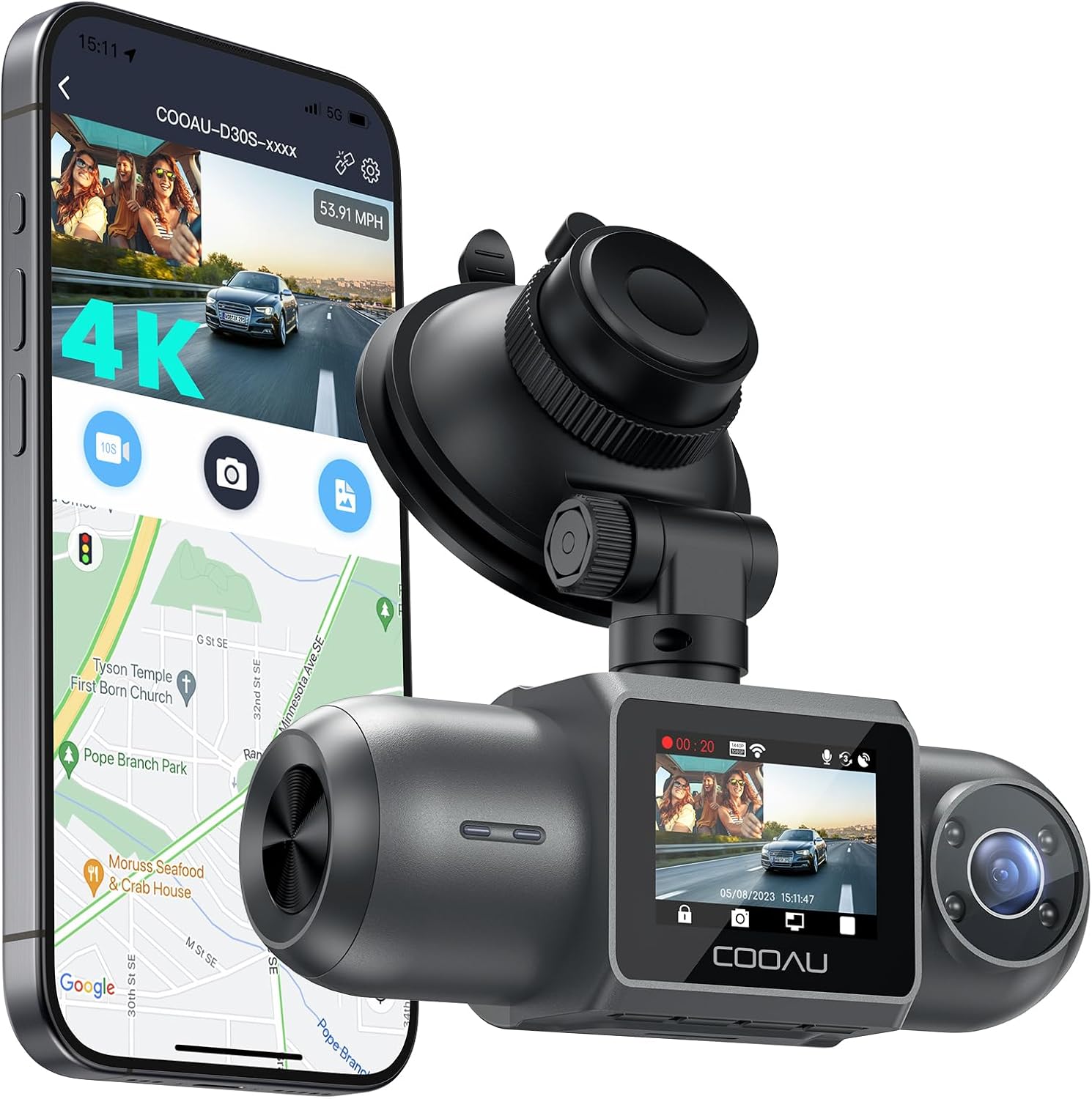
If passengers are in your car, the inside camera is not optional. It is the difference between your word and somebody else's. The D30S records the front and the cabin, with the front channel at 2.5K and the inside channel at 1080P, and the inside channel is the one that settles the argument about what happened in the back seat.
The 4 infrared LEDs are the feature that matters for rideshare night work. Infrared means the cabin footage still shows faces and movement when the interior is dark, instead of a black rectangle with a dome light blowing out one corner. Pickups at 2 a.m. are exactly when you want that working.
The supercapacitor is the other thing I would underline. In a hot climate, a supercapacitor is the difference between a camera that keeps working and a camera that becomes a swollen brick. It also lists parking mode, G-sensor, loop recording, GPS and Wi-Fi. Two notes on those. Parking mode is only as good as its power source, and the cigarette lighter kills it when the ignition dies, so it needs a proper hardwire to the fuse box to be real. And loop recording is only reliable if the card is healthy, which brings us back to high endurance.
The part that saves the install: Thinp Electrostatic Film
Nobody writes about this part, and it is the reason a lot of cameras end up in a glovebox. You get four clear electrostatic films, double sided, heat resistant, plus an adhesion promoter in the pack. The film goes on the glass, the mount sticks to the film, and when you sell the car or swap cameras you peel the film instead of fighting cured adhesive off your windshield with a razor blade.
The heat resistance is the point. Adhesive that holds fine in April is the same adhesive that lets go in July, and a camera that drops off the glass mid-drive is a camera that is not recording. The adhesion promoter is what turns a clean glass surface into a surface that actually holds. Most people skip that step and then blame the pad.
If you are moving a camera between cars, or you have ever spent twenty minutes scraping residue off a windshield, this is the cheapest upgrade in the whole setup.
The comparison table
| Setup | What it covers | Best for | What to know |
|---|---|---|---|
 Visit on Amazon → Visit on Amazon →ROVE R2-4K Dual |
Front and rear | Full coverage in one purchase | STARVIS 2 sensor, 128GB card included |
 Visit on Amazon → Visit on Amazon →VIOFO A119 V3 |
Front only | Simple, no rear cable | 2K, GPS, true HDR |
 Visit on Amazon → Visit on Amazon →COOAU D30S |
Front and cabin | Rideshare and delivery | Supercapacitor, 4 IR LEDs, parking mode |
 Visit on Amazon → Visit on Amazon →Thinp Electrostatic Film |
Mounting surface | Any install, any camera | Heat resistant film, adhesion promoter |
How I check a camera before I trust it
The same four questions every time, and they are the questions you should ask too.
What does the night footage actually look like at 40 mph? Not in a parking lot, not in a driveway. Moving, with headlights around, on a road where a plate has to be readable.
Can it survive a week on a hot dashboard without shutting down? Heat is the failure mode that does not announce itself. The camera does not beep and warn you. It just stops, or it corrupts a file, and you find out later.
What does parking mode really cost in battery drain? A parking mode that flattens your battery is not a feature, it is a tow truck. That means a hardwire kit and a voltage cutoff, done properly, and it means testing on a real car.
Would I hand this footage to an insurance adjuster? That is the final filter. Not whether it looks nice, whether it proves something. Plates, timestamps, and context.
What the specs really mean
Resolution is the number that sells cameras and the least useful one on its own. A 4K camera with a low bitrate can look worse than a good 1080p camera, because bitrate is how much video data gets recorded per second, and it is the number nobody checks. So when you see 4K, look at the sensor and the bitrate before you believe it.
Field of view is the other one. Around 140 degrees is the sweet spot. Narrower and you miss the side of your own car, which is exactly where a lane-change impact happens. Wider and plates turn into smudges at the edges of the frame, because you are stretching the same sensor across more road.
Then there is the boring stuff that decides whether any of it works. A capacitor instead of a lithium battery. A high endurance card. An adhesive mount with a proper film and promoter underneath it. A hardwire kit if you want parking mode to mean anything. None of that shows up in a marketing photo, and all of it is why one camera lasts four years and another one lasts four months.
The two accident stories I opened with are the whole argument. Same driver, same roads, same city. The only variable was whether there was a camera on the glass and whether the footage was usable. Everything in this guide exists to make sure you end up in the nine-day version of that story instead of the three-month one.
Should you buy the ROVE R2-4K Dual?
Yes, if you want both directions covered and you do not want to shop for two cameras. Front and rear in one box, STARVIS 2 for the night footage, and a 128GB card included so you can install it the same day it arrives. Just replace that card with a high endurance one when it wears out, because every card wears out. Visit on Amazon →
Should you buy the VIOFO A119 V3?
Yes, if your priority is simple and reliable over feature count. One camera, forward facing, 2K with GPS and true HDR, no rear cable to run, and no account needed to retrieve your own footage. If you have never owned a dash cam, this is the least complicated way to stop driving without a witness. Visit on Amazon →
Should you buy the COOAU D30S?
Yes, if passengers ride in your car. The cabin camera plus infrared LEDs covers the dark pickups that a front-only camera misses entirely, and the supercapacitor means it is built for a hot climate instead of merely marketed in one. Pair it with a proper hardwire if you want parking mode to actually function. Visit on Amazon →
Whichever one you pick, buy the film. It is the least exciting item on this page and the one that keeps the other three stuck to your windshield.