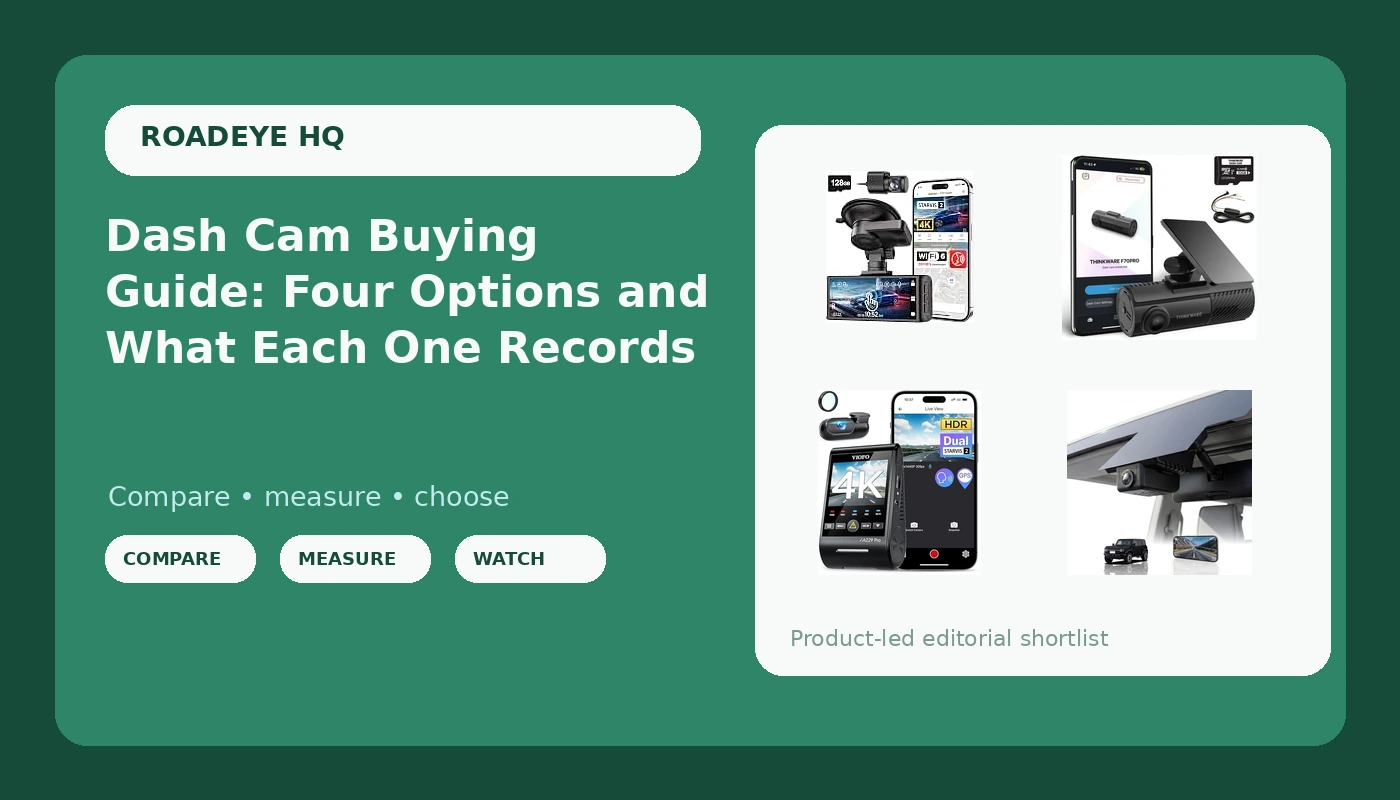
Most dash cam purchases happen after something has already gone wrong, which is the worst possible moment to learn what a camera can and cannot prove. A clip is only worth what it shows: a plate, a timestamp, and enough context to answer the one question that decides a claim, which is who moved into whose lane. That is the lens this guide uses. Below are four night-driving dash cam options covering the realistic spread of needs: a dual-sensor 4K front-and-rear system, a 4K kit that ships with a memory card, a 1080p camera built around night vision, and a front-only unit shaped specifically for one truck platform. None of them is a magic box. Each one solves a slightly different problem, and picking the wrong one usually means paying for coverage you will never use or missing coverage you will wish you had.
Related: Hardwiring a Dash Cam for Parking Mode: What It Actually Takes →
Quick answer
Buy for the footage you will actually need, not the resolution printed on the box. If you want the front and the rear of the car covered by two STARVIS 2 sensors, the VIOFO A229 Pro is the dual-channel option here. If you would rather not shop for a card separately, the REDTIGER kit includes a 128GB card and adds 5GHz WiFi for faster file transfers. If a single 1080p camera with night vision and a G-sensor is enough for your driving, the THINKWARE F70 PRO covers that ground. If you drive a Ford Bronco or Raptor from 2021 through 2024, the vehicle-specific front 4K camera is the only one of the four built for that dashboard and trim, and it does not fit the Bronco Sport. Any of these can serve as a witness. None of them replaces a high-endurance memory card, and none of them will help if the footage cannot be read.
Four useful options
| Model | Best fit | What stands out |
|---|---|---|
| VIOFO A229 Pro 4K HDR Dash Cam Front and Rear, Dual STARVIS 2 Sensors | Drivers who want both ends of the car recorded by one system | 4K HDR recording with STARVIS 2 sensors front and rear |
| REDTIGER 4K STARVIS 2 Dashcam Front Rear, 5GHz WiFi 20MB/s, Free 128GB Card | Buyers who want the memory card included and faster wireless transfers | 4K STARVIS 2 front and rear, 5GHz WiFi rated at 20MB/s, bundled 128GB card |
| THINKWARE F70 PRO Dash Cam 1080p Full HD, Wi-Fi, Night Vision, G-Sensor | Simple single-camera coverage without a rear install | 1080p Full HD, Wi-Fi, night vision, G-sensor |
| Front 4K Dash Cam for Ford Bronco & Raptor 2021-2024 (Not for Bronco Sport) | Bronco and Raptor owners who want a front camera made for that platform | Front 4K recording designed for the 2021-2024 Bronco and Raptor |
The dual-channel option: VIOFO A229 Pro 4K HDR Dash Cam Front and Rear, Dual STARVIS 2 Sensors
The trade-off with any two-channel system is data. Twice the cameras means twice the files, which means card capacity and card quality matter more than they do on a single-camera setup. You also have to route a cable from the windshield to the rear glass, and how clean that job looks depends entirely on how much time you spend on it. HDR recording is genuinely useful when headlights and deep shadow share the same frame, but no amount of HDR fixes a dirty lens or a windshield that has not been cleaned since spring.
The card-included option: REDTIGER 4K STARVIS 2 Dashcam Front Rear, 5GHz WiFi 20MB/s, Free 128GB Card
A bundled card removes the step most people skip until the last minute, and skipping it is how you end up recording onto whatever card was already rattling around in a drawer. That said, a card arriving in the box does not automatically make it a high-endurance card, and constant loop recording is hard on ordinary cards. Treat the included 128GB card as a starting point and verify the endurance rating on the card itself. The 5GHz WiFi is the other practical advantage: moving a multi-gigabyte clip over a slow connection is the reason people stop reviewing their own footage.
The single-camera option: THINKWARE F70 PRO Dash Cam 1080p Full HD, Wi-Fi, Night Vision, G-Sensor
The obvious limitation is coverage: a single camera sees forward and nothing else, so a rear-end collision from behind is not captured on video by this unit. What it does offer is a lower-friction install and fewer things to go wrong. Night vision is the feature to scrutinize hardest on any camera, because it is the claim every brand makes and the one that decides whether a plate is readable at night. A G-sensor is worth understanding before you rely on it: it flags and locks event clips, but sensitivity set too high fills your card with locked files that loop recording cannot overwrite.
The vehicle-specific option: Front 4K Dash Cam for Ford Bronco & Raptor 2021-2024 (Not for Bronco Sport)
This is the narrowest of the four, and that is intentional. It records forward only, so it is not a replacement for a two-channel system if rear coverage matters to you. What it offers is a camera designed around a specific vehicle rather than a universal mount that you adapt yourself, which matters on trucks and SUVs where the windshield, mirror housing, and trim do not leave much room for a generic bracket. Read the fitment note twice. The Bronco Sport is a different vehicle from the Bronco, and this unit is not made for it.
Prices and availability may change. Product images, names, and retailer links are matched to verified listings. No current price, rating, stock status, or measured result is stated here without current evidence.
What 4K actually means in a dash cam
Resolution is the easiest number to market and the hardest to interpret. A camera can record 4K frames and still produce footage where a plate at 40 mph is an unreadable smudge, because resolution is only one input. The others are the sensor, the bitrate, and the field of view.
The sensor decides how much light each frame has to work with. STARVIS 2 sensors appear in two of the cameras above, and the reason sensor names matter is that a large, light-sensitive sensor at a lower resolution often beats a small sensor pushed to a higher one, especially after dark. This is the gap between a spec sheet and a night clip.
Bitrate is the amount of video data recorded per second. A high-resolution camera paired with a low bitrate throws away detail in compression, which is exactly the detail you needed, the lettering on a plate or the shape of a bumper. Two cameras labeled 4K can look very different on the same street at the same hour.
Field of view is the third variable. A very wide lens sees more of the road but stretches the edges of the frame, and plates near the edge turn into distorted shapes. Around 140 degrees is the practical middle ground: wide enough to catch a car entering your lane from the side, narrow enough that plates stay legible.
Heat, power, and the card: what decides whether footage exists
A dash cam that shuts down in July or corrupts its card in month four is not a dash cam, it is a decoration. Three things determine whether footage survives to be useful.
Power source matters in hot climates. Cameras built around capacitors tolerate dashboard heat far better than cameras built around lithium batteries, and a parked dashboard in a desert summer is one of the harshest environments consumer electronics ever see. If you live somewhere with real summers, this is not a minor spec.
Parking mode only works when it is wired to power. Motion and impact recording while the car is off requires a hardwire kit to the fuse box, because the cigarette lighter socket dies with the ignition. That also means parking mode has a real battery cost, and how much depends on your car and how the voltage cutoff is set.
The card is the part people spend the least on and the part that fails first. Constant recording plus heat is exactly the workload that high-endurance cards are rated for and ordinary cards are not.
Five steps to make the decision:
- Decide whether you need rear coverage. If yes, only two of the four options above qualify.
- Confirm the vehicle. Year, model, and trim first, especially for the Ford-specific unit.
- Check the card situation. If a card is included, verify its endurance rating before trusting it.
- Plan the power. Decide now whether you want parking mode, because that means hardwiring.
- Budget for the card and the install, not just the camera.
Practical guidance before you buy
- Clean the glass and mount the camera high, near the mirror, so the lens sees road rather than hood.
- Aim the lens slightly down so the horizon sits in the upper third of the frame.
- Format the card in the camera, not on a computer, and reformat on a schedule.
- Review one clip a month, in the dark, and ask whether you could read a plate.
- Keep a spare high-endurance card in the car, because the day you need footage is the day a card dies.
Which option should you choose?
Choose the VIOFO A229 Pro 4K HDR Dash Cam Front and Rear, Dual STARVIS 2 Sensors when you want both the front and rear of the car recorded by one system with 4K HDR up front. Choose the REDTIGER 4K STARVIS 2 Dashcam Front Rear, 5GHz WiFi 20MB/s, Free 128GB Card when you want front and rear 4K coverage plus a card in the box and faster wireless file transfers. Choose the THINKWARE F70 PRO Dash Cam 1080p Full HD, Wi-Fi, Night Vision, G-Sensor when a single camera with night vision and impact detection fits your driving and you would rather not wire a rear channel. Choose the Front 4K Dash Cam for Ford Bronco & Raptor 2021-2024 (Not for Bronco Sport) when you drive that specific truck and want front-only coverage made for it.
One caveat that applies to all four: nothing in this article is a measured result, a heat test, or a frame-by-frame footage comparison, and no current price or rating is stated here. Confirm fitment, card requirements, and hardwire needs against the listing before you buy, and treat any night vision claim as something to verify with your own eyes.
The bottom line
The right dash cam is the one whose footage you could hand to an adjuster and have it settle a question instead of starting an argument. Front and rear coverage answers more questions than a single camera, a bundled card gets you recording sooner, and a camera built for your specific vehicle removes the mounting guesswork. Whichever of the four you pick, the camera is only half the system. The card and the wiring decide whether the footage still exists when someone asks for it.