Most dash cam setup decisions get made in the wrong order. Someone picks a camera off a product page, sticks it to the windshield with whatever is in the box, and drops in the spare micro SD card that came out of an old phone. Weeks later there is a collision at 11 p.m., and the clip turns out to be a dark smear with no plate, no rear angle, and a file that stops recording three seconds before impact. A dash cam setup is a system, not a gadget. The camera captures, the card stores, the mount holds all of it against glass that can bake well past 150°F in a parked car. Get any one of those three parts wrong and the other two stop mattering.
Related: How to Hardwire a Dash Cam Without Draining Your Battery →
Quick answer
Build the setup around the footage you will actually need: night driving, a rear angle, and a file that survives heat. That means a camera with the channels you want, a high endurance card rated for constant writing, and a mount that stays put through summer. The camera gets all the attention, but storage and mounting are where most setups quietly fail. Match every part to the same recording duty and the same temperature range, and check the listed fitment before you order anything.
Four useful options
| Model | Best fit | What stands out |
|---|---|---|
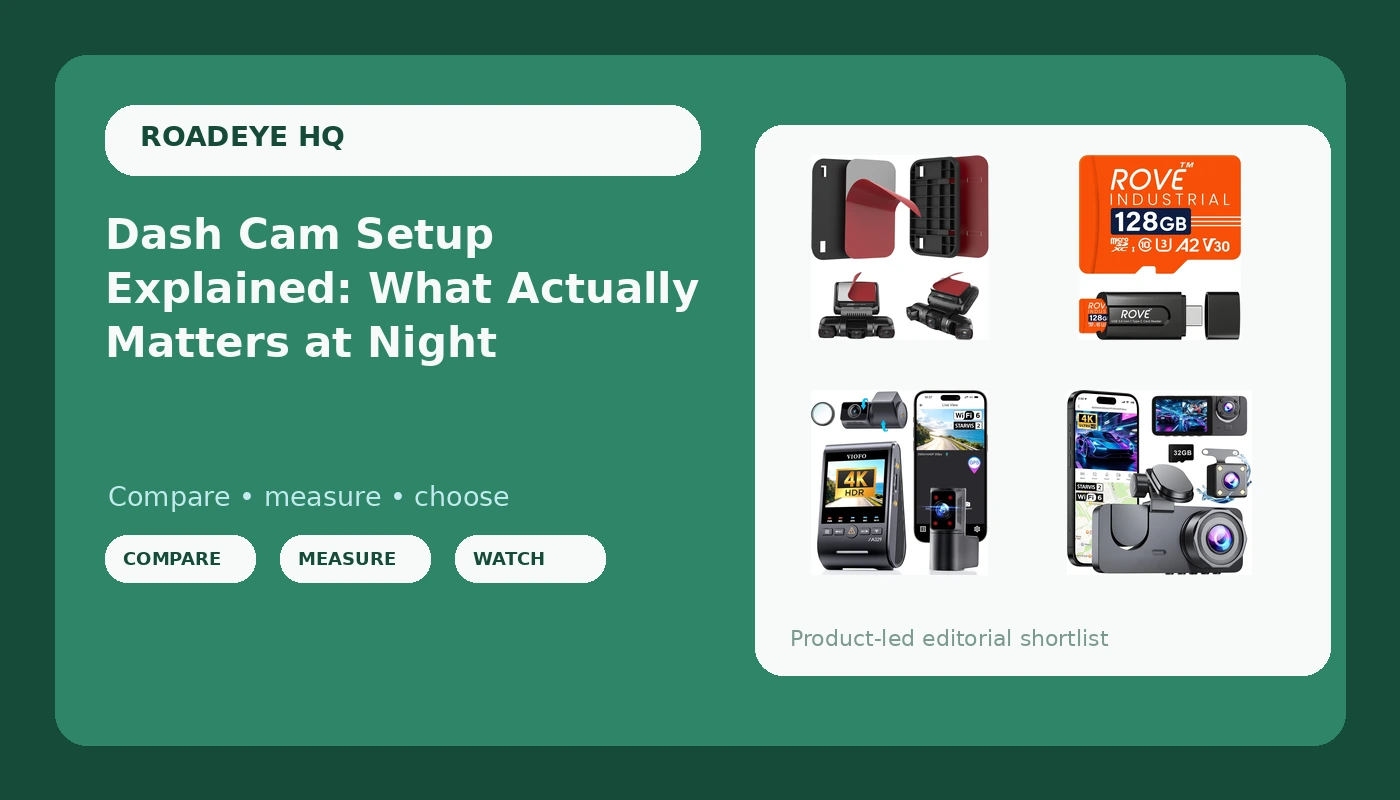
| VIOFO A329S 4K+2K+2K Dash Cam Front Cabin and Rear, STARVIS 2 HDR, Wi-Fi 6 | Drivers who want front, cabin, and rear coverage from one system | Three channels with STARVIS 2 HDR sensors and Wi-Fi 6 |
| Dash Cam Front and Rear Inside, 4K Full HD 3 Channel Dash Camera for Car | Budget three-channel builds | Front, rear, and interior coverage in a single camera |
| ROVE Industrial 128GB High Endurance Micro SD Card, USB 3.0 Card Reader | Anyone running loop recording every day | High endurance rating plus a USB 3.0 reader for offloading clips |
| Double Sided Sticker Heat Resistance Tape for Pruveeo D90/A6/D88 Dash Cam | Replacing a mount that let go in the heat | Heat resistant double sided adhesive listed for specific Pruveeo models |
Premium three-channel coverage: VIOFO A329S 4K+2K+2K Dash Cam Front Cabin and Rear, STARVIS 2 HDR, Wi-Fi 6
Three channels is the part worth understanding before you buy. A front-only camera proves what happened ahead of you and nothing else. Add a cabin channel and you can document a passenger interaction, a traffic stop, or who was reaching for what. Add a rear channel and a lane-change dispute stops being one driver's word against another. The trade-off is real: three streams write three times as much data, generate more heat in the housing, and demand a card that can keep up. HDR matters here too, because the hardest frame to capture is not a dark street, it is a dark street with a set of oncoming headlights pointed straight at your lens. HDR is the feature that keeps a plate from disappearing into that glare.
Budget three-channel coverage: Dash Cam Front and Rear Inside, 4K Full HD 3 Channel Dash Camera for Car
The honest trade-off with any budget three-channel camera is not the channel count, it is everything behind the number. When a single processor splits its work across three feeds, each feed gets less bitrate, and bitrate is what decides whether a license plate at 40 mph is legible or just a pale rectangle. A 4K label on the box does not settle that question on its own, because a sensor that cannot resolve detail will not resolve it at a higher resolution setting. What this camera does offer is coverage structure: front, cabin, and rear from one install, which is more evidence than a single-channel camera at twice the price. If your priority is having a rear angle at all, that structure is worth more than a cleaner image from one direction.
The storage layer: ROVE Industrial 128GB High Endurance Micro SD Card, USB 3.0 Card Reader
A dash cam writes to its card continuously, every day, for years, in a hot plastic shell on a windshield. That is the opposite of how a normal micro SD card is used, and it is why standard cards corrupt. The high endurance rating exists for exactly this workload, and it is the single specification worth checking on the card itself rather than on the product page. Capacity matters too, but for a different reason than most people assume: a larger card means the camera overwrites older footage less often, so a clip from last Tuesday may still be there when your insurer asks for it. It also means the card has more room to rotate through loop recording before it starts deleting, which keeps the newest files intact.
The mounting layer: Double Sided Sticker Heat Resistance Tape for Pruveeo D90/A6/D88 Dash Cam
Adhesive failure is the least glamorous dash cam problem and one of the most common. A mount that lets go does not just drop the camera, it changes the angle, and a camera pointing three degrees off axis will frame the wrong part of the road. Heat is what kills the tape, which is why the heat resistance rating matters more than the thickness of the pad. Be deliberate about fitment here: this tape is listed for the Pruveeo D90, A6, and D88, so if you drive something else, confirm your bracket matches before ordering. Surface prep matters as much as the pad itself, and a cold, clean windshield applied indoors will hold far better than a warm one applied in a parking lot with dust on it.
Prices and availability may change. Product images, names, and retailer links are matched to verified listings. No current price, rating, stock status, or measured result is stated here without current evidence.
Why the memory card decides whether you have evidence
Every dash cam runs the same basic loop: write a segment, close the file, write the next segment, delete the oldest segment when the card fills. That cycle is a constant stream of write operations, and flash memory has a finite number of them. A standard card rated for occasional photos and app data will burn through its write cycles far sooner under this load, and the failure mode is not a clean error message. It is a card that keeps accepting writes while producing files the camera cannot read, or a loop that silently stops looping.
Two symptoms are worth knowing because both look like camera problems and are usually card problems. The first is a camera that freezes or reboots mid-drive; the second is footage with gaps where a segment should be. Before you replace a camera, pull the card and test it. A card that has stopped looping can leave you with weeks of old files and nothing from the drive that mattered.
Capacity interacts with this. Three-channel recording produces roughly three times the data of a single channel, so a card that holds a comfortable week of single-channel footage holds a couple of days of three-channel footage. That is a reason to size up rather than down, and a reason to prefer the high endurance rating over a faster speed class alone, since sustained writing in heat is the workload, not peak burst speed.
Channel count, heat, and where the camera sits
Adding channels adds heat. Each additional video stream means more processing inside a housing that is already sitting in direct sun, and the components that fail first are the ones that store energy. Lithium batteries swell and eventually fail in a hot car; capacitors are built to tolerate it. That is why a camera marketed for hot climates should be judged on its power storage, not its resolution sticker. Parking mode makes the same demand from a different direction, because it runs the camera while the car is off, and it only works when the camera is wired to a constant power source rather than a socket that dies with the ignition.
Placement changes what the footage can prove. A camera mounted low behind the rearview mirror sees less of the road ahead and more of your dashboard. A camera mounted in the middle of the glass is more visible to a thief and more exposed to the sun. For the lens itself, a field of view around 140 degrees is a reasonable middle ground: narrower misses the side of your car in a merge, wider stretches the edges of the frame until plates near the sides become unreadable.
- Decide what the footage needs to prove. A rear-end claim needs a rear channel. A passenger dispute needs a cabin channel. Everything else is optional.
- Pick the channel count first, because it drives heat, power draw, and how much storage you need.
- Size the card for the channel count. Three channels write three times the data, so a larger high endurance card buys you retention time, not just capacity.
- Check how the camera stores power. Capacitors tolerate heat better than lithium batteries in a car that sits in the sun.
- Verify the mount and its adhesive before install, including whether replacement pads are listed for your specific model.
- Plan the power source. Parking mode requires a hardwire kit; a cigarette lighter socket shuts off with the ignition and takes parking mode with it.
Practical guidance before you order
- Check the listed fitment on any accessory. Replacement adhesive, hardwire kits, and mounts are often model specific, and a pad listed for one camera may not fit another bracket.
- Prefer the high endurance rating over a headline speed class when the card will live in a dash cam.
- Format a new card in the camera itself, not on a computer, so the file system matches what the camera expects.
- Test playback from the card directly with a reader rather than trusting the camera app, especially before a long trip.
- Recheck the camera angle after any re-mount. A camera that has shifted is still recording, just not recording what you need.
- Do not assume loop recording is still looping. Spot check the oldest file on the card occasionally to confirm it is being overwritten on schedule.
Which option should you choose?
Choose the VIOFO A329S 4K+2K+2K Dash Cam Front Cabin and Rear, STARVIS 2 HDR, Wi-Fi 6 when you want front, cabin, and rear coverage from a single system and HDR matters for the night driving you actually do. Choose the Dash Cam Front and Rear Inside, 4K Full HD 3 Channel Dash Camera for Car when three angles matter more to you than a higher bitrate on one of them, and you would rather have a rear channel than a cleaner front image. Choose the ROVE Industrial 128GB High Endurance Micro SD Card, USB 3.0 Card Reader when you are running loop recording daily and want a card rated for the workload plus a reader for offloading clips. Choose the Double Sided Sticker Heat Resistance Tape for Pruveeo D90/A6/D88 Dash Cam when a bracket has come loose and you need replacement adhesive, after confirming it is listed for your camera.
One caveat worth stating plainly: channel counts, resolution labels, and card ratings are claims made by the listings, and they are not the same thing as measured performance. A three-channel camera is not automatically better than a two-channel one, and a 4K label does not guarantee a readable plate at speed. Treat every specification as a starting point, then judge the setup on whether it produces footage you would hand to an adjuster.
The bottom line
A dash cam setup fails at the cheapest part first. The camera is the visible purchase, but the card that stores the footage and the adhesive that holds the bracket decide whether the clip exists when someone asks for it. Buy the channel count that matches what you need to prove, pair it with a card rated for constant writing, mount it so it survives the summer, and confirm every accessory fits your specific model. Do that, and the setup stops being a gadget and starts being a witness.