I've stood in a Phoenix parking lot at 11 p.m. with a police report, a dented rear bumper, and nothing to show for it. The other driver said I ran the light. Without footage it was three months of he-said-she-said, and my premium went up anyway. Two years later a distracted driver hit me at 45 mph and the cheap cam on my windshield settled the claim in nine days. That gap is the entire reason I care about this category, and it's the lens I use for this 4K dash cam comparison of three cams at very different price points and very different levels of ambition.
Here's the honest framing up front: I have not had these three on my windshield yet. What follows is a read of what each one is built to do, what's in the box, and how each would hold up against the four questions I run every camera through. Night footage at speed. Heat. Parking mode drain. And whether the footage would survive contact with an insurance adjuster. When I have clips, I'll update this with real frames.
For most drivers, the ROVE R2-4K Dual is the pick of this group, because a STARVIS 2 sensor and a 128GB card in the box solve the two problems that actually cost people money: unreadable night plates and a card that was never bought. If you drive for hire and need the cabin on camera, the DDPAI N4T Pro is the one that covers all three angles, and the budget triple-channel cam is the cheapest way to get an interior view, with the caveats that come with a $40 class cam.
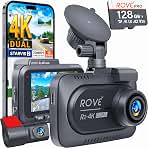
ROVE R2-4K Dual Dash Cam Front and Rear, STARVIS 2 Sensor, Free 128GB Card
STARVIS 2 sensor on a front and rear setup, plus a 128GB card in the box. The sensor is what decides whether a plate is readable at night, and the included card means you're recording the day it arrives
Only two channels. No cabin view, so a rideshare passenger dispute is a blind spot you cannot fix later
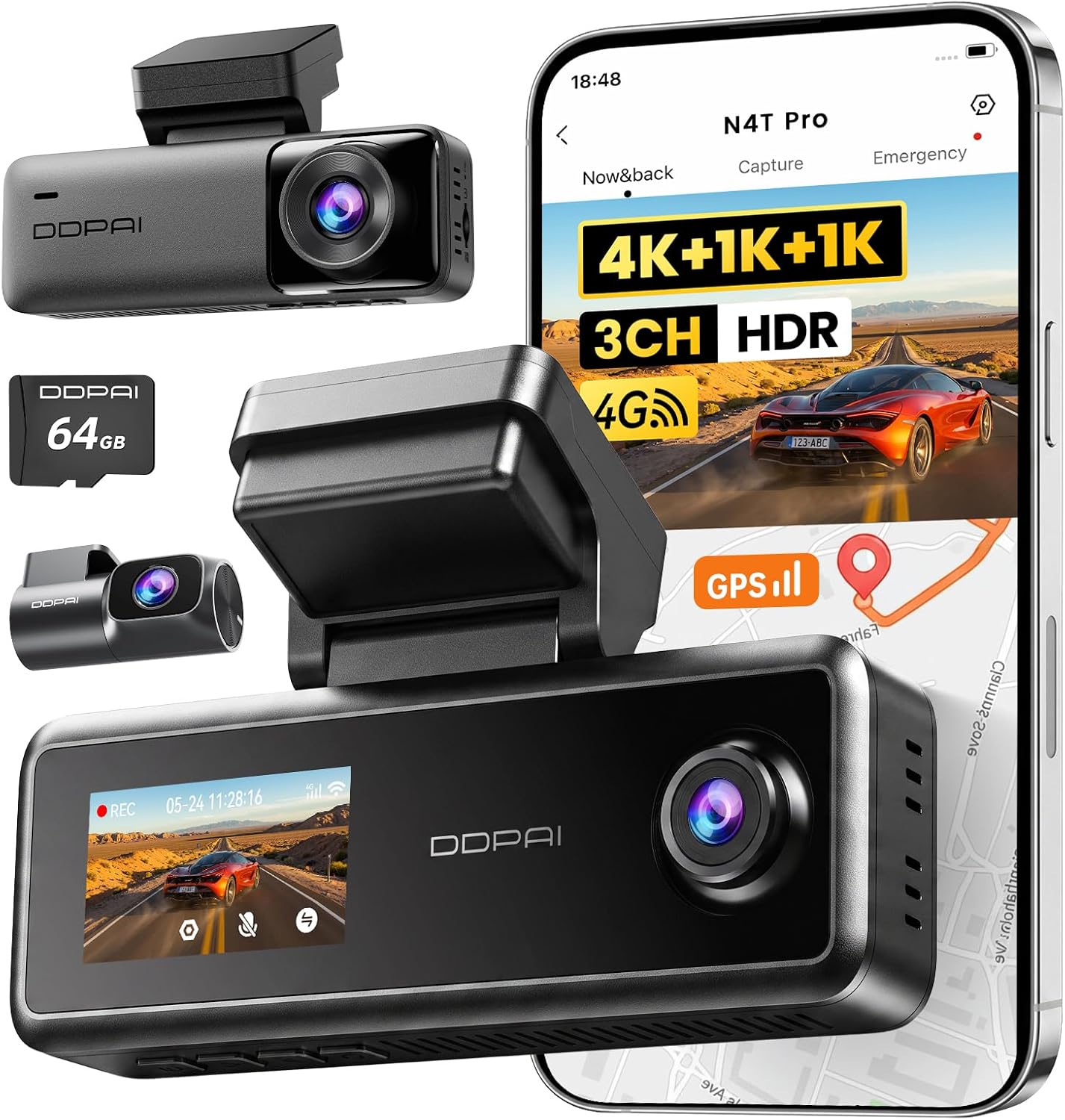
DDPAI N4T Pro 4K 3 Channel Dash Cam, 64GB Card, Triple HDR, WiFi 6
Three channels with Triple HDR, and WiFi 6 means pulling a clip to your phone happens in seconds instead of minutes. The most complete coverage set in this group
A 64GB card spread across three channels fills fast. Verify it's a high endurance card, because a standard card is a countdown timer
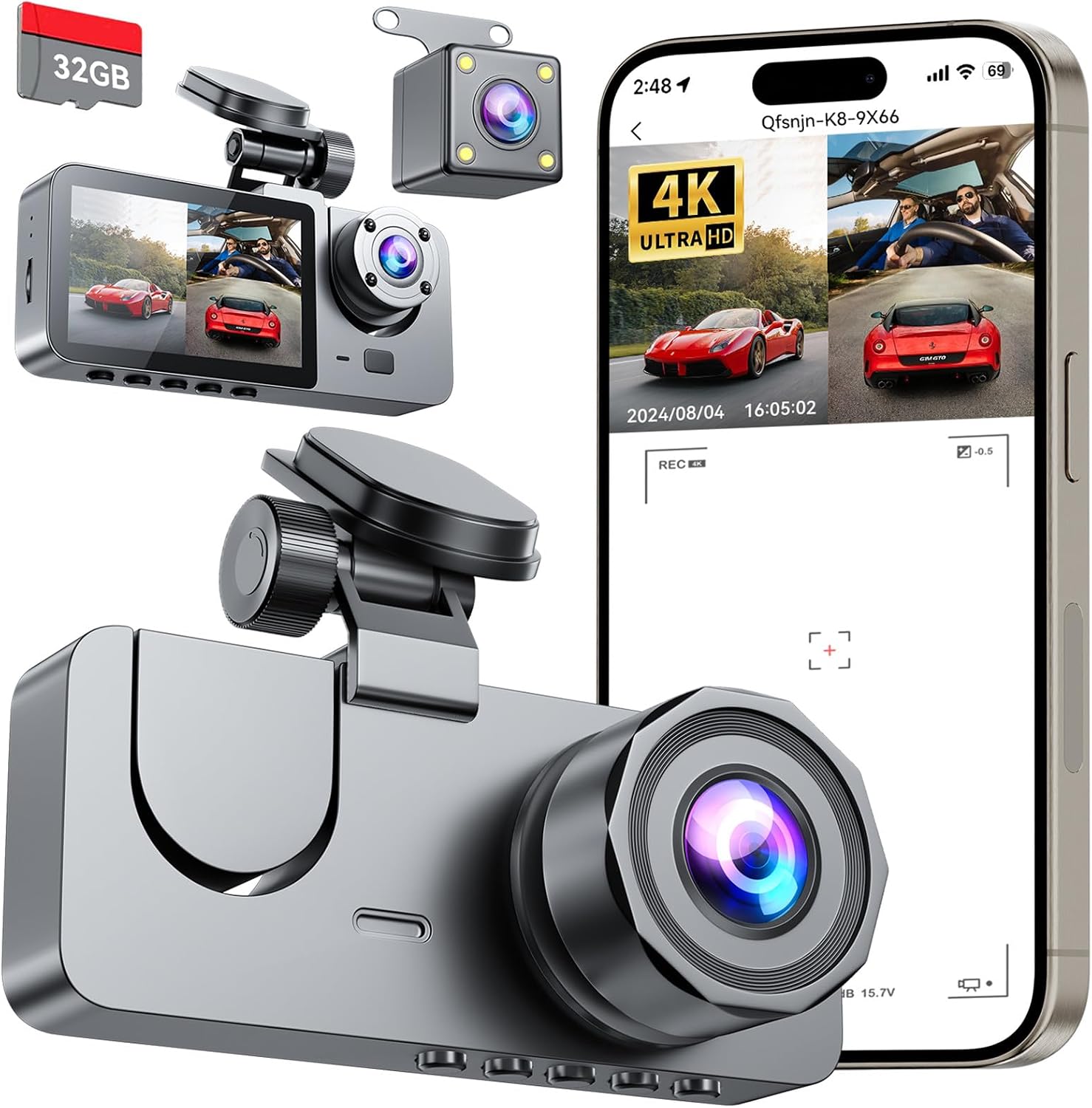
Dash Cam Front and Rear Inside 3 Channel 4K Full UHD Dash Camera for Cars
Front, rear, and inside coverage at the lowest entry point here. The cheapest path to a cabin-facing channel I've seen in this class
No card included, no sensor named, and "4K Full UHD" on a box is a marketing claim until you check bitrate and sensor size. Budget cams are a lottery ticket
Prices and availability were captured from Amazon Creators API and may change.
What each camera is actually built to do
The ROVE R2-4K Dual is the traditional two-channel build: one camera forward, one facing back. The name tells you the two things that matter. STARVIS 2 is a sensor family built for low light, and it's the difference between a plate you can read and a white smear with headlights in it. The included 128GB card matters more than people think, because it removes the single most common failure point in a dash cam setup, which is a driver who never bought a card and is running on whatever was in a drawer.
The DDPAI N4T Pro is the coverage play. Three channels means front, rear, and inside, all at 4K-class resolution per the product record, with Triple HDR for handling bright-to-dark transitions and WiFi 6 for pulling files. If you've ever waited four minutes for a 3-minute clip to transfer over an old 2.4GHz connection, you understand why that last spec is not a luxury. The 64GB card in the box is a starting point, not a finish line.
The third cam, the Dash Cam Front and Rear Inside 3 Channel 4K Full UHD Dash Camera for Cars, is the value option. Same three-channel concept, no brand name attached, no card in the box, and a name that leans hard on "4K Full UHD" without telling you which sensor is doing the work. I've bought enough of these to know the range: some run for years and embarrass cameras costing four times as much, and most cook their capacitors by month four and you never find out until you need the clip.
Night footage is the whole argument
Accidents do not happen at noon in perfect light. They happen at 11:40 p.m. on the 101 when someone drifts into your lane with their high beams on, and the only question that matters is whether your camera can read a plate through that.
This is where the ROVE's STARVIS 2 sensor is the most interesting thing in the group. Low-light sensor design is not a marketing number, it's physics: bigger pixels, better light gathering, less noise when you push the gain. The DDPAI's Triple HDR is aimed at the same problem from a different direction, holding detail in the bright and dark parts of the same frame so a plate isn't blown out by the headlights behind it. Both approaches are legitimate. Neither one is a guarantee.
The budget three-channel cam is the one I'd want to see clips from before I believed anything. "4K Full UHD" is a resolution claim, and resolution without bitrate is a screenshot of a smudge. A 4K file recorded at a low bitrate looks worse than a good 1080p file, and it's the number nobody checks on the box. When I get one of these on the windshield, the test is simple: park it, have a friend drive past at 40 mph at night, and see whether I can read the plate from the clip. Not the frame on the screen. The clip.
Heat, and why Phoenix is the real reviewer
A parked dashboard in Phoenix hits 180°F in July. That is not an exaggeration, it's a Tuesday. Heat kills more dash cams than crashes do, and it kills them silently, in a way you don't notice until the day you need the footage and the camera has been rebooting itself for three weeks.
The mechanism is boring and it's the whole story: lithium batteries swell and fail in that environment, and capacitors don't. If any camera in this comparison turns out to pack a lithium battery, that's a hard pass for anyone in the Southwest, no matter how good the night footage is. I want to see the power source confirmed before I'd trust any of these through a summer.
The second heat problem is the mount. Suction cups fall off at 110°F, usually onto a hot dashboard, usually while you're parked at the airport for a week. Adhesive mounts and a proper tuck of the cable are worth the twenty minutes. And the third heat problem is the card, which I'll get to.
Parking mode and the hardwire question
Parking mode is the feature people buy and never actually use, because it only works when the camera is wired to the fuse box. Plug it into the cigarette lighter and it dies the second you turn the key. That's not a camera limitation, it's a wiring limitation, and it's the single most common reason someone tells me their parking mode "doesn't work."
If any of these three supports parking mode, budget an hour and a fuse tap kit. Then watch your battery. A camera that records motion events all night in a parking garage will drain a healthy battery in a couple of days and a tired one in a single night. I don't make parking mode claims without a real drain test on a real car, and I'd apply the same rule to all three of these.
The SD card is half the system
This is the part people get wrong, and it's the part that costs them the claim.
A normal SD card is not built for constant recording in a hot car. It corrupts, and it corrupts at exactly the moment you need it, because that's how flash memory fails under heat and constant write cycles. High endurance is the rating you want, and you verify it on the card itself, not in the listing title.
The ROVE ships with a 128GB card, which is a genuinely useful inclusion and probably the single most practical thing in this comparison. The DDPAI ships with 64GB, which is a starting point across three channels; three 4K streams write a lot of data, and 64GB is not a lot of loop time. The budget cam ships with nothing, so add a high endurance card to the cost before you compare it to anything else. And check that loop recording is actually looping; a card that fills up and silently stops recording is worse than no camera, because you'll believe you're covered.
Which one for which car
If you drive a normal commute and want the cleanest two-channel setup with the least fiddling, the ROVE R2-4K Dual is the one I'd start with. Front and rear is what 90% of claims need, the sensor is the right family for night work, and the included card means you're not making a second purchase decision on day one. Check the ROVE R2-4K Dual on Amazon.
If you drive for a living, the math changes. Rideshare and delivery drivers need the cabin on camera, because the dispute that ends your week is usually about what happened inside the car, not what happened in the lane. The DDPAI N4T Pro covers all three angles in one system, and WiFi 6 makes pulling a clip on the side of the road fast enough that you'll actually do it. Check the DDPAI N4T Pro on Amazon.
And if the budget is the constraint, the three-channel cam here is the cheapest way to get an interior view, with the understanding that you're buying a card separately and you're accepting lottery-ticket odds on longevity. Check the Dash Cam Front and Rear Inside 3 Channel on Amazon.
What I still need to see
Three things would change my ranking, and I'd rather say so than pretend a spec sheet settled it.
First, night clips at 40 mph. A plate I can read is worth more than any feature list. Second, a week on a hot dashboard with the camera logging its own uptime, because a cam that shuts down at 150°F is a cam that isn't there when you need it. Third, real parking mode drain numbers on a real car, because "supports parking mode" and "works as a parking camera" are two different sentences.
The fourth thing is the one I keep coming back to after six years of driving for hire. A dash cam is an insurance witness, not a gadget. The ROVE's sensor and included card, the DDPAI's three-channel coverage and fast transfers, and the budget cam's price all matter only to the extent they produce a clip an adjuster accepts. Everything else on the box is decoration.