I spent six years driving rideshare in Phoenix, roughly forty thousand miles a year, most of it after dark on I-10 and Loop 101. The first time a red-light runner hit me and then told the cop I ran the light, I had no footage, and I spent three months losing an argument I should have won in a single afternoon. The second time, I had a camera on the glass, and the claim settled in nine days. That gap is why I care about this category more than any reasonable person should.
This is a comparison of four things that end up on a windshield, and they are not four versions of the same purchase. Three are cameras. One is the film that decides whether a camera is still attached to the glass in July. If you are shopping dash cams for night driving, the ranking question is not which box carries the biggest number. It is which one hands you a readable plate at 40 mph with streetlights behind the car, and which one is still recording after a summer parked in the sun.
Short version: the VIOFO A229 Pro is the pick when night footage and dual-channel detail are the entire point and you are willing to pay for it. The REDTIGER F7NP is the value pick, and it arrives with a card in the box. The front-and-inside cam is the rideshare answer. The electrostatic film is the least expensive item here, and it is the one that keeps the other three from ending up on your floor mat.
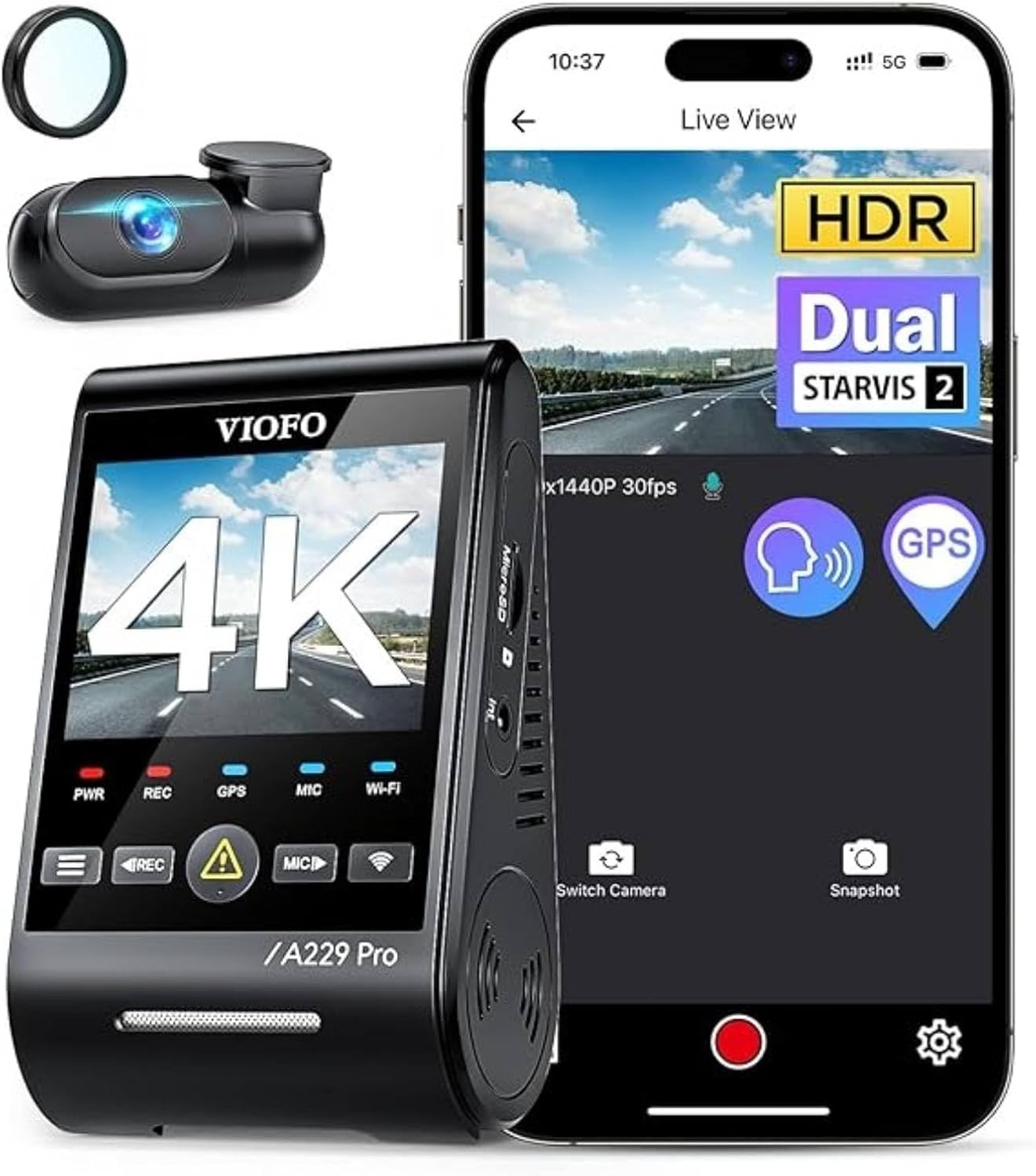
VIOFO A229 Pro 4K HDR Dash Cam Front and Rear, Dual STARVIS 2 Sensors
Dual STARVIS 2 sensors front and rear, 4K HDR up front, the strongest low-light hardware in this group
Highest cost here, and the price is for the camera, not for the memory card or the install
REDTIGER F7NP 4K Dash Cam Front Rear, STARVIS 2 Sensor, Free Card Included
Front and rear coverage, STARVIS 2 sensor, and a card included so you are not hunting one on day one
Rear channel is the weaker half, and a bundled card is rarely the high-endurance card you want long term
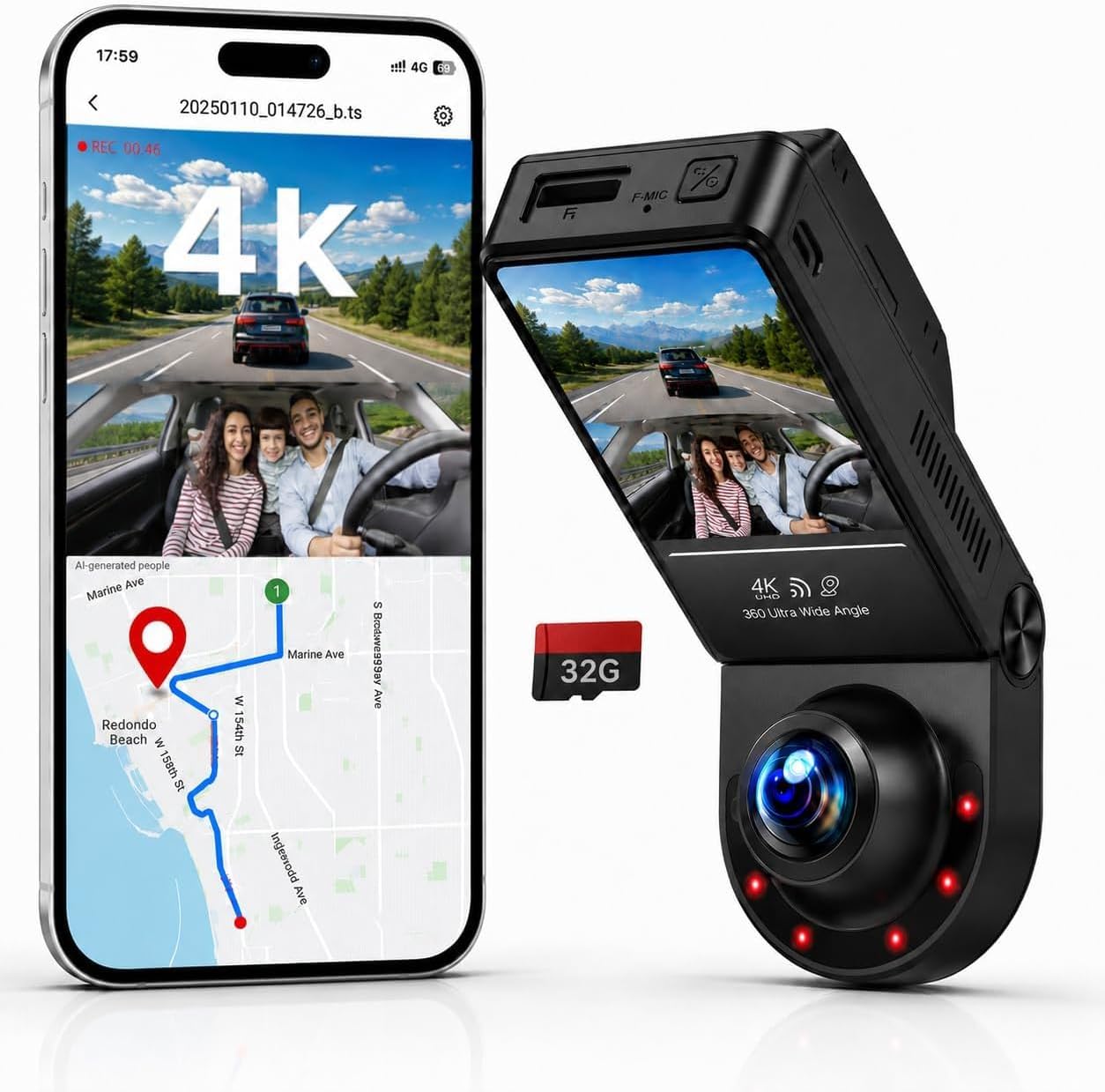
360° Dash Cam Front and Inside 4K+2.5K, 2 Channel Dashcam for Car
Two channels covering the road and the cabin, which is the coverage rideshare drivers actually need
No rear-facing channel, so a tailgater or a rear-end hit is not documented from behind

Thinp 4 Pcs Electrostatic Film for Dash Cam, Double Sided Dash Cam Sticky Pads Clear Sticker Shield for Windshields Heat-Resistant Electrostatic Stickers for Dashcam, with Adhesion Promoter
Lets you mount and remove a cam without glue residue, and the heat-resistant film protects the adhesive
Not a camera, requires a clean install, and a trapped bubble or a dusty windshield ruins the bond
Prices and availability were captured from Amazon Creators API and may change.
How I judge a dash cam before it earns a spot on my glass
A dash cam is an insurance witness. Everything else it does is decoration. That single sentence kills most of the marketing in this category, because it means the only questions that matter are the boring ones.
What does the night footage look like at 40 mph? Accidents do not happen at noon in perfect light, and they rarely happen at 10 mph in a parking lot. The clip that saves you is the one where the other driver's plate is legible while both cars are moving, under sodium streetlights, with headlight glare washing across your own windshield.
Can it survive a week on a 130°F dashboard? Phoenix kills more cameras than crashes do. A camera that shuts down in the heat is a camera that was not recording during the two minutes you needed it.
What does parking mode actually cost in battery drain, and is it wired so it works at all? Parking mode is useless unless the camera is hardwired to the fuse box. Plugged into the cigarette lighter, it dies the second the ignition does.
Would I hand this footage to an adjuster without explaining it? That is the final filter, and it is the one most people skip.
VIOFO A229 Pro: the night-footage benchmark
The VIOFO A229 Pro is the camera in this comparison built around low-light detail. Dual STARVIS 2 sensors, one at the front and one at the rear, with 4K HDR recording up front. STARVIS 2 is the part that matters at night, because it is a sensor generation designed for sensitivity in poor light rather than a number printed on a box. HDR is the part that matters when an oncoming truck's headlights flare across your lens and everything behind it turns to white.
Two channels means two problems solved. The front channel documents what you hit. The rear channel documents who hit you, which is the claim I have personally watched turn on a single frame of footage. Rear-end collisions are the most common accident a rideshare driver deals with, and without a rear view you are relying on the other driver's honesty.
What it costs you is money and setup. This is the most expensive camera here, and the listing is about the camera itself. Plan on a high-endurance card and, if you want parking mode, a hardwire kit and an afternoon under the dashboard. A dual-channel 4K install is also more work than a single camera: the rear cable has to be routed along the headliner and down the pillar, and if you rush that part you will be looking at a dangling wire for the next two years.
The honest trade-off is this. If you only ever drive in daylight, in a city where nobody rear-ends anybody, you are paying for footage you will never watch. Nobody lives in that city.
REDTIGER F7NP: the value pick that arrives ready to run
The REDTIGER F7NP is the middle of this group and probably the one most drivers should look at first. Front and rear coverage, a STARVIS 2 sensor, and a memory card included in the box. That last detail matters more than it sounds, because the single most common mistake I see is a driver who installs a camera, never buys a card, and discovers the problem the day they need the footage.
Included cards are usually not high-endurance cards, so treat the bundled one as a starter and plan to replace it with a card rated for constant recording and heat. That is not a knock on the camera. It is the same advice I would give with any cam in this list, because a normal card corrupts at exactly the wrong moment.
The trade-off with a front-and-rear setup at this price is the rear channel. Rear cameras in this tier are there to prove sequence and position, not to read a plate three car lengths back at night. If the rear footage is going to decide a contested claim for you, that is the argument for stepping up to the dual-STARVIS flagship above.
Where it wins is the whole package. Two channels, a modern sensor, a card you can start using today, and enough budget left over for a hardwire kit so parking mode is actually functional instead of decorative.
The front-and-inside cam: coverage for drivers with passengers
The 360° Dash Cam Front and Inside is a different shape of product, and for rideshare drivers it solves a different problem. Instead of a rear channel, it runs a front channel at 4K and a cabin channel at 2.5K, so you get the road ahead and the people behind you in the same recording.
If you drive for a living, that interior view is the footage that settles the argument you cannot settle any other way. A passenger dispute, a claim about what was said, a question about who was in the car, all of it comes down to a cabin camera with a timestamp. I have watched drivers lose weeks to a complaint that a single interior clip would have ended in an afternoon.
The cost is the rear view. Front and inside means no camera pointed out the back window, so a rear-end collision is documented from the front camera's perspective only, which shows the impact but not the other driver's behavior in the seconds before it. If you want cabin and rear coverage at the same time, you are looking at a three-channel setup, and that is a different budget entirely.
The other thing to check on any front-and-inside camera is the field of view. A 140-degree lens is the sweet spot. Narrower than that and you miss the side of your own car in a lane-change dispute. Wider and plates start looking like smudges at the edges of the frame.
The electrostatic film: the part nobody buys until after the mount fails
The Thinp electrostatic film set is the least glamorous item here and the one I would add to every order. It is a clear film that goes on the windshield, the camera's adhesive pad sticks to the film instead of the glass, and when you sell the car or move the camera you peel the film off with no glue residue and no razor blade against your windshield.
The heat-resistant part is the point. Suction cups and adhesive pads fail in a hot car, and when they fail they usually take the camera with them, sometimes onto the dashboard and sometimes into the footwell mid-drive. Film gives the adhesive a stable surface and lets you re-position a camera without burning through your supply of replacement pads.
There is an adhesion promoter in the kit, which is the difference between a film that stays put and a film that peels at the corner in August. Installation is the weak spot. The glass has to be genuinely clean, and any dust or trapped air under the film becomes a bubble that eventually lifts. It is not a camera and it will not record anything. It is the difference between a mounted witness and a camera sitting in your cupholder.
Heat is the spec nobody prints on the box
Every camera in this comparison lives or dies on the same question: what happens at 130°F on a dashboard.
Lithium batteries swell in that heat. I have pulled swollen cells out of cameras that were marketed for hot climates, and the failure is not dramatic. The camera keeps working until it doesn't, and you find out when you go to pull a clip that was never recorded. Capacitors are the power source I trust on a dashboard, because there is nothing in them to swell.
The same logic applies to the mount. A suction cup that holds fine in March is a projectile in July. This is exactly why the electrostatic film and a proper adhesive mount belong in the same conversation as the camera, and why I treat mounting as a spec rather than an afterthought.
Parking mode and the honest battery math
Parking mode is the feature people pay for and then never activate, because it requires a hardwired connection to the fuse box. Plug into the cigarette lighter and the camera shuts off with the ignition, which means it records nothing while your car sits in a lot.
Hardwiring is an hour of work and a fuse tap, and it is worth doing once. The trade-off is battery drain. A camera in parking mode draws from your car's battery, and a car that sits for days at a time can end up with a dead battery and a camera that recorded nothing anyway. If you park for long stretches, the answer is a dedicated parking battery rather than pulling off the starter battery, and that is a separate purchase.
My rule: no parking mode claim without knowing what it draws and how long the car sits. Otherwise you are paying for a feature that quietly drains the thing you need to start the car.
The card is the most important part of the system
Nobody budgets for the memory card, and the card is where most footage dies. You need a high-endurance card, which is a rating for cards built for constant recording and heat, not a marketing word. A standard card in a camera that writes continuously will corrupt, and it will do it silently, and you will find out when you go to pull the clip.
Two practical rules. Replace the card every year or two of daily driving, because flash memory wears out. And check the card's rating on the card itself rather than on the listing, because "high endurance" gets used loosely.
Which camera goes on which windshield
If night footage is the priority and you want the strongest low-light hardware front and rear, the VIOFO A229 Pro is the pick, and you should budget for the card and the hardwire kit at the same time.
If you want two-channel coverage without overthinking it, the REDTIGER F7NP gets you front and rear plus a card on day one, and the money you save covers the accessories.
If you drive passengers for a living, the 360° Dash Cam Front and Inside covers the road and the cabin, and you accept that nobody is watching your back bumper.
And whichever one you choose, add the electrostatic film and sticky pads before you mount anything. It is the cheapest way to keep a camera where you put it, and the cheapest way to remove it later without leaving a scar on your windshield.
What I would tell a friend in the parking lot
The camera that wins is the one that is still running when the thing happens. That is not a spec sheet, it is a heat tolerance and a card rating and a mount that does not quit. Night footage is the only footage that matters, and the clip that settles a claim is the one where the plate is readable, the timestamp is right, and the file is not corrupted.
Buy the best low-light hardware you can justify, buy a high-endurance card on the same day, hardwire it if you want parking mode, and put film under the mount before you press anything against the glass. Everything else is decoration.