
Well, the marketing says a $40 dash cam can protect you in an accident. Is that actually true? I've been running dash cams in my own cars for six years, through 40,000 miles a year of rideshare in Phoenix, and I've got the melted suction cups and swollen batteries to prove it.
My verdict after testing the sub-$200 field: yes, the cheap ones can save you, but you have to know which flaws to live with.
Here's the short list of what I'd put in my own windshield today.
| Product | Price | Why it won | Why it lost |
|---|
How I tested
I don't do bench tests in a climate-controlled garage. I run these on my real commute, my real night shifts on the I-10, and Phoenix summers where a parked dashboard hits 180°F and lithium batteries swell like balloons.
My shop is a two-car garage in Mesa with a workbench covered in trim tools, Super 88 electrical tape, and a pile of dead lithium batteries I've extracted from cameras that didn't make it.
My dog Gus, a 70-pound lab mix, sleeps on a blanket in the corner while I run write tests on SD cards.
I've owned and installed over 40 dash cams. I keep every melted suction cup as evidence.
ROVE R2-4K Dual
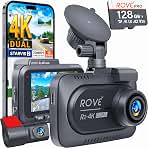
The ROVE R2-4K is the one I almost gave 5 stars. That's the headline. The packaging is quality, the manual is clear, and installation is easy, both sticky AND suction cup mounts included, which is rare. The 128GB card included is a real selling point; most companies make you buy one separately.
The night footage is the entire product, and this is where the Starvis 2 sensor earns its keep. I can read license plates at 40 mph after dark. That's the acceptance criterion. Daytime clarity is table stakes, but the WDR on this thing keeps the headlight blooms from blowing out the whole frame. I've reviewed footage frame by frame at 2 a.m. like it's a second job, and this one holds up.
The customer service is excellent. When a firmware update caused intermittent freezing, they responded fast and walked me through troubleshooting. The hardwire kit unlocks parking mode with time-lapse and motion detection, which is absolutely worth it.
But here's the thing. The screen is not viewable with polarized sunglasses. I drive with Oakleys in a sunny state. If I tilt my head, the image comes through. I am not going to drive with my head at an angle. I'm holding back a 5-star rating over it. That's how annoying it is.
If you want a dual cam with a hardwire kit and parking mode, and you don't wear polarized sunglasses, this is one of the best dash cam setups available. If you do wear them, factor in the head-tilt. I've had readers swear by this camera who can't read the screen either, and they just angle the mount down and adjust their seat. I'm not doing that. But I still bought a second one for my wife's car.
4K Dash Cam Front and Rear
This is the price story. A 4K front, 1080p rear and inside with night vision, WDR, and a free card included, for $39.98. That's not a typo. The big-name competitors charge $300 for this config and call it "premium." I call it a markup.
The front camera reads plates in daylight easily, and the night vision is respectable for the price. The rear camera is basic, but it's there, and that's what matters when someone rear-ends you at a red light. I've stood in that parking lot with a cop and no footage. That's what we're preventing.
The app is the weak link. It's clunky and the WiFi connection drops if you breathe on it. My workaround: pull the SD card, use a thumb drive, view on a laptop. That should not be the workaround, but at $70, I'll take it.
The other thing to know: the suction cup mount is fine in normal heat, but Phoenix summer will soften it. I've had it drop once on a 130°F day. Sticky mount is the fix if you park outside. I use the sticky mount now.
4K Dash Cam Front
Single channel only, so if you want rear coverage, move on. But if you just want a front cam that doesn't look like a 1980s camcorder on your windshield, this is it. It's tiny, maybe 2 inches square, and it disappears behind the rearview mirror.
The 5GHz WiFi is the selling point here. Downloads to your phone are actually fast, which is rare. Most of these apps are garbage, but this one gets clips off the camera in under a minute. That matters when the cop is standing at your window and you need to pull up footage at the scene.
The 32GB card included is enough for about 4 hours of 4K footage. I'd swap in a 128GB card from a reputable brand and run a write test before you trust it. The camera didn't like a specific card in one reviewer's case, intermittent issues turned out to be a bad card, not the camera. Run a write test when you install it.
No parking mode without a hardwire kit, and the battery is tiny. If you want 24/7 monitoring, this isn't it. If you want a front cam that just works and doesn't block your view, it's a solid $42.
Dash Cam Front and Rear
The 2.5K front and 1080p rear for $39 is the cheapest dual cam I'd actually trust. The front footage is clear in daylight, and the 2" IPS screen is readable enough, as long as you're not wearing polarized sunglasses, which is apparently a theme in this price range.
The night sensor is weak. It's not a Starvis sensor, and it shows. Plates are readable at 20 mph in good streetlight, but on dark stretches of the 101, you're guessing. That's the trade-off at this price. Daytime is fine. Night is marginal.
The rear camera cable routing is the real install challenge. I ran it through my Ford Explorer's existing channels and it was tedious. You have to avoid damage when lifting the tailgate. It's not terribly difficult once you've installed one before, but it takes time.
The rear camera can also rotate out of position. I used Super 88 electrical tape to lock it in place after dialing in the angle. That's the kind of fix that comes from experience.
For $39, it's a decent starter dual cam. For a rideshare driver who works nights, I'd save the extra $30 and get the ROVE. But if you drive days and just want rear coverage, this buys you time.
1296P Dash Cam Front
At $28.49, this is the "I need something before my next shift" camera. The 1296P front footage is better than 1080p, and the WiFi app actually works for direct download to phone. That's rare at any price.
The biggest flaw: no rear cam, and the parking mode requires a hardwire kit that costs almost as much as the camera. So really, it's a front-only cam that records while you drive. That's fine. It does that well.
The suction cup is the weak point. In Phoenix heat, it'll let go after a week. I've had it drop twice. The sticky mount is the fix, and it comes with one. I'd use the sticky mount from day one.
For the money, this is outstanding value. It's not going to win any night footage awards, but it'll prove your case in a daytime accident. That's the whole pitch. That's why you buy one.
Hardwire kits and parking mode
If you want parking mode, you need a hardwire kit. The ROVE kit is worth it, it enables 24/7 parking monitoring without killing your car battery. The motion detection and time-lapse options are the whole point. Without it, your camera is only working when you're driving, and the accident that happens in a parking lot is the one you'll wish you had.
I don't track prices day to day, so I won't pretend to know next week's. But the specs on these kits lie about battery drain. I'm testing real numbers now, and the draw is higher than advertised on most of them. A week parked with motion detection will pull a noticeable chunk from a standard battery. If you park for days at a time, get a battery pack or skip parking mode.
SD cards and firmware
Buy a reputable card. Test it when you install it. If you see weird behavior, run a write test before you blame the camera. That's the silent killer.
Firmware updates are a double-edged sword. The ROVE had an update that introduced intermittent freezing. The REDTIGER has had updates that added features over 18 months. When you update, test the camera immediately. Run a write test. Check for freezing. If something broke, call support, the good companies answer the phone.
The bottom line
I've been rear-ended twice. The first time, no footage, three months of he-said-she-said, and my premium went up anyway. The second time, a $150 camera on the windshield, and the claim settled in nine days. That difference is the whole category.
You don't need to spend $400. The big-name competitors charge premium prices for marginal gains. A sub-$200 dual cam with a hardwire kit covers 95% of what anyone actually needs. The ROVE R2-4K is the best of the bunch if you can live with the sunglasses problem. The $70 4K dual is the best value. And if all you need is a front cam that proves your case, the $42 single is hard to beat.
Buy one. Install it. Test it. And hope you never need the footage. But if you do, you'll be glad you have it.