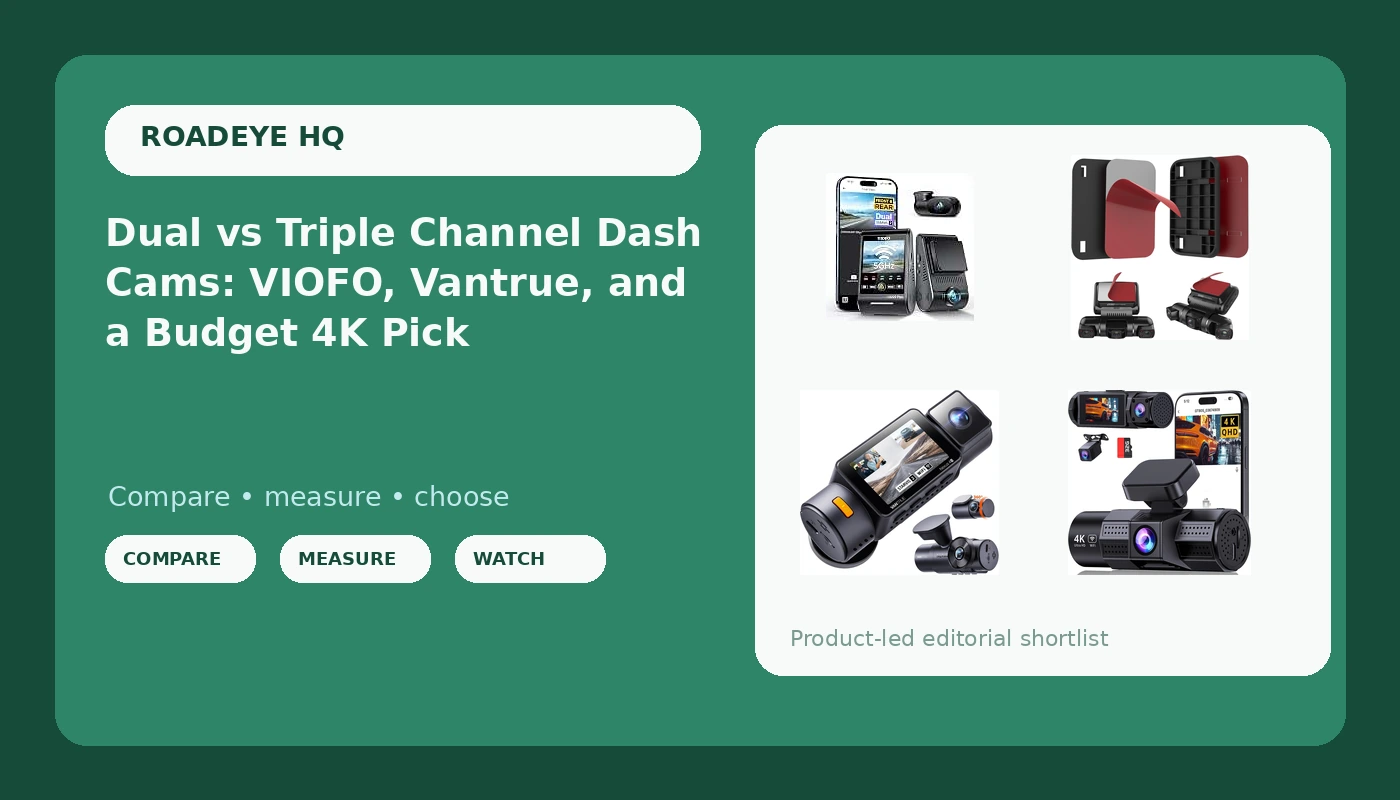
I have stood in a Phoenix parking lot holding a police report and no footage. I have also watched a claim settle in nine days because a windshield camera caught a plate and a timestamp. That difference is the only reason I care about dash cams, and it is why I rank them by what they can prove rather than by what the box promises. This comparison looks at dual and triple channel dash cams: a two-camera VIOFO, a three-camera Vantrue, a budget 4K three-channel unit, and the heat-resistant mounting tape that decides whether any of them are still stuck to the glass in August.
Related: Parking Mode Battery Drain Explained
The short answer: a two-camera kit with good sensors and a real high-endurance card will beat a three-camera kit with a cheap card every time. Channel count is the easiest spec to sell and the easiest one to overbuy. What matters is whether the front camera can read a plate after dark, whether the camera survives the heat, and whether the card is still recording when you need the clip. Everything below is sorted against those three questions.
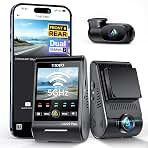
VIOFO A229 Plus Dash Cam Front and Rear, 2K Dual STARVIS 2 Sensors & HDR
Dual STARVIS 2 sensors with HDR, front and rear in one kit, and the sensor generation I trust most after dark
No interior view, so it will not settle a passenger or rideshare dispute
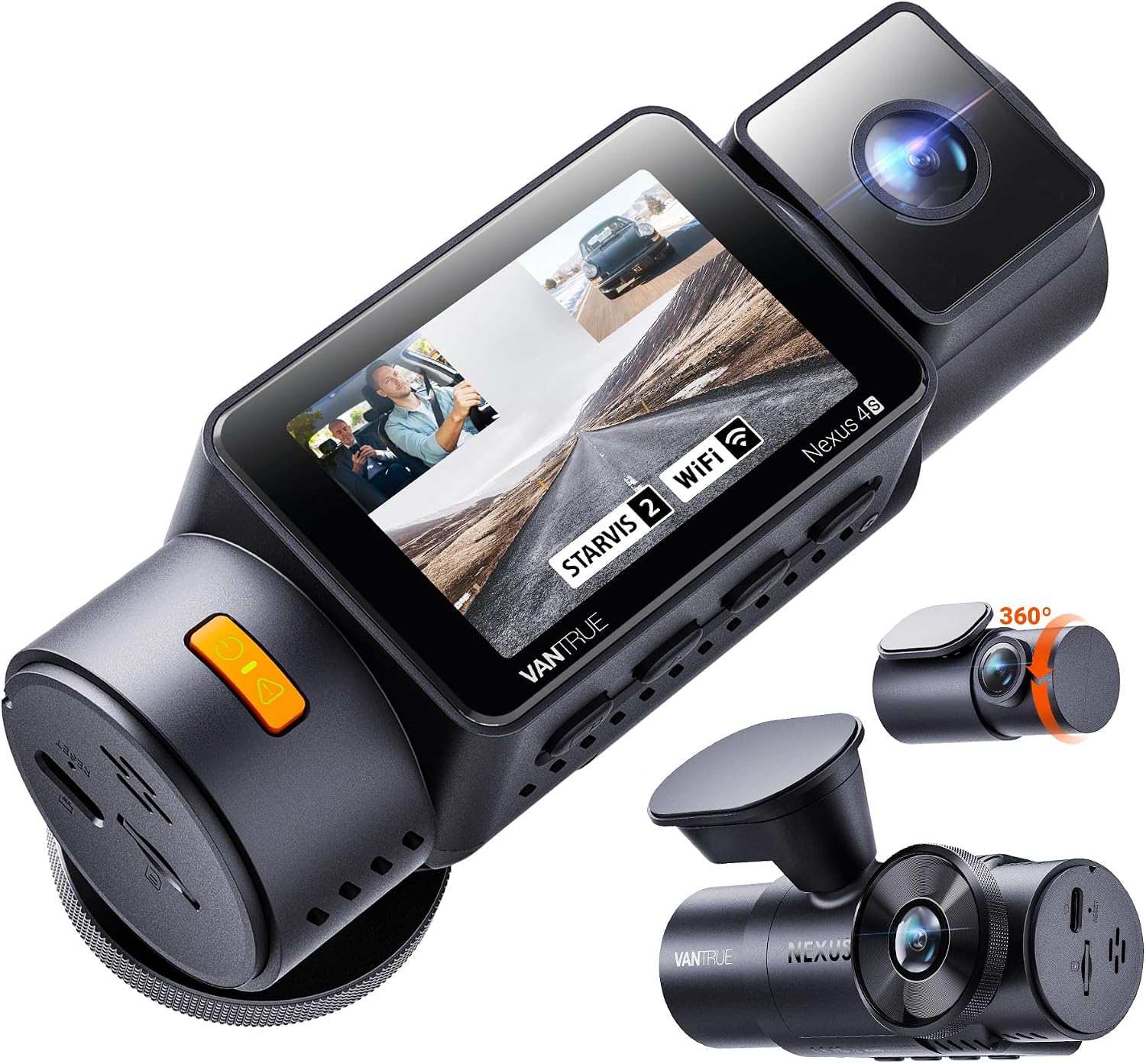
Vantrue N4S 2.7K 3 Channel Dash Cam, Triple STARVIS 2 Night Vision
Three STARVIS 2 sensors covering front, cabin, and rear, which is the most complete witness setup here
The most expensive way to cover a car, and three channels spread your card and bitrate budget thinner
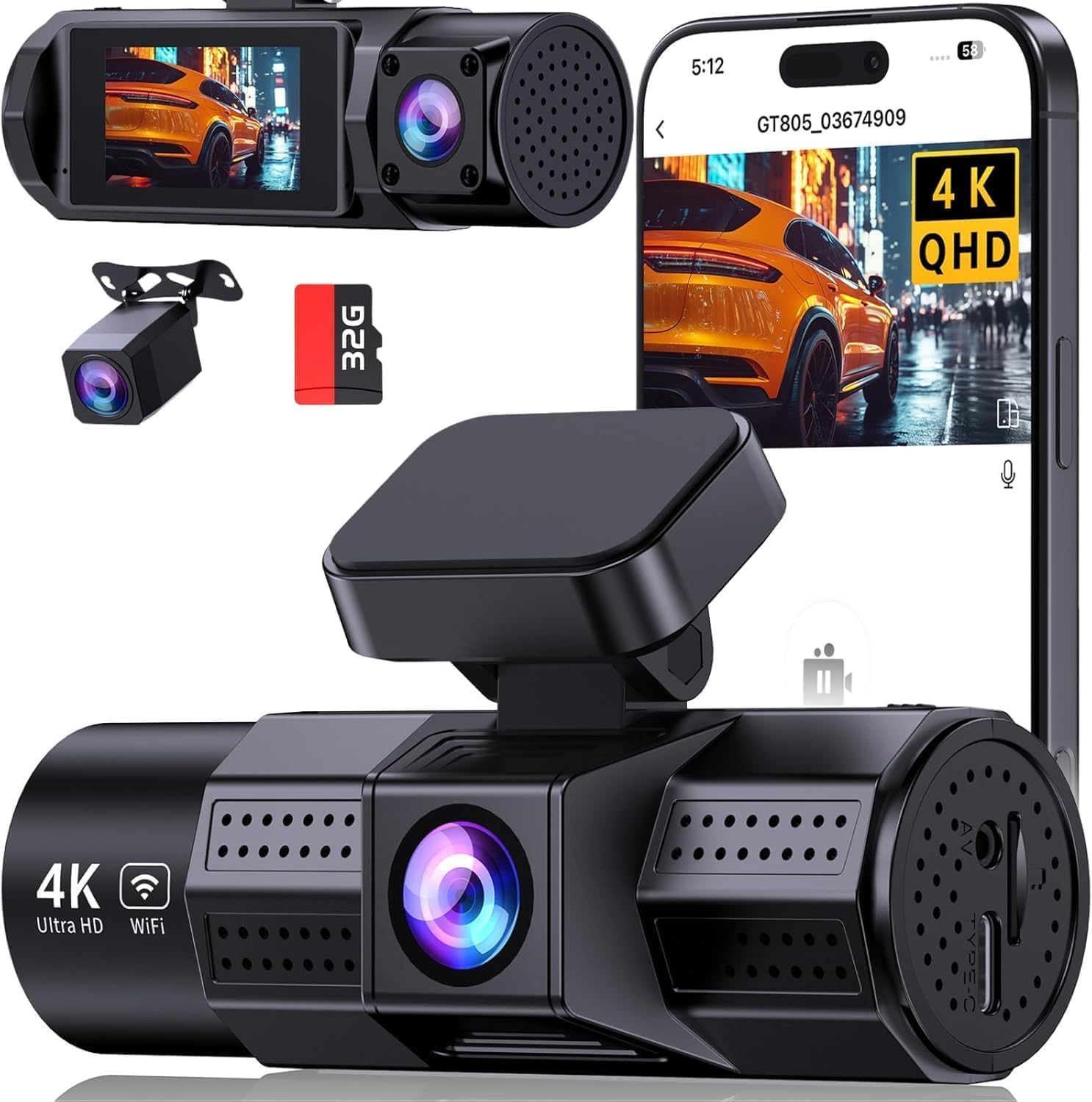
4K 3 Channel Dash Cam with WiFi, 32GB Card, Front Rear Inside Camera
4K on the front camera, three channels, WiFi, and a card in the box so you can record on day one
The bundled 32GB card is a starting point, not a long-term high-endurance solution

Double Sided Sticker Heat Resistance Tape for Pruveeo D90/A6/D88 Dash Cam
Heat-resistant adhesive that holds a mount where a suction cup gives up
Fits specific Pruveeo mounts, so it is not a universal replacement
Prices and availability were captured from Amazon Creators API and may change.
How I sorted these four
Four things decide whether a dash cam earns its space on the windshield.
Night footage. Most collisions happen in bad light. A camera that produces clean daytime video and mush at 40 mph after dark is decoration. Sensor generation matters more than the resolution number on the sticker, which is why the STARVIS 2 sensors in two of these cameras are worth more than a bigger number with a weaker sensor behind it.
Heat survival. A parked dashboard in Phoenix can reach temperatures that kill a lithium battery in a single summer. Capacitor power is the only kind I trust in a hot climate, so that gets checked before anything else.
Channel coverage. Front only proves you were not the one who drove into someone. Rear coverage catches the tailgater and the rear-ender. An interior camera catches the passenger dispute, the traffic stop, and the rideshare argument. You pay for every channel in money, storage, and bitrate.
The card. A normal SD card is not built for constant overwrite cycles and heat. High endurance is the rating to look for, printed on the card itself, not in the listing title.
The dual-channel pick: VIOFO A229 Plus
The A229 Plus is a front and rear kit with dual STARVIS 2 sensors and HDR, recording 2K at both ends. That is the sweet spot for a normal car. Two channels at 2K each leave more data per frame than three channels crammed through the same processor and card, and HDR is the setting that decides whether the shadowed car in the next lane is a shape or a plate.
Rear coverage is the part people skip and then regret. My own second incident was a rear-ender at 45 mph, and the only reason it did not become a month of phone calls was that the camera behind me had the impact on video. If you are choosing between a single front camera and a front and rear kit, take the rear camera.
The trade-offs are real. There is no interior view, so it will not help with a passenger dispute. The rear camera has to be routed to the back of the car, which is an afternoon job if you do it properly. And if you want parking mode, it needs a hardwire kit to the fuse box rather than the cigarette lighter. Skip that step and parking mode dies the moment the ignition does.
The triple-channel pick: Vantrue N4S
The N4S records 2.7K across three channels with triple STARVIS 2 sensors and a night vision claim attached to the cabin camera. If you drive for a living, this is the shape you want. The interior camera is the one that answers the question a front and rear kit cannot: what happened inside the car.
For rideshare drivers, that matters more than resolution. A passenger dispute, a claim about the route, or a conversation at a traffic stop all live in the cabin view. The rear camera covers the lane behind you, and the front covers the road ahead, so you end up with three angles on one timeline.
What you give up is money and card headroom. Three channels at 2.7K fill a card faster than two channels at 2K, and the front camera is 2.7K rather than 4K, which is a deliberate trade of peak detail for full coverage. If you buy this one, budget for a large high-endurance card on the same day, not next month. Also verify the parking mode wiring situation before you assume it will record while parked.
The budget route: 4K three channels with a card included
This one gives you a 4K front camera, three channels covering front, rear, and inside, WiFi for pulling clips to your phone, and a 32GB card in the box. It is the cheapest way to get all three angles at once, and the included card means you can verify the camera works before you spend more on storage.
The honest trade-off is that 4K on the front only matters if the sensor and bitrate behind it can use the resolution. A 4K label on a weak sensor looks like a smudge at 20 feet, so check the sensor and the recording bitrate before you get excited about the number. The bundled 32GB card is fine for testing and too small for daily recording across three channels, and it is unlikely to carry a high endurance rating. Plan to replace it.
The other consideration is track record. A budget three-channel unit is a lottery ticket in a way the VIOFO and Vantrue are not. Some of them run for years. Some cook their capacitors by month four, and you will not find out until you need the clip. Buy it knowing that, keep the receipt, and test the footage on day one rather than the week of your accident.
The part nobody budgets for: the mount
Every camera here is only as good as the thing holding it to the glass. Suction cups are the weak point of most installs, and a hot dashboard is where they let go. A camera that drops off the windshield mid-drive records nothing useful for the rest of the trip.
This double sided heat resistance tape is replacement adhesive for Pruveeo D90, A6, and D88 mounts, so it is not a universal fix. Check your mount before ordering. If you do run one of those cameras, or a mount that takes the same adhesive pad, this is the difference between a camera that stays put through a Phoenix summer and one that ends up on the floor mat.
The general rule stands regardless of brand: clean the glass with alcohol, let it dry completely, press the mount for a full minute, and give the adhesive a day before you hang the camera. Most mount failures are install failures.
The trade-offs that actually decide this
Resolution versus channel count is the first fork. Three 4K channels through one processor is a promise no consumer camera keeps honestly, so something gives, usually bitrate. Two channels at 2K with good sensors produce footage I would hand to an adjuster. Three channels at a lower per-channel quality produce more angles of worse video.
Storage is the second fork. More channels and higher resolution both eat card capacity and write speed. Whatever you buy, a high-endurance card sized for your channel count is not optional, and the included card on a budget kit is a starting point rather than a finished setup.
Heat is the third. Capacitors survive a hot dashboard, lithium batteries do not, and a swollen battery in a camera glued to your windshield is a safety problem, not just a warranty problem.
Parking mode is the fourth, and it is the one people get wrong. It only works if the camera is hardwired to the fuse box. A cigarette lighter install shuts off with the ignition, which means the camera that was supposed to watch your car in a parking lot was asleep the entire time.
Which one I would run
For a normal commuter car, the VIOFO A229 Plus. Dual STARVIS 2 sensors, HDR, and rear coverage at a resolution that holds up after dark. It is the setup I would put on a family car without hesitation.
For a rideshare or delivery driver, the Vantrue N4S. Three sensors and an interior view are worth more to you than a sharper front camera, because your disputes happen inside the car as often as they happen on the road.
For a tight budget or a second vehicle, the 4K three-channel kit. You get all three angles and WiFi for the least money, provided you accept the lottery and upgrade the card immediately.
For anyone fighting a mount that keeps letting go in the heat, the heat-resistant tape, once you confirm it fits your specific mount.
Before you click buy
Check the power source and confirm it is a capacitor, not a lithium battery. Check that the card you own is rated high endurance, and buy one if it is not. Decide whether you need the cabin view before you pay for it, because that single question is what separates the VIOFO from the Vantrue. And if you want parking mode, price the hardwire kit into the decision now, not after the camera is already on the glass.
A dash cam is an insurance witness. Buy the one whose footage you would trust in a parking lot with a cop and a clipboard.