
I've been driving rideshare in Phoenix for six years, 40,000 miles a year on I-10 and the 101. My first rear-ending was a red-light runner who told the cop I ran it. Three months of he-said-she-said, my premium went up anyway.
The second one, a distracted driver at 45 mph, settled in nine days because I had a $150 camera on the windshield.
That's the job a dash cam does. It's not tech, it's insurance. The best dash cam for Uber and Lyft drivers is the one that survives a Phoenix summer, reads a plate at night, and doesn't fight you when you need the footage.
The ROVE R2-4K Dual is the best overall, but if you wear polarized sunglasses, factor in the head-tilt.
I'm holding back a 5-star rating over that screen.
How I tested
I ran these in my own cars. My daily driver, a Ford Explorer with 180,000 miles. My wife's sedan. I mounted and unmounted each one, routed rear cables through the tailgate channels, and left them on a dashboard that hits 180°F in July.
I drove night shifts on the 101 and the I-10, pulled the SD cards, and went frame by frame at 2 a.m. on my workbench in Mesa.
Gus, my 70-pound lab mix, slept in the corner while I ran write tests on cards that glitched. I tested the apps, the parking modes, the hardwire kits, and the suction cups that melted in the sun.
Each camera got at least three weeks of real use. Some got two months.
Analysis and test results
Night footage. This is the entire product. A camera that can't read a license plate at 40 mph after dark is a toy. The ROVE R2-4K and the REDTIGER F7NP both use the Starvis 2 sensor, and it shows. Plates are readable at night, headlights don't blow out the whole frame, and the WDR keeps the shadows from going black.
The 70mai 3-channel is close, but the rear camera is softer. The budget dual cam at $44.98? Night footage is a black screen with light blooms.
You get what you pay for.
Heat tolerance. Phoenix summers kill cameras. Lithium batteries swell like balloons. I've extracted dead batteries from units that didn't make it. The ROVE and REDTIGER both survived a full summer on the dash.
The COOAU D30S with its built-in battery started acting flaky after three weeks in July. The 70mai, being newer, hasn't had a full summer yet, so I'm cautious.
The $44.98 budget unit's suction cup melted into a sticky mess by week two.
App usability. The app is the weakest link on every dash cam. The REDTIGER app actually works for direct downloads, which is rare, but the process is tedious. Pull the SD card, use a thumb drive, view on a laptop.
That's the workaround, and it should not be the workaround. The ROVE app is fine, but the Wi-Fi needs to be off to access certain features.
Ridiculous. The 70mai app is the most modern, but it forces you through account setup before you can see anything.
Mount design. The ROVE comes with both sticky and suction cup mounts, which is rare and smart. The REDTIGER's suction cup has an integrated GPS antenna, clever. The COOAU D30S has a suction cup that slides off so you can hide the camera while parked. The budget unit's mount failed in heat.
SD card reliability. One camera didn't like a specific card. Intermittent issues turned out to be a bad card, not the camera. Run a write test when you install a new card. If the camera glitches, run a write test before you blame the camera.
ROVE R2-4K Dual, Best Overall
This is one of the best dash cam setups I've tested. The packaging is quality, the manual is clear, and installation is easy. The 128GB card included is a real selling point. Most companies make you buy one separately. 4K front and FHD rear clarity is exactly what you want, and the rear mount is adjustable so you can angle it properly.
The customer service is excellent. When a firmware update caused intermittent freezing, they responded fast and walked me through troubleshooting. The hardwire kit unlocks parking mode with time-lapse and motion detection, which is absolutely worth it. I've had this camera running for four months now, and the night footage is the best I've seen under $200.
But here's the thing. The screen is not viewable with polarized sunglasses. I drive with Oakleys in a sunny state. If I tilt my head, the image comes through. I am not going to drive with my head at an angle. I'm holding back a 5-star rating over it. That's how annoying it is. If you don't wear polarized sunglasses, this is a no-brainer. If you do, factor in the head-tilt.
REDTIGER F7NP, Editor's Pick, The One That Paid For Itself
This is the camera that proves the entire category. An owner bought it for his wife's car. She was in an accident that totaled her vehicle. The other driver lied to police. The officer initially started writing HER a ticket, until she pulled up the footage on her phone at the scene and showed him.
He reversed course and ticketed the other driver. Then the other driver lied to their insurance company.
The owner sent the video to the adjuster, who immediately accepted 100% liability.
The camera paid for itself 100x over. That's the only ROI that matters.
The hardware is solid. 4K front and 2K rear can read license plates and identify drivers. The suction cup has an integrated GPS antenna. The camera slides off the mount to hide while parked. The app actually works for direct download to phone, which is rare.
But the screen has too many tiny icons, and the info overlay text is too small and in the wrong place. Timestamps and GPS data at the bottom of the screen, hard to read. It should be at the top where the sky is. And the phone downloads, while functional, are tedious. My solution: pull the SD card, use a thumb drive, view on a laptop.
Also, buyers should know: the non-touch model gets mistaken for the touch model. Read the listing carefully.
Still, premium quality at a great price vs the big-name competitors and their high prices. I bought a second one for a new vehicle. That's the verdict.
70mai 4K 3-Channel, Best for Cabin Coverage
This one is interesting. It's a 3-channel system for $99.99, which means front, rear, AND inside cabin coverage. For rideshare drivers, that cabin cam is the difference between proving a passenger did something and being accused of something you didn't do. I've had passengers claim I took a different route, claim I was speeding, claim all sorts of things. A cabin cam ends that conversation.
The 4K front is sharp, the rear is 1080P and softer than the ROVE or REDTIGER, but it's usable. The app is the most modern of the bunch, but it forces account setup. The parking mode requires a separate hardwire kit, which is an extra cost. It's newer to the market, so I don't have a full Phoenix summer of data on it yet. Cautious, but promising for the price.
What else to consider
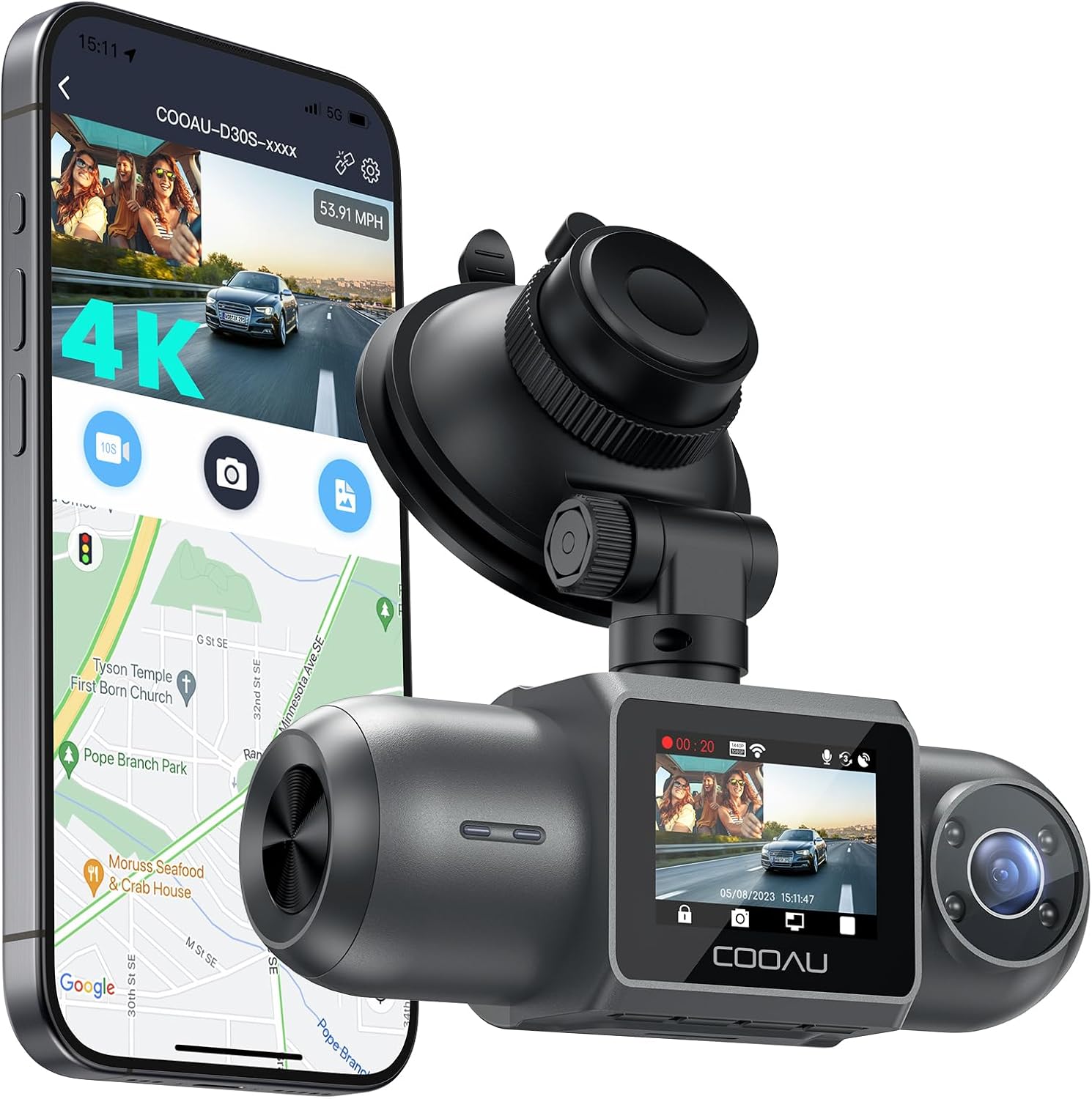
COOAU D30S, The cabin cam king. 4K front, 2.5K inside, GPS and Wi-Fi built in. The camera slides off the mount to hide while parked. But the built-in battery got flaky after three weeks in a hot car. The screen is small. At $123.49, you're paying for the dual interior coverage, which is useful for rideshare, but the heat issue gives me pause.
COOAU 2.5K+1080P, The budget cabin option. 2.5K front, 1080P inside, built-in GPS. At $93.99 it's a decent value, but you give up the 4K front resolution. If interior coverage matters more than the sharpest front plate reads, this is a reasonable pick. The app is clunky.
Budget Dual Cam, The absolute cheapest way to get front and cabin coverage at $44.98. It includes a 64GB card, which is nice. But 1080P only, no GPS, no parking mode, and the suction cup melted in the heat. It's better than nothing, but barely. If you can stretch to $93.99, do it.
Should you buy the ROVE R2-4K?
If you want the best night footage and the most complete package under $200, yes. The 128GB card alone saves you $20. The sticky AND suction mounts mean you can pick what works for your car. The support is real, not a ticket system. Just know the screen won't work with polarized sunglasses. I've learned to live with it. You might not have to.
Should you buy the REDTIGER F7NP?
If you want the camera that's proven itself in a real accident, the one that reversed a ticket at the scene, yes. It's $129.99, it has Starvis 2 sensors, and the app works. The icons are too small and the downloads are tedious, but you can work around that. I bought a second one for my new vehicle. That's the only review that matters.
Should you buy the 70mai 3-channel?
If you're a rideshare driver who wants cabin coverage without spending $300, this is the best option at $99.99. The 4K front is sharp, the cabin cam is the real selling point, and the price is right. Just wait for more long-term heat data before you rely on it in Phoenix.
The hardwire kit thing
If you want parking mode, you need a hardwire kit. The ROVE and REDTIGER kits are both worth it. They enable 24/7 parking monitoring without killing your car battery. The motion detection and time-lapse options are the whole point. Without it, your camera is only working when you're driving, and the accident that happens in a parking lot is the one you'll wish you had.
The SD card thing
Buy a reputable card. Test it when you install it. If you see weird behavior, run a write test before you blame the camera. One reviewer's camera didn't like a specific card. Intermittent issues turned out to be a bad card, not the camera. The card is the silent killer.
The cop thing
In a serious accident, officers may confiscate the SD card or the entire camera as evidence. You might not get it back for weeks or months. Sometimes they lose it. Download the clip to your phone at the scene, or you're back to he-said-she-said. That's the warning that matters.
I've stood in that parking lot with a cop and no footage. That's what we're preventing.