Related: Dash Cam Night Footage: What to Look For Before You Buy
I drove rideshare in Phoenix for six years, about 40,000 miles a year on I-10 and the 101, and most of it after dark when the surge pricing kicked in. The first time someone ran a red light and then told the officer I ran it, I had nothing to show him. That argument took three months and my premium went up anyway. The second time, a distracted driver hit me at 45 mph and there was footage on the windshield. That claim settled in nine days. The difference between those two weeks is why a dash cam for rideshare drivers is not a gadget to me. It is a witness, and every other feature is decoration.
Rideshare changes what the witness has to see. You are not just covering the road ahead. You have people in the back seat, you spend real time parked in airport queues and grocery lots, and your car bakes in the sun between fares. A single windshield cam misses the passenger side, the door ding in a parking lot, and whoever leans into your window at a red light. Every setup below is multi-channel for that reason, and the last entry is a memory card rather than a camera, because the card is the part of the system that fails first.
Best Overall: IIWEY N6 360° Dash Cam 4 Channel
The N6 is the widest net you can throw around a car. Four channels and a 360 degree view means the footage is not limited to whatever the windshield happens to be pointing at. When someone backs into you in a parking lot, or a passenger dispute starts about a phone that was never in the car, the angle that saves you is usually the one you did not think about on the day you bought the camera.
The eight IR lights matter more than the channel count for anyone working nights. Infrared is what makes a cabin camera usable after dark, because a camera without it records a black rectangle where your passengers are sitting. In a rideshare car, the cabin view at 2 a.m. is the footage that decides who said what, and no amount of front channel resolution substitutes for it.
A 128GB card included in the box is the right call from the manufacturer, and it is worth saying plainly why. Most cameras ship without one, and most people install the camera and then grab whatever card is loose in a drawer. That is how you end up with a corrupted card and no clip of the thing you needed. Having the card in the box removes the excuse.
What I would verify before trusting it: the night footage at 40 mph, which is the only speed that matters for reading a plate; whether the camera runs on capacitors rather than a lithium battery; and the real bitrate, because a low bitrate 4K file looks worse than a clean 1080p one. Four channels also means four files writing at once, so the card has to be a high endurance part rather than a bargain bin one.
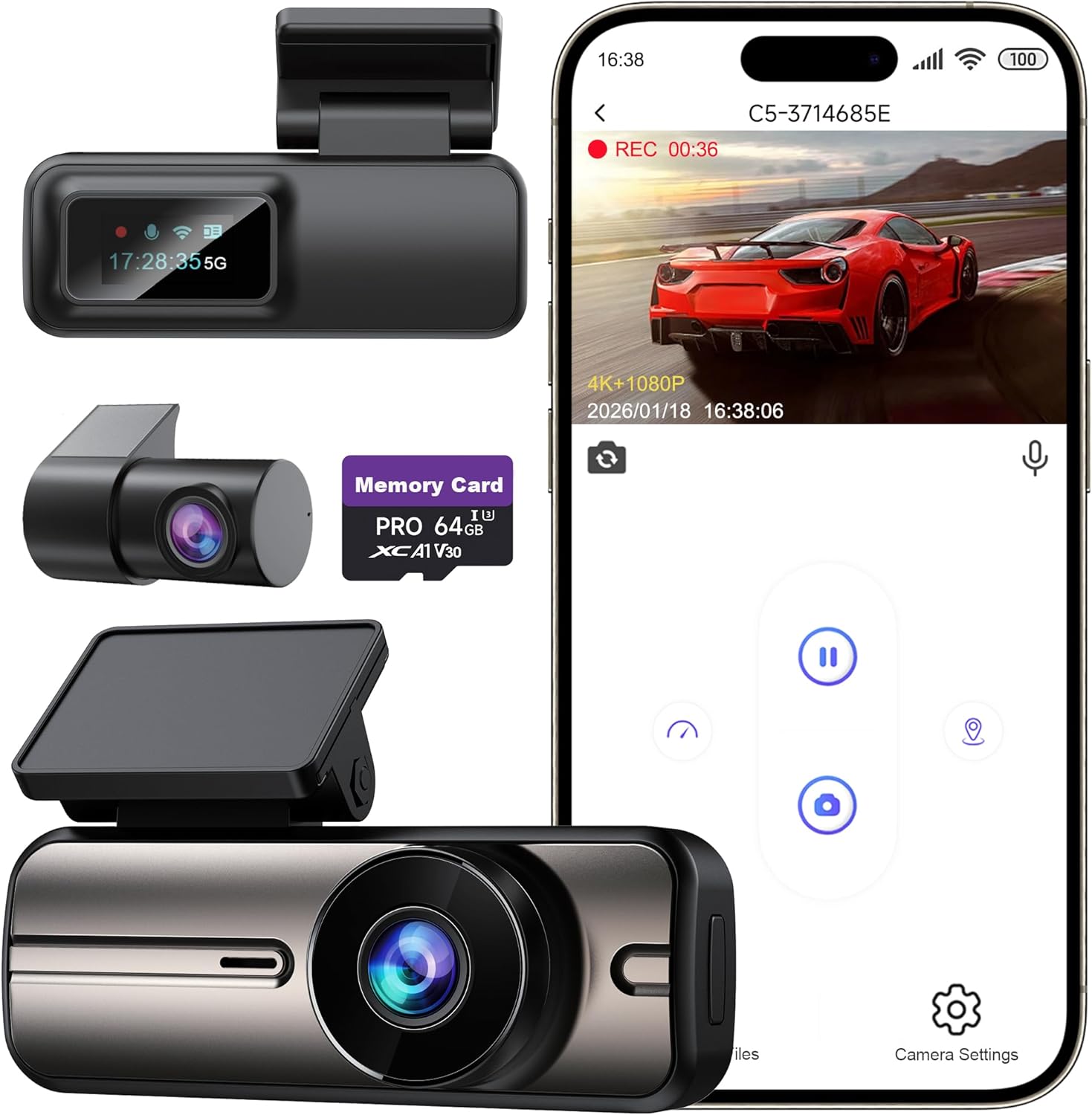
Best Value: Dash Cam Front and Rear 4K+1080P with 5GHz WiFi
Two channels, a 4K front sensor paired with a 1080p rear, and a 64GB card in the box. The rear channel is the one rideshare drivers underrate until the first rear-end claim. I have been hit from behind twice, and the second time the rear view is what made the claim boring instead of expensive. If you spend your day in traffic, the camera facing backward earns its place as fast as the one facing forward.
5GHz WiFi is a real quality of life difference, not a spec sheet decoration. On 2.4GHz, pulling a clip takes long enough that people give up and yank the card instead, and yanking the card is how cards get dropped, lost, and corrupted. A 5GHz radio means you can move a clip onto your phone in the parking lot while everyone is still standing around, which is exactly the moment it matters.
App control is a tradeoff worth naming. It is genuinely convenient for reviewing and downloading footage. It is also a dependency, and if the app wants an account before it shows you your own recording, that is a problem, because the day you need the clip is not the day you want to be resetting a password in a parking lot.
The included 64GB card will get you started. Running two channels, expect it to fill and loop over the oldest footage fairly quickly. That is normal behavior, and it is the reason I would pair this camera with the high endurance card below instead of letting it run on whatever came in the box.
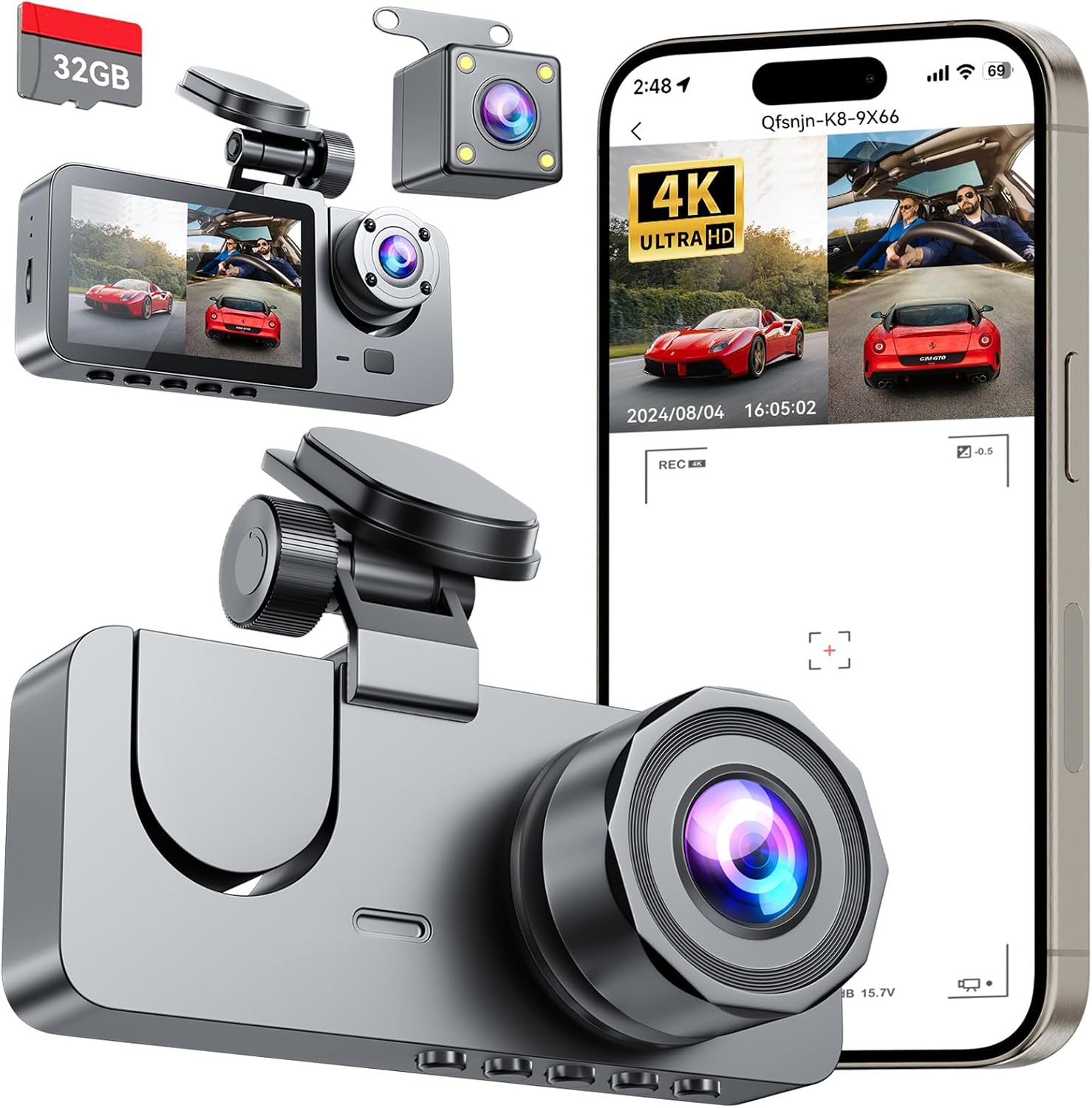
Best for Cabin Coverage: Dash Cam Front and Rear Inside 3 Channel 4K
Three channels: front, rear, and inside. For rideshare, that is the shape that matches the job. The front camera documents the road. The rear camera documents whoever is following too close. The cabin camera documents the passenger, and that is the channel a standard dash cam simply does not have.
Full UHD 4K on the front channel is the headline, and headlines deserve skepticism. What makes 4K useful is a sensor and a bitrate that can actually resolve a plate at distance. If the plate comes out as a smear, the resolution number did nothing for you. Check footage, not stickers. The same rule applies to any camera claiming Ultra HD in this price bracket.
The interior view also raises a fair question about privacy, including your own. It records you as well as your passengers. For a working driver that is usually the right trade, and most platforms expect you to disclose that a camera is running. Know your local rules and put a notice on the window. A camera that surprises a passenger creates the exact argument you were trying to avoid.
Three channels is a lot of writing to one card, so card quality matters here more than on a single-channel setup. If you want interior coverage without the hardware of a four-channel system, this is the straightforward way to get it.
The Part Everyone Skips: 128GB Micro SD Card U3 V30 A1
This is the least exciting product in the guide and the one most likely to decide whether you have footage at all. Dash cams write constantly, in a hot car, in a loop, for years. A standard card is not built for that cycle, and when it fails it tends to fail quietly: the camera keeps showing a recording light while the file itself is unreadable.
U3 and V30 are the speed ratings that matter for sustained video writing. A1 speaks to app performance, which is less relevant on a dashboard but does not hurt. The rating that really separates a dash cam card from a phone card is endurance, and a card sold for dash cams and security cameras is the right category to shop in.
128GB is a sensible middle. Small enough that losing a card is not a catastrophe, large enough that a multi-channel setup has room to loop without overwriting this morning's commute before you have pulled the clip off it.
One habit worth building: check the card every few weeks. Pull the most recent file, watch it, confirm the timestamp is correct and the video plays. A card that has been dead for a month looks exactly like a working card from behind the wheel.
The reference table
This is the same comparison I keep in my own notes. Every row is a piece of the system, not a ranking of hype.
| Setup | Channels | Card in the box | Best for |
|---|---|---|---|
 Visit on Amazon → IIWEY N6 360° Dash Cam |
Four, 360° view | 128GB included | The most complete record around the car |
 Visit on Amazon → Front and Rear 4K+1080P |
Two, front and rear | 64GB included | Clean forward footage with fast app transfers |
 Visit on Amazon → Front, Rear and Inside 3 Channel 4K |
Three, including cabin | Not specified in the listing | Passenger and rear-end disputes |
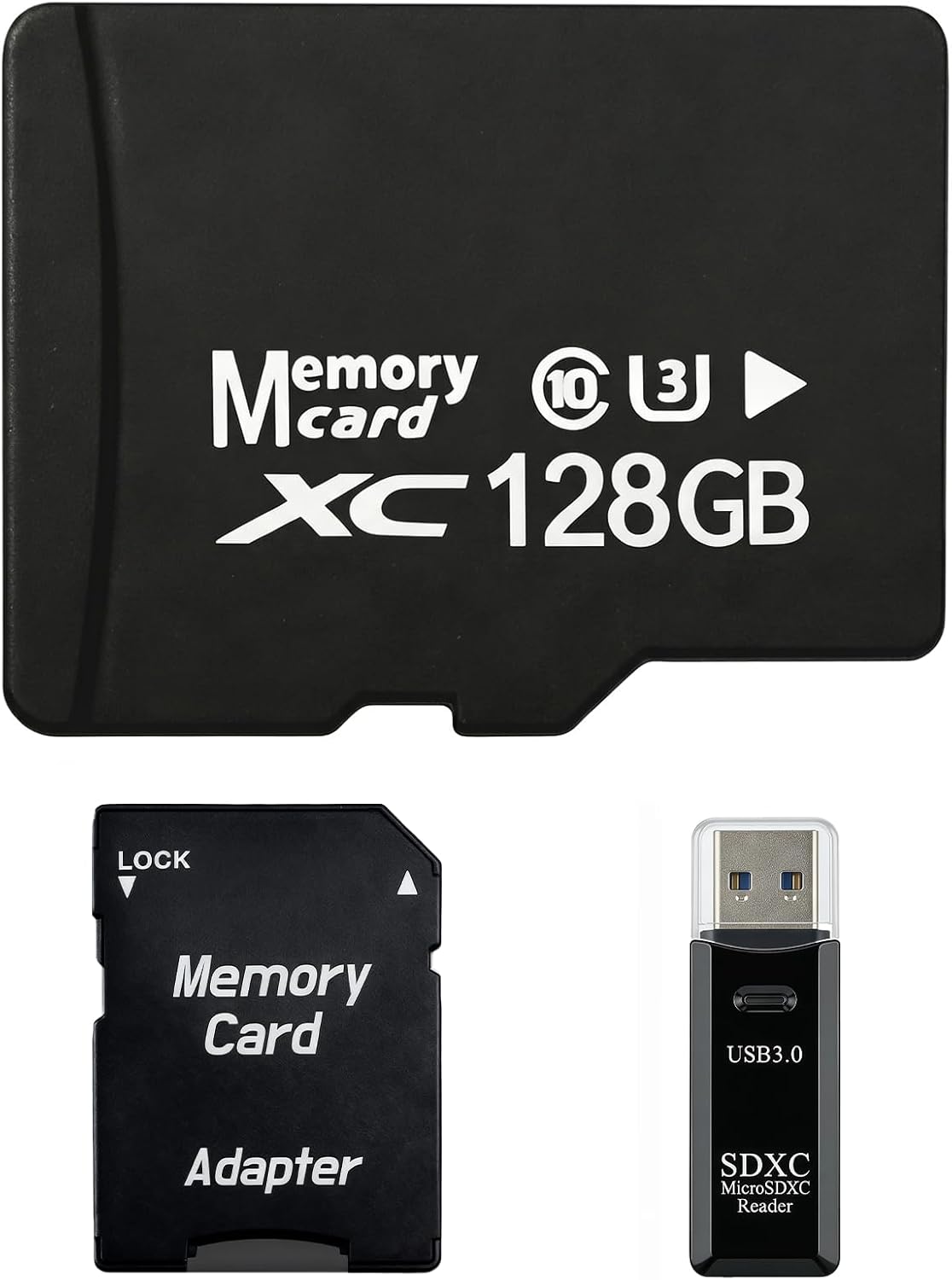 Visit on Amazon → 128GB Micro SD Card U3 V30 A1 |
Not a camera | This is the card | Replacing a card that already corrupted |
The pattern in that table is the one I would want a new driver to take away: coverage first, then the card, then the app. A camera with four channels and a bad card records nothing you can use. A camera with one channel and a good card at least gives you the truth about one angle.
What I check before I trust any camera
Night footage is the only footage that matters. Accidents do not happen at noon in perfect light. Show me a clip at 40 mph after dark and I will tell you whether the camera is worth buying, because that is the speed and the light where a plate either resolves or turns into a smudge. Any camera can look sharp on a sunny afternoon.
Heat is the second filter. If it cannot survive a Phoenix summer, it cannot survive your car. A dashboard parked in the sun gets hot enough to soften plastic, and a camera packing a lithium battery will swell in that environment. Capacitors are the power source I trust on a windshield. This is the single most common way a dash cam dies quietly, and most buyers never connect the failure to the battery chemistry.
Parking mode only counts if it is hardwired. The cigarette lighter socket dies with the ignition, so a camera plugged into one stops recording the moment you walk away. If you want the camera watching the car in an airport lot, it has to be wired to a fuse that stays live, and you should know what that does to your battery. I have run that drain test on a real car, and the answer is never as generous as the marketing suggests.
Bitrate is the number nobody checks. A 4K camera with a low bitrate looks worse than a good 1080p camera, because the detail you paid for never gets written to the file. Field of view matters too. Around 140 degrees is the sweet spot. Narrower misses the side of your own car, wider makes plates look like smudges at the edges.
And the card has to be high endurance. That rating is the difference between footage and a red light that lied to you.
Should you buy the IIWEY N6 360° Dash Cam?
Yes, if you want the most complete picture of what happens around your car and you drive nights. Four channels and IR cabin lighting are the combination that covers the passenger seat, the parking lot, and the road at once, and the included 128GB card means you are not shopping for a card on install day. Verify the night footage and the power source before you commit, then leave it running.
Should you buy the Front and Rear 4K+1080P with 5GHz WiFi?
Yes, if front and rear coverage plus a fast app is the whole job. The 5GHz radio is the feature you will actually notice every week, because pulling a clip in a parking lot beats yanking a card and hoping you do not drop it. Add a high endurance card when the included one fills up.
Should you buy the Front, Rear and Inside 3 Channel 4K?
Yes, for rideshare specifically. The cabin channel is the one that answers the questions a standard camera cannot, and three channels is enough coverage without the extra hardware of a four-channel build. Disclose the camera to your passengers and check your local rules.
Should you buy the 128GB Micro SD Card?
Yes, and probably before you buy anything else. The card is the cheapest insurance in the whole system and the most common point of failure. Buy it for the endurance rating and the category it is sold for, not for the biggest number on the label, and check it every few weeks with a real clip.