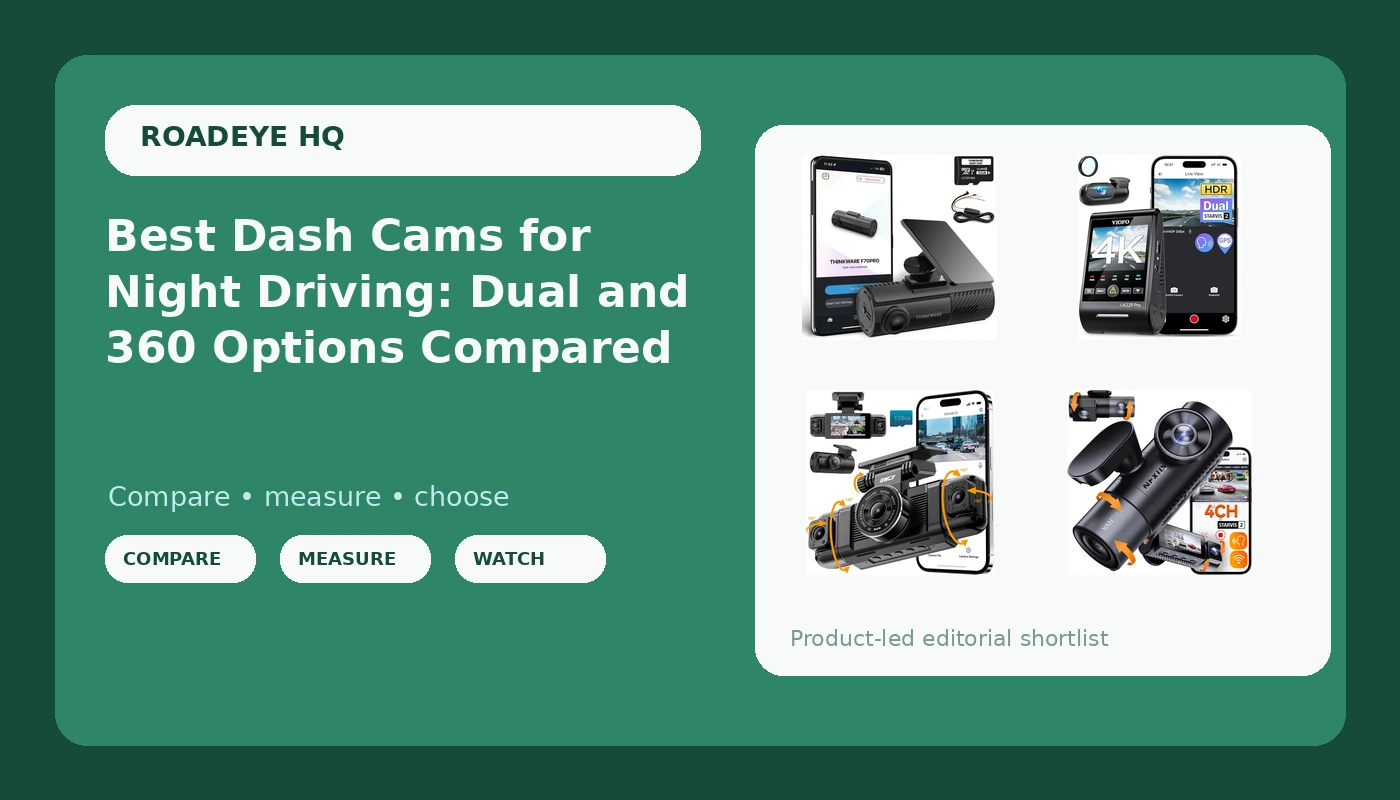
Most people buy a dash cam after something has already gone wrong. By then the only question that matters is whether the clip shows a plate, a face, or a lane position clearly enough to end an argument with an adjuster. Shopping for dash cams for night driving is where that question actually gets decided, because night footage is where inexpensive sensors fall apart first. This guide covers six current models, from a compact single-channel commuter camera to multi-channel surround systems, and lays out the verified differences between them: rated resolution, channel count, sensor family, coverage angle, and connectivity. It does not guess at performance, and it does not quote prices that move week to week. It compares what each product listing actually specifies so you can match a camera to the way you drive.
Related: How to Hardwire a Dash Cam for Parking Mode
Quick answer
The VIOFO A229 Pro 4K HDR Dash Cam Front and Rear, Dual STARVIS 2 Sensors is the strongest fit for drivers who want maximum front detail plus rear coverage, because it combines a 4K HDR front camera with a rear camera and a pair of STARVIS 2 sensors. Choose the Vantrue N5 4 Channel WiFi 360° All Sides Dash Cam instead when you need side and cabin coverage from a single system rather than the highest front resolution.
Dash cams worth comparing
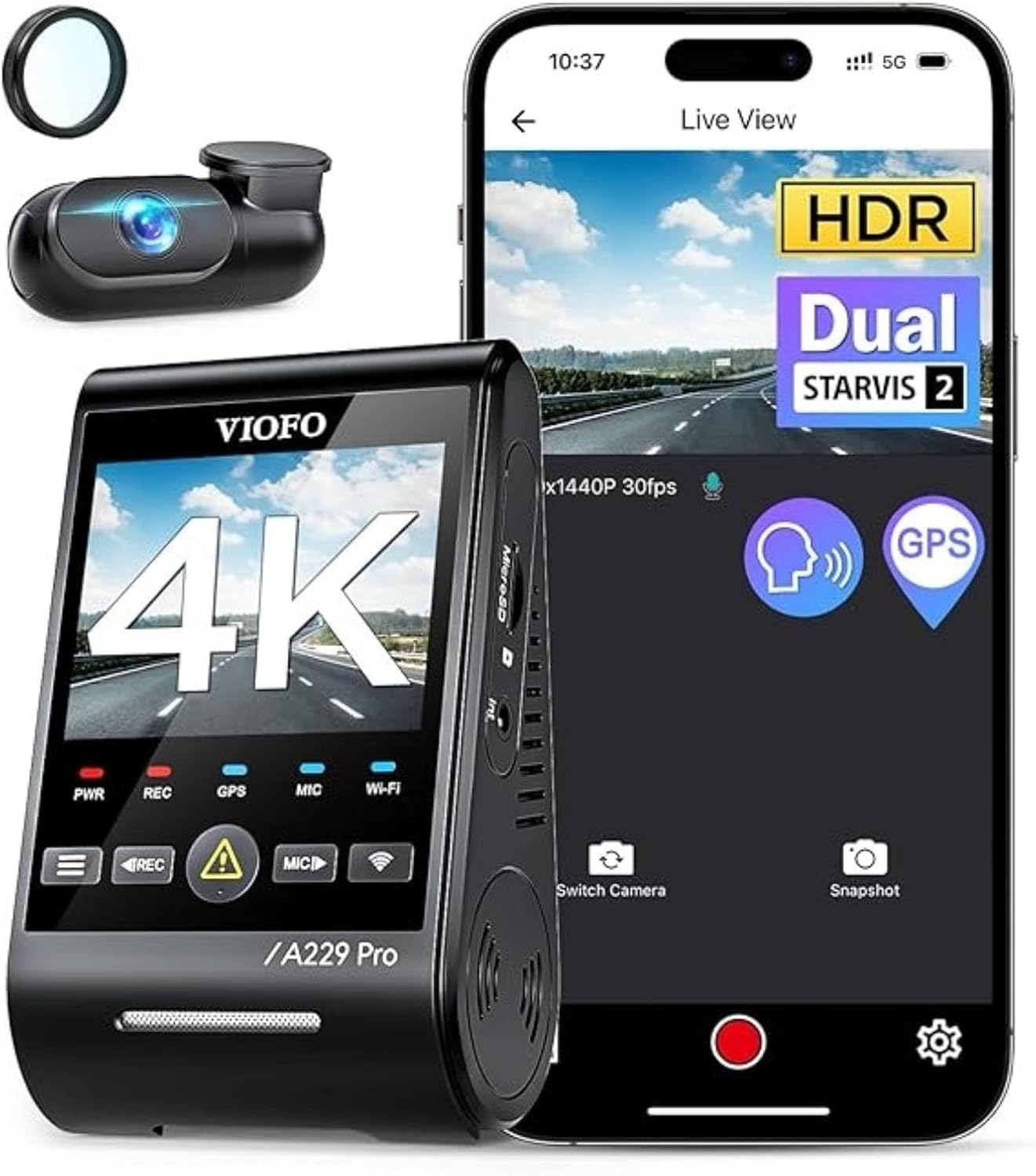
VIOFO A229 Pro 4K HDR Dash Cam Front and Rear, Dual STARVIS 2 Sensors
A two-channel system built around a 4K HDR front camera and a rear camera, with dual STARVIS 2 sensors and HDR processing named in the listing.
Visit on Amazon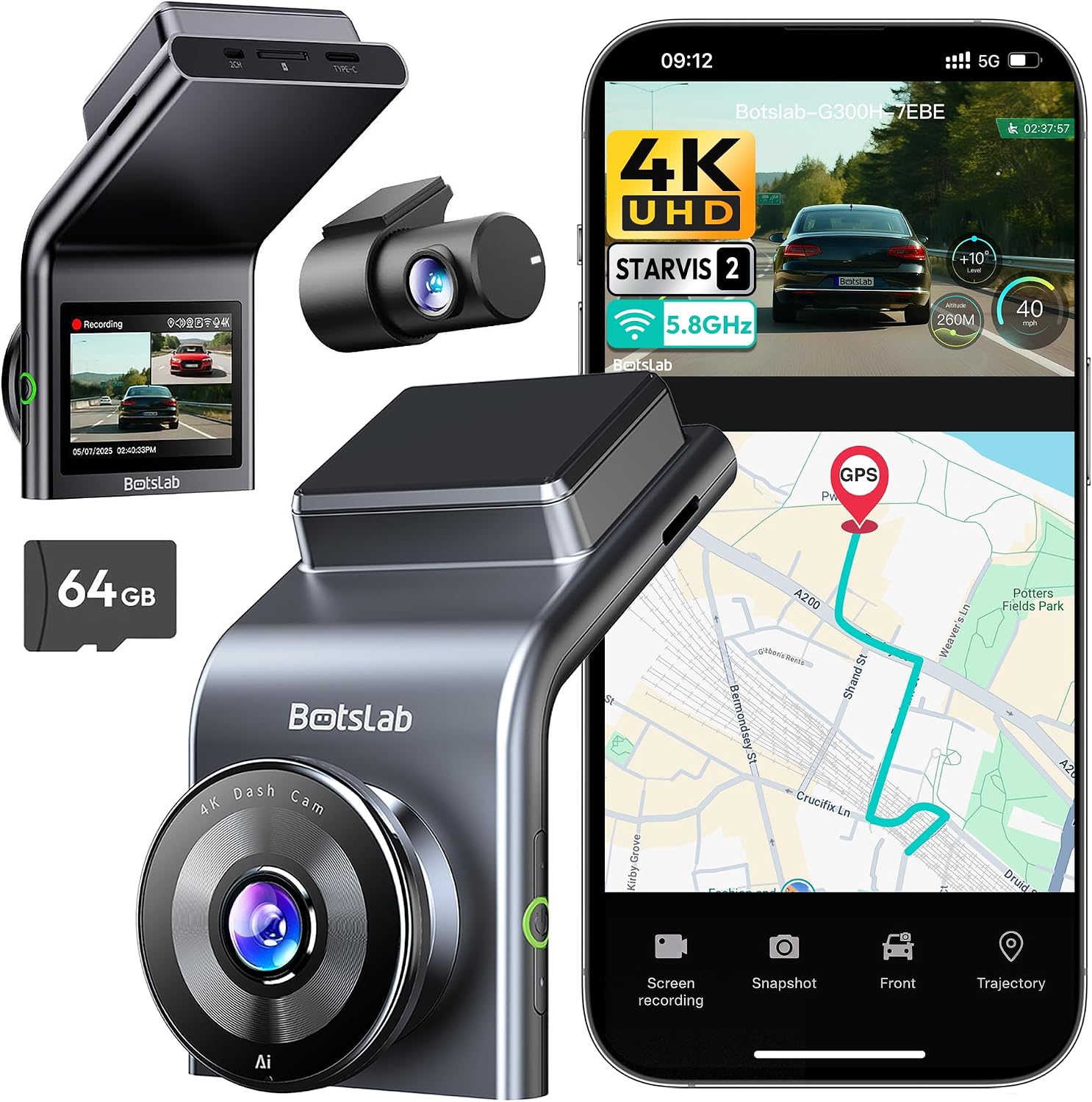
BOTSLAB G300H Plus 4K STARVIS 2 Dual Dash Cam Front and Rear[2026 Upgraded]
A front and rear dual camera setup with 4K capture and a STARVIS 2 sensor, positioned as a 2026 revision of the G300H Plus.
Visit on Amazon
THINKWARE F70 PRO Dash Cam 1080p Full HD, Wi-Fi, Night Vision, G-Sensor
A single-channel 1080p Full HD camera with Wi-Fi, night vision, and a built-in G-sensor for impact detection.
Visit on Amazon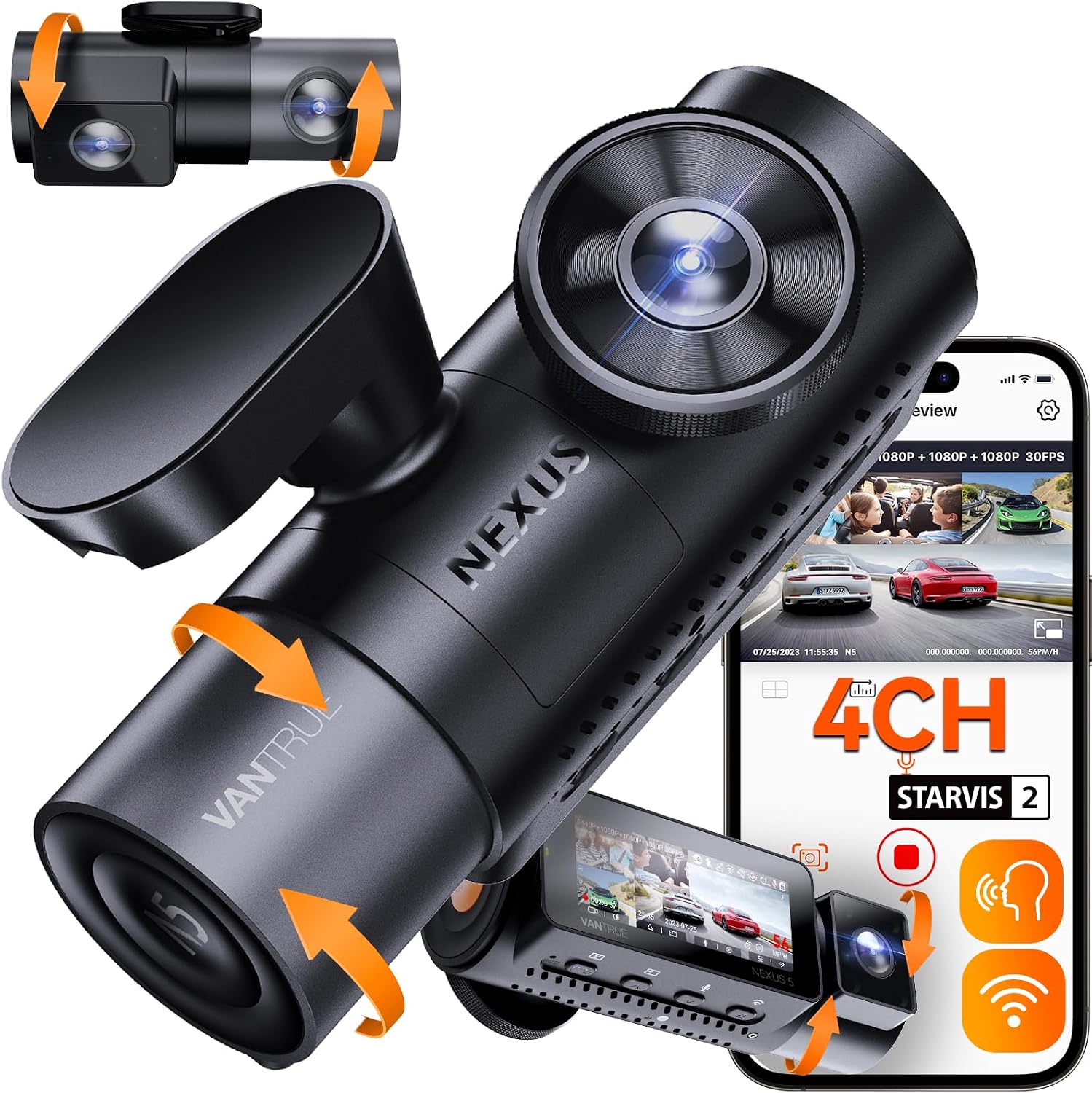
Vantrue N5 4 Channel WiFi 360° All Sides Dash Cam
A four-channel camera with Wi-Fi that records all sides of the vehicle for full surround coverage.
Visit on Amazon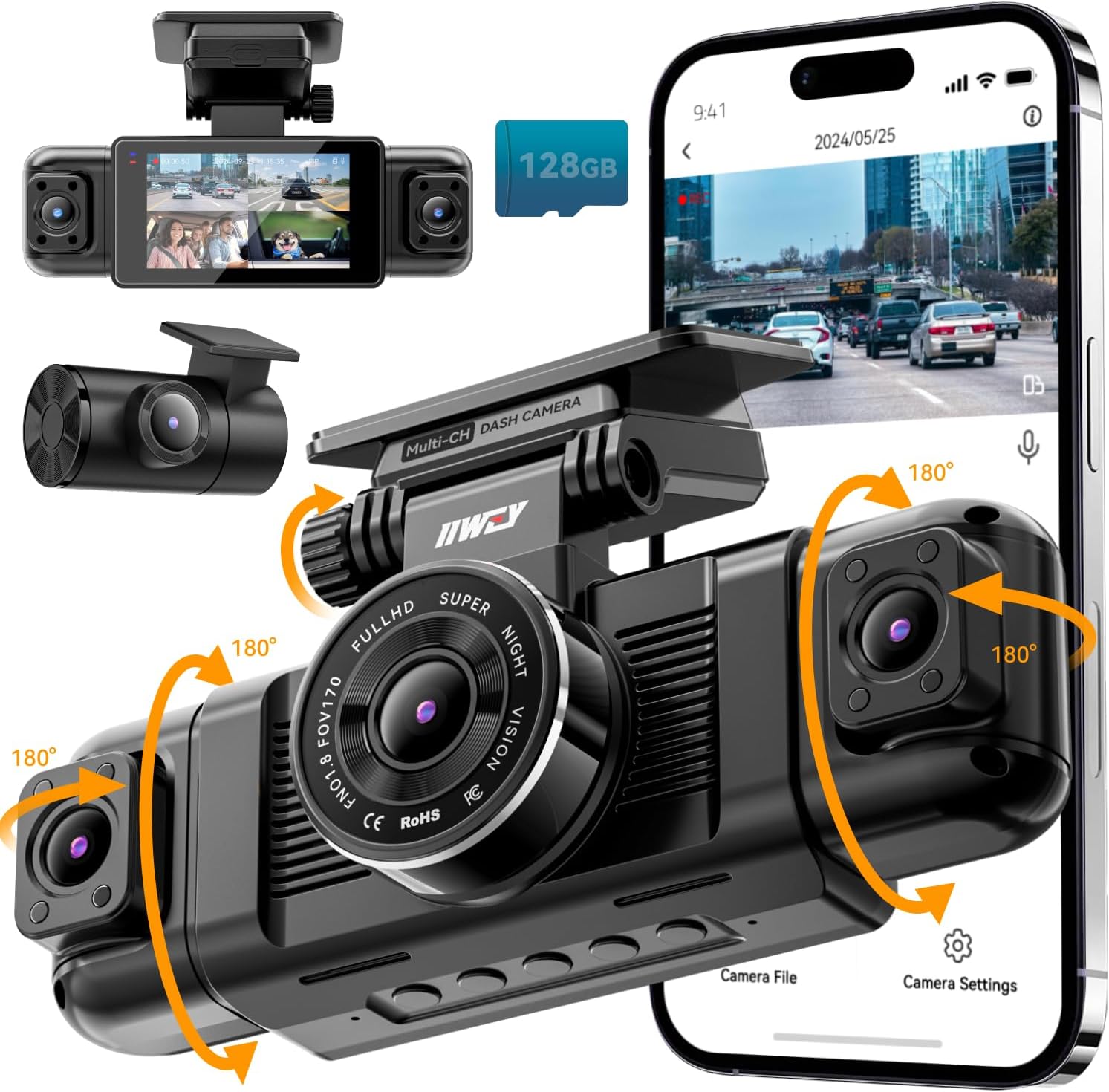
IIWEY N5 4 Channel Dash Cam for Cars, 360° View 2K Front 1080P Rear Inside
A four-channel system with a 2K front camera plus 1080p rear and interior views for 360 degree coverage.
Visit on Amazon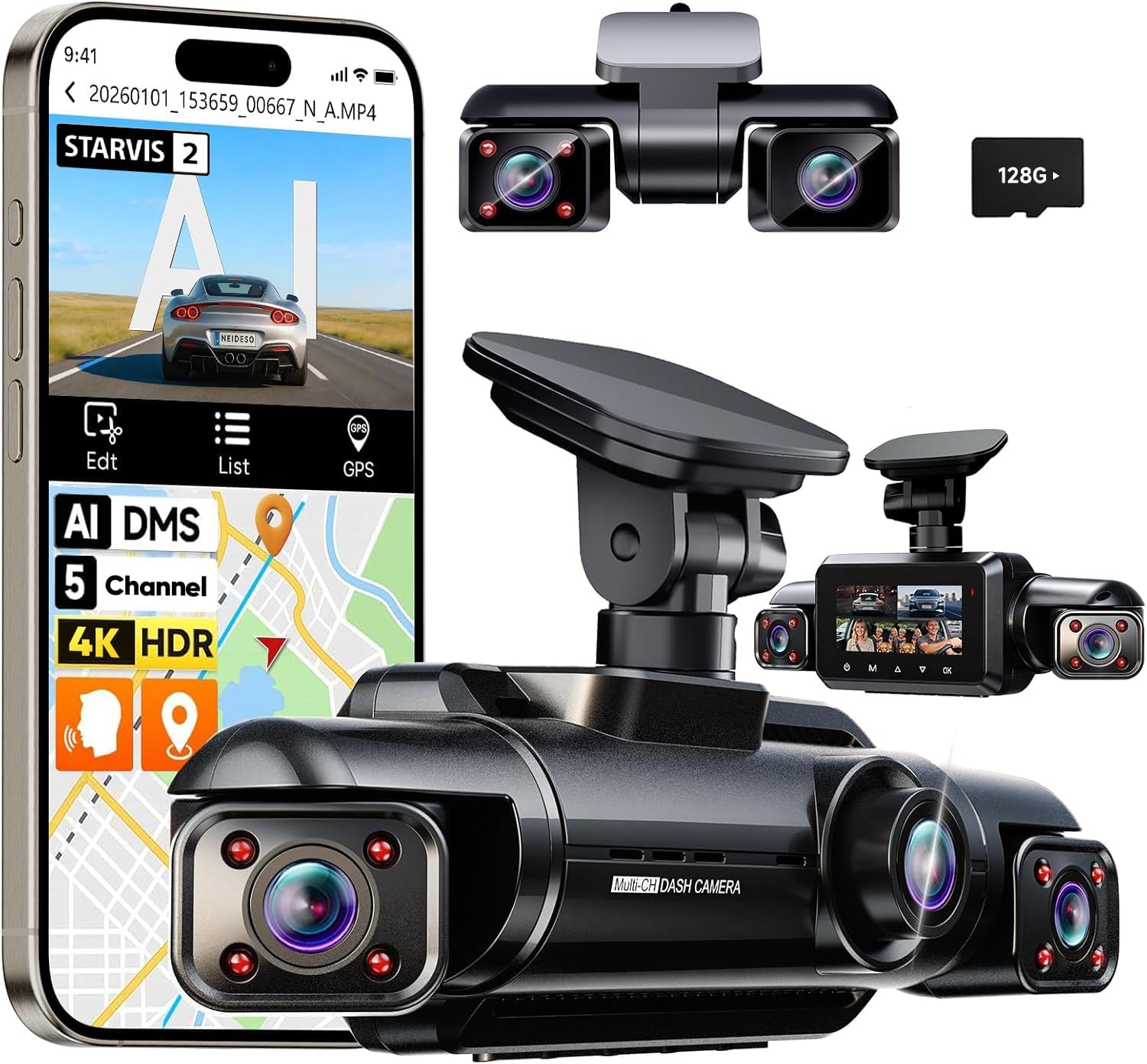
Neideso 5 Channel 360° View Dash Cam Front and Rear, 4K + 3 * 1080P
Check current Amazon price
A five-channel surround system pairing a 4K front camera with three 1080p cameras for full perimeter recording.
Visit on AmazonPrices and availability may change. Check the retailer for current details.
How these products were compared
This guide compares five things: sensor family and rated resolution, channel count and total vehicle coverage, night capture specifications, parking mode support, and connectivity through Wi-Fi or an app. Product names, images, and retailer links are matched by product identifier so that every card points to the product shown. Descriptions stay inside what the listings state, and where a listing is silent on a detail, this guide treats it as unknown rather than filling the gap with an assumption.
The most useful distinction here is not brand loyalty. It is what the camera is built to prove. A single-channel 1080p camera answers one question: what happened in front of me. A dual-channel 4K system answers that question with more detail and adds what happened behind. A four or five-channel surround system answers the questions that come up in parking lots, lane changes, and rideshare work, where the damage often arrives from the side or from inside the cabin.
No current prices appear in this article because they change too often to be trustworthy in print. Use the link on any card to confirm the current price, availability, and return terms at the retailer before you commit.
How to choose the right dash cam
Start with channel count, then work backward to resolution. More channels means more coverage, but it also means the recorder is splitting its processing and storage budget across more cameras. A five-channel system with a 4K front camera and three 1080p cameras records a lot of angles, and that volume is the real cost. A two-channel system recording 4K up front puts its detail budget into the view that most often decides fault. Neither is better in the abstract. The right answer depends on whether your risk sits ahead of the bumper or around the whole car.
Sensor family matters more than the number printed on the box. STARVIS 2 sensors appear in the VIOFO A229 Pro and the BOTSLAB G300H Plus, and that matters at night because sensor sensitivity is what separates a readable plate from a bright smear under headlights. HDR processing matters for the same reason: it helps hold detail in the shadows and the glare at the same time. When you read a listing, look for the sensor and the processing named explicitly, not just a resolution claim.
Field of view is a trade-off, not a spec to maximize. A lens around 140 degrees is the usual compromise: wide enough to catch the lane beside you, narrow enough that a plate across an intersection is still legible when you zoom the clip. Very wide lenses buy coverage at the cost of detail. Coverage angle also decides how much of the cabin and side glass a surround system can see, which is the whole point of a four or five-channel setup.
Then plan for heat and storage, because those two things end more dash cam careers than collisions do. Cameras that use capacitors instead of lithium batteries tolerate dashboard temperatures far better, and a camera mounted on a windshield in direct summer sun is living in an oven. Pair whatever you buy with a high endurance memory card rated for constant recording, sized so that the loop does not overwrite the clip you need before you can pull it.
If you plan to run parking mode, decide early whether you will hardwire the camera to the fuse box or leave it on the accessory socket. Parking mode depends on a power source that survives the ignition turning off, so a socket install defeats it. Our high endurance memory card guide covers the storage side of that setup in more detail.
VIOFO A229 Pro 4K HDR Dash Cam Front and Rear, Dual STARVIS 2 Sensors
The VIOFO A229 Pro is the top pick here because it makes the fewest compromises on the thing that matters most: front detail at night. It records 4K HDR from the front camera, adds a rear camera for what happens behind you, and uses two STARVIS 2 sensors, one per channel. HDR is the part worth understanding. It is designed to hold detail in both the dark and bright parts of a frame, which is exactly the situation you get at night when headlights, streetlights, and reflective plates all land in the same image.
The trade-off is scope. This is a two-channel system, so it covers front and rear, not the sides or the cabin. If your concern is a side swipe in a parking garage or a passenger dispute, you are paying for resolution you will not use and missing angles you need. It is also the kind of camera that rewards a proper install, since a 4K front channel plus a rear channel generates more data than a single-channel unit, and the memory card has to keep up with it.
Alternatives to consider
The Vantrue N5 4 Channel WiFi 360° All Sides Dash Cam is better suited to drivers who want one system covering every side of the vehicle, while the Neideso 5 Channel 360° View Dash Cam Front and Rear, 4K + 3 * 1080P is a stronger fit when you want a 4K front camera plus the widest surround coverage available in this group.
The IIWEY N5 4 Channel Dash Cam for Cars, 360° View 2K Front 1080P Rear Inside, the BOTSLAB G300H Plus 4K STARVIS 2 Dual Dash Cam Front and Rear[2026 Upgraded], and the THINKWARE F70 PRO Dash Cam 1080p Full HD, Wi-Fi, Night Vision, G-Sensor cover the rest of the range. The IIWEY N5 trades front resolution down to 2K in exchange for four channels including an interior view. The BOTSLAB G300H Plus stays dual-channel but brings 4K and a STARVIS 2 sensor. The THINKWARE F70 PRO is the simplest option: a single 1080p Full HD channel with Wi-Fi, night vision, and a G-sensor, with no rear or side coverage at all.
Day-to-day use and maintenance
A dash cam is only as good as its last recorded file, so treat maintenance as part of the purchase. Format the memory card on a regular schedule using the camera itself rather than a computer, since the camera writes the file system it expects to read. Check the footage periodically instead of assuming the little red light means everything is fine. Loop recording that silently stops when a card fills up is one of the most common ways people discover a problem, and they usually discover it after a collision.
Keep the lens and the windshield in front of it clean. A smudge that looks invisible in daylight becomes a haze across every night clip. Watch the mount as seasons change, since adhesive and suction mounts behave differently in extreme heat and cold. Finally, remember that dash cam footage is evidence, so check your local rules about audio recording and about what you are allowed to mount where before you install anything.
Buying checklist
- Measure your windshield area and check that the camera and mount will not block your view of the road.
- Choose channel count based on your normal driving, not a rare edge case.
- Confirm the exact model includes the cameras and accessories you expect, including a rear camera if the listing implies one.
- Verify the sensor family and HDR support rather than trusting a resolution headline.
- Buy a high endurance memory card sized for the number of channels you are running.
- Decide how you will power parking mode before you install.
- Check the current retailer price, availability, and return terms through the card link.
Final recommendation
Choose the VIOFO A229 Pro 4K HDR Dash Cam Front and Rear, Dual STARVIS 2 Sensors when front detail and rear coverage are what your commute demands and you want the clearest record of what happened ahead of you. Choose the Vantrue N5 4 Channel WiFi 360° All Sides Dash Cam when your risk sits around the whole vehicle and side or cabin coverage matters more than maximum front resolution. If you want the widest surround setup in this group, the Neideso five-channel system is the one to compare against it. And if a single forward-facing camera is all you need, the THINKWARE F70 PRO keeps the install and the storage math simple. Whichever you pick, budget for the memory card and the install, because those two decisions decide whether the camera is still recording when you need it.