I have stood in a Phoenix parking lot with a police report in my hand and nothing on video, and I have also watched a claim settle in nine days because a cheap camera caught the other driver's plate. That gap is the whole reason this site exists. So when I sit down to write a dash cam comparison, I am not ranking spec sheets. I am asking which camera will still be recording on the day you actually need it, at 11 p.m. on the 101, with headlights in your face and a plate two car lengths ahead.
The four products below answer four different questions. One is a front-only workhorse for people who want proof of what happened ahead of them. One covers both ends of the car. One watches the cabin, which is what rideshare drivers actually need. And one is a five-dollar piece of windshield film that decides whether any of the other three stay stuck to the glass when the dashboard hits 180°F in July.
The short version: the ROVE R2-4K Dual is the best all-around pick for most drivers because it covers front and rear with a STARVIS 2 sensor and includes a 128GB card, the VIOFO A119 V3 is the best front-only value, the COOAU D30S is the one I would hand a rideshare driver who needs cabin footage at night, and the Thinp electrostatic film is the cheapest insurance on this list, because the best camera in the world is useless if it is lying on your floor mat.
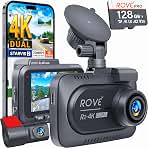
ROVE R2-4K Dual Dash Cam Front and Rear
Front and rear coverage in one kit, STARVIS 2 sensor, and a 128GB card in the box
Rear camera means a second cable to run, which is a real afternoon of work
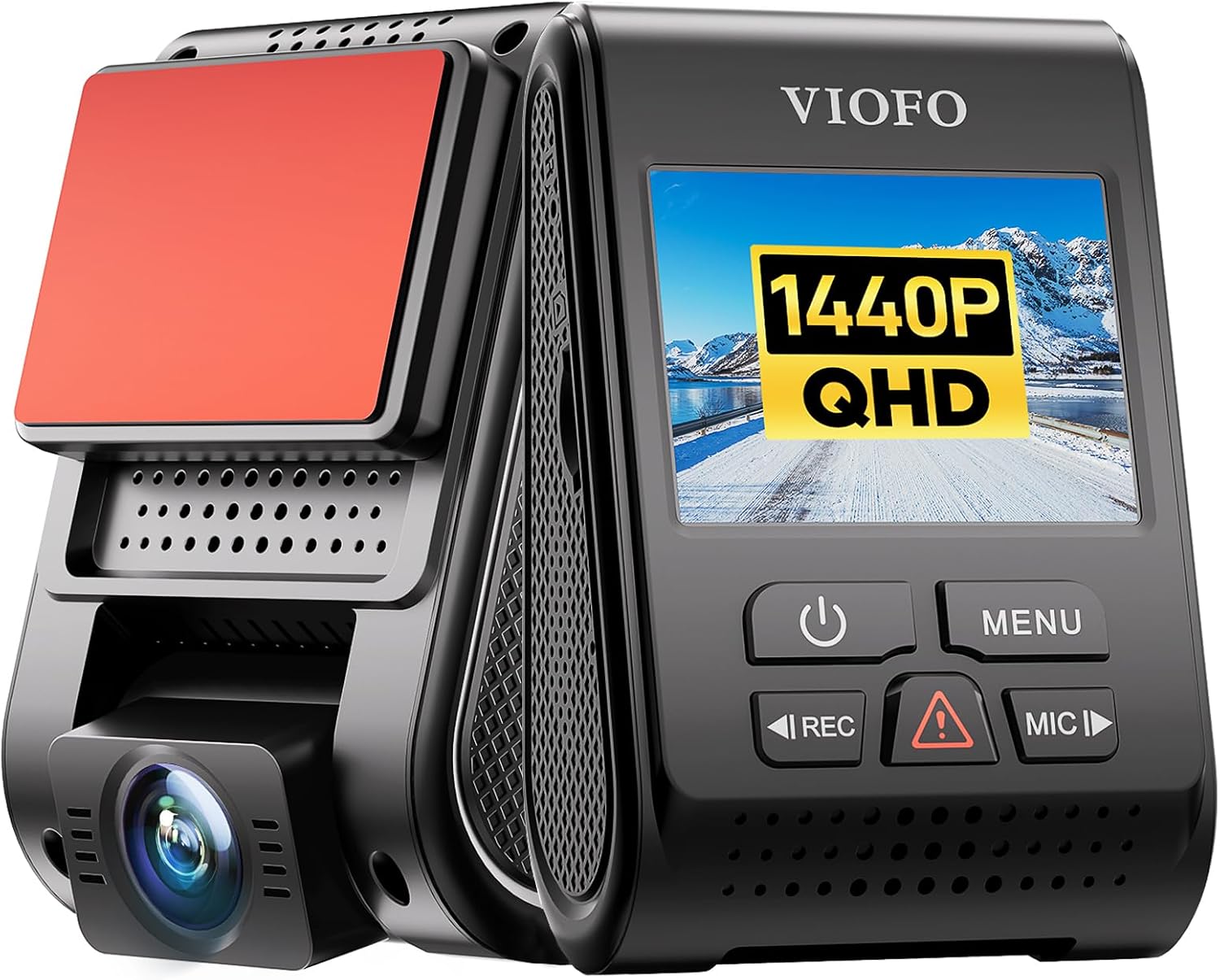
VIOFO A119 V3 Dash Cam
2K front recording, GPS, True HDR, and a reputation for just working
Front only, so a rear-end hit gives you audio and nothing else
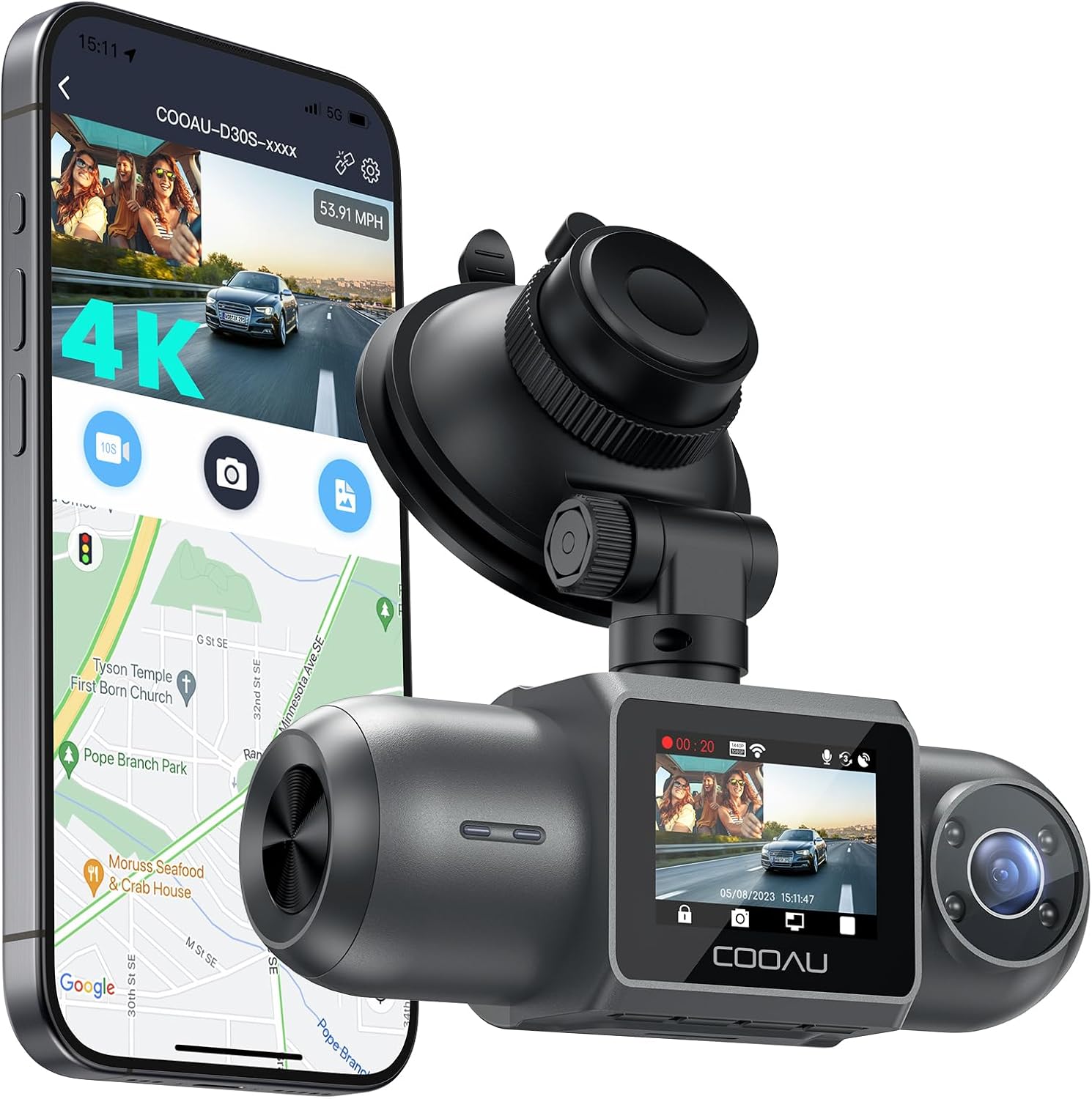
COOAU D30S 4K Dash Cam with GPS Wi-Fi
Front and inside dual recording, infrared cabin LEDs, supercapacitor
The cabin lens is for passengers, not for plates behind you

Thinp 4 Pcs Electrostatic Film for Dash Cam
Four clear films, double-sided, heat resistant, with adhesion promoter
Not a camera, so it only matters if you mount on glass
Prices and availability were captured from Amazon Creators API and may change.
Why a windshield film belongs in a dash cam comparison
The Thinp kit is four clear electrostatic films with an adhesion promoter, and it costs less than a fast-food lunch. On paper that makes it the odd one out here, and in practice it is the product that decides whether the other three are still doing their job in September.
Here is the problem it solves. Adhesive mounts and suction cups both fail the same way in the desert: heat softens the bond, the camera sags, and one morning you find it hanging by the power cable. An electrostatic film sits between the glass and the mount, spreads the load, and protects tint or a defroster grid from the adhesive you are about to press onto it. The film is reusable and the pack gives you four, so you can move a camera between vehicles or replace a film that has collected dust without buying a whole new mount kit.
Two honest limits. Electrostatic film is not a permanent mount, so if you park in a lot where people lean on cars, it is not a security system. And it does nothing for a camera that is already sagging because its own bracket is weak. What it does is give you a clean, heat-resistant surface to stick to, and the adhesion promoter in the box is the part most cheap film kits leave out. If you are mounting on glass, spend the few dollars. See the Thinp electrostatic film kit on Amazon.
The front-only workhorse: VIOFO A119 V3
The A119 V3 records 2K to the front, has GPS, and lists True HDR. It is a single-channel camera, which means one lens, one cable, one job. If your only question is "what happened in front of me," this is the most straightforward way to answer it, and it is the camera I would put on a new driver's windshield because there is nothing to configure and nothing to explain.
The case for it is simplicity. No rear cable to route through trim, no cabin lens to position around a headrest, no second channel splitting the bitrate. GPS stamps your speed and location onto the clip, which is the detail that ends arguments about who was where and how fast. True HDR is the feature that matters at dusk, when a bright sky and a dark road fight each other and a cheaper camera turns both into gray mush.
The case against it is the obvious one: a front-only camera cannot see the guy who rear-ends you at a red light. I have watched that exact scenario play out, and the footage showed the impact noise and nothing else. If you drive in traffic where rear-end collisions are a real risk, and in Phoenix they are, you want a second channel. Check the VIOFO A119 V3 on Amazon.
The dual-channel pick: ROVE R2-4K Dual
This is the one I would buy with my own money for a normal car. It records front and rear, uses a STARVIS 2 sensor, and includes a 128GB card, which matters more than people think. A dual-channel camera at high resolution fills a card fast, and a card that fills without a high-endurance rating is a card that corrupts at the worst possible moment. Getting 128GB in the box removes one purchase decision and one failure point.
STARVIS 2 is a low-light sensor family, and low light is the only lighting condition that counts. Daytime footage looks fine on almost anything, including the fifty-dollar lottery cameras. Night footage is where the cheap sensors fall apart, and where you find out whether the plate in front of you is readable or just a white smear. A STARVIS 2 sensor is the right starting point for that problem.
The cost is installation. A rear camera means running a cable from the windshield to the back glass, usually under trim and around airbags, and doing it wrong is worse than not doing it. Budget an afternoon, or pay someone who has done it before. The other trade-off is that you are splitting recording resources across two channels, so the front channel is not the same as a dedicated single-channel camera at the same price. Check the ROVE R2-4K Dual on Amazon.
The rideshare pick: COOAU D30S
The D30S records 4K up front and a second 2.5K or 1080P channel for the inside of the car, which makes it a different tool from the other two. For an Uber or Lyft driver, the cabin is where the disputes happen. A front camera proves what the traffic did. A cabin camera with four infrared LEDs proves what the passenger did, and it does it in a dark car at 1 a.m. when the only light is a phone screen.
The supercapacitor is the spec I care about most here. Lithium batteries swell in desert heat, and a swollen battery in a camera mounted above your head is not a hypothetical. A capacitor handles temperature swings without that failure mode, which is exactly what a camera living on a Phoenix windshield needs.
GPS and Wi-Fi mean the camera logs where you were and lets you pull a clip to your phone without removing the card, and the G-sensor and loop recording are standard here. Parking mode is listed too, but read the fine print: parking mode only works if the camera keeps power after the ignition dies, which means a hardwire kit to the fuse box. Plugged into a cigarette lighter, parking mode is a bullet point, not a feature. The cabin lens also does not replace a rear camera, so if someone hits you from behind, this camera shows you your own reaction and not their plate. Check the COOAU D30S on Amazon.
Heat, capacitors, and the Phoenix test
Every camera on this list will look fine in October and questionable in July. Heat is the failure mode nobody puts on a box. A parked dashboard in full sun reaches temperatures that cook consumer electronics, and the components that give up first are the battery and the mount, in that order.
That is why the supercapacitor in the COOAU matters, why the Thinp film exists, and why I tell people to look past the resolution sticker. A 4K claim without the sensor and bitrate behind it is a number, not a picture. A wide field of view that stretches the edges until plates are unreadable is a spec sheet win and a real-world loss. And a mount that sags at 110°F takes the camera with it.
The other heat conversation is the SD card. Whatever camera you buy, buy a high-endurance card rated for constant recording, and check the rating on the card itself rather than the listing. A standard card in a dash cam is a countdown timer you cannot see.
What I would buy for which driver
Front-only coverage on a budget: the VIOFO A119 V3. Simple, 2K, GPS, no installation drama.
Full coverage for a normal commute: the ROVE R2-4K Dual, with the included 128GB card and the STARVIS 2 sensor doing the night work.
Rideshare or delivery driving: the COOAU D30S, because the infrared cabin channel is the footage that settles passenger disputes, and the supercapacitor is the right choice for a hot climate.
Mounting on glass, any of the above: the Thinp electrostatic film kit, plus the adhesion promoter that comes with it.
The trade-offs I will not pretend away
None of these four is a complete system on its own. A single-channel camera leaves your rear exposed. A dual-channel kit costs you an afternoon of cable routing and splits your recording resources. A cabin camera protects you from passenger claims but not from rear impacts. And a piece of film only helps if you install it before the mount fails, not after.
What ties them together is the same principle that runs through everything on this site: a dash cam is an insurance witness. The resolution is nice, the app is nice, the Wi-Fi is nice. The only thing that matters is whether the camera is mounted, powered, and recording when something happens in front of you, behind you, or in the back seat. Pick the coverage that matches your risk, mount it properly, put a high-endurance card in it, and then forget about it until you need it.