Related: Best Dash Cam for Night Driving: What the Clip Has to Prove
I have stood in a parking lot with a cop, no footage, and a story that was not mine. I have also watched a claim settle in nine days because a cheap camera caught a distracted driver at 45 mph. That gap is the entire reason I care about this category. A dash cam front and rear setup is an insurance witness first and a gadget second, and everything else, the app, the cloud, the parking alerts, is decoration until the footage has to prove something.
I drove rideshare full time in Phoenix for six years, roughly 40,000 miles a year on I-10 and the 101, most of it at night when the surge pricing kicked in. I got rear ended twice. The first one was a red light runner who told the officer I ran the light, and without footage that became a three month he said she said fight that raised my premium anyway. The second one had a camera on the windshield, and the claim settled in nine days.
Since then I have run more than 40 dash cams through my own commute and my own night shifts, and through Phoenix summers where a parked dashboard hits 180°F. I keep every melted suction cup and every corrupted SD card as evidence. Here are the four setups I would put on a windshield right now, and what each one is actually for.
Best Overall: Garmin Dash Cam 67W
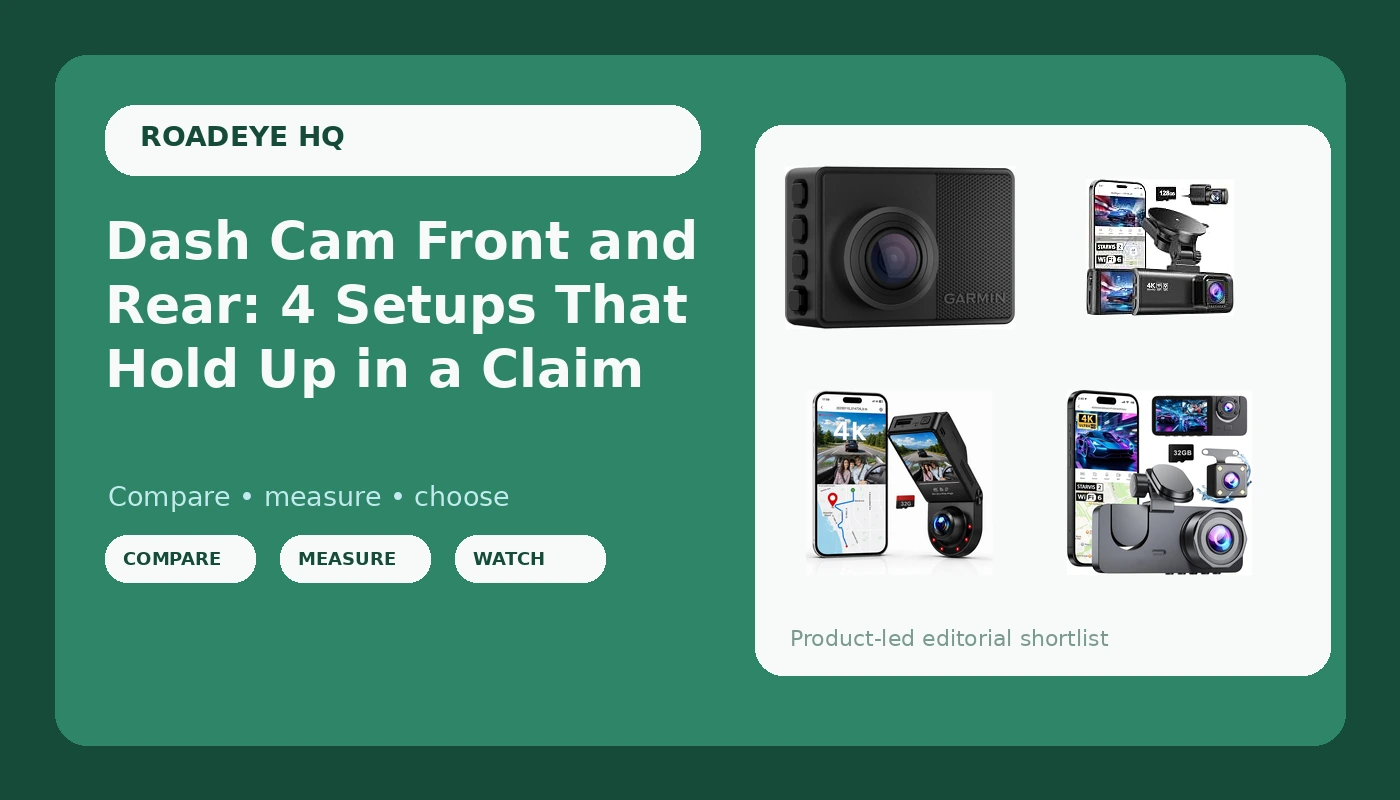
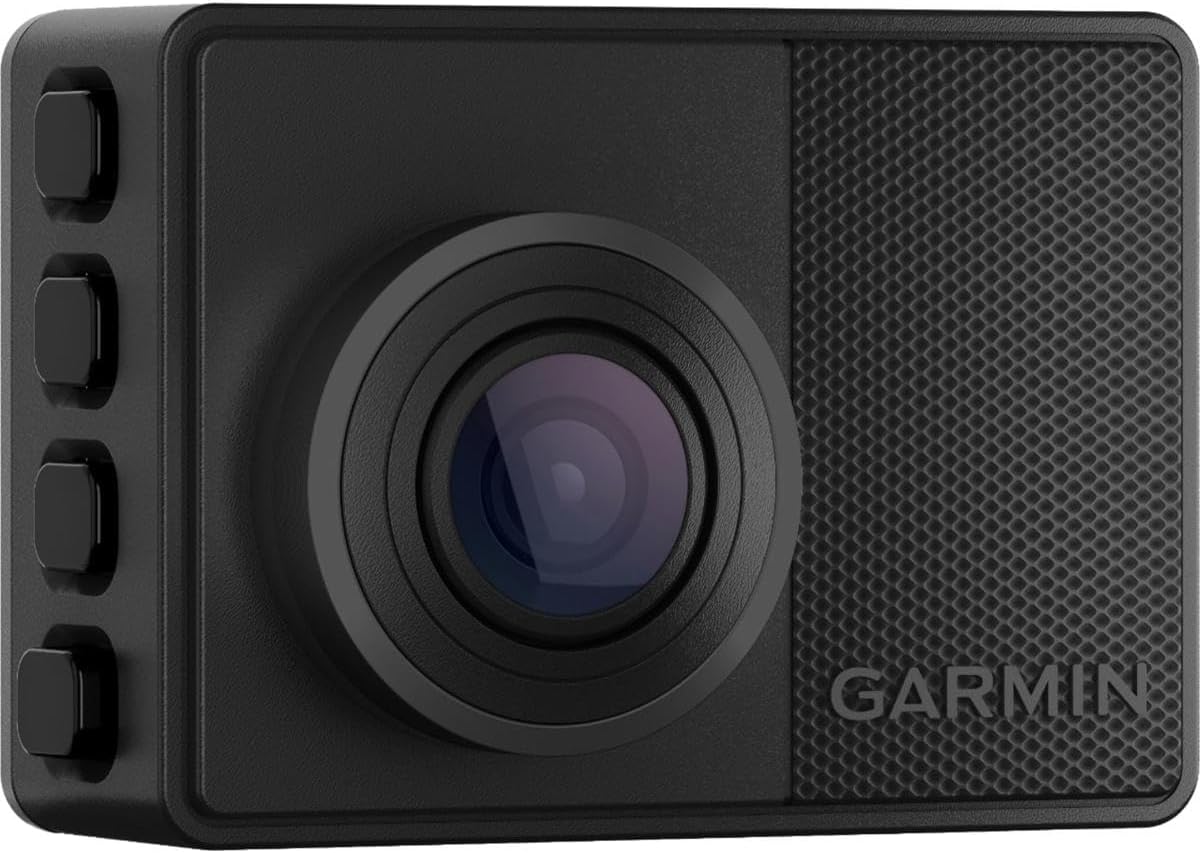
If I had to hand one camera to a driver who wants the least friction, this is it. The Garmin Dash Cam 67W records 1440p, it carries an extra-wide 180 degree field of view, and it is compact and discreet enough that it disappears behind the mirror. Voice control matters more than people expect. You can save a clip without taking a hand off the wheel, which is the difference between capturing the moment and narrating it afterward.
The 180 degree field of view is wider than the 140 degree sweet spot I usually argue for. Wide is good for context and bad for plates, so I want to see how a plate reads near the edge of the frame before I call any lens perfect. What puts this camera at the top is the connected side: you can monitor your vehicle while you are away from it, and the camera includes a memory card, so there is no extra trip to buy one. Check current Amazon price.
Where it loses points is coverage. This is one camera. If someone rear ends you, you have the front clip and nothing else. I run a rear camera for a reason: two of my own claims came from behind me, and one of them is the one that raised my premium. If your budget allows only one camera, this is the one. If it allows two, keep reading.
Best Value: REDTIGER F7NP 4K Dash Cam Front and Rear
The REDTIGER F7NP is the setup I point budget conscious drivers toward when they want front and rear coverage in one box. It records 4K in the front, it covers the rear, and it uses a STARVIS 2 sensor, which is the part that actually matters once the sun goes down. A card is included too, and the card is the component people cheap out on and then blame the camera for.
Night footage is the only footage that matters. Accidents do not happen at noon in perfect light. A 4K label on a camera with a weak sensor and a low bitrate looks worse than a clean 1080p clip, so sensor generation is the first number I check, not the sticker on the box. STARVIS 2 is a real step forward in low light sensitivity, and 4K in the front plus a rear camera gives an adjuster two angles of the same event, which is exactly what ends a he said she said argument.
The trade off is simplicity. Two cameras mean two mounts, two cables to route, and more places for a heat related failure to show up. In a Phoenix summer I care about that. But for a front and rear bundle that includes a card, this is the value pick. Check current Amazon price.
Best for Rideshare: 360° Dash Cam Front and Inside
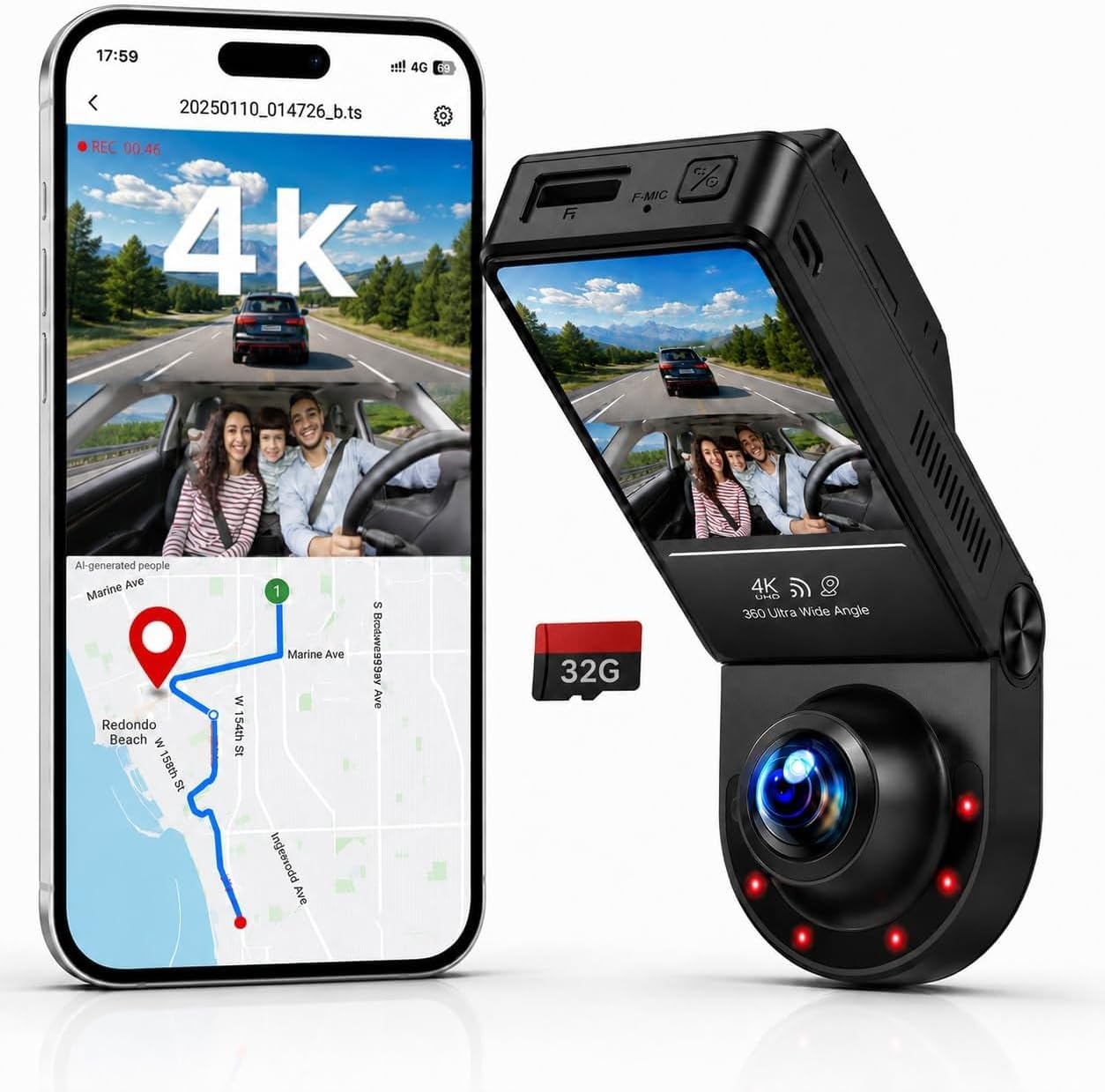
If you drive passengers, the camera inside the car is not optional. This 360 degree dash cam records the front and the cabin in two channels, 4K for the road and 2.5K for the inside, and that cabin view is what settles the arguments that happen in the back seat.
I drove rideshare for six years, and the thing nobody tells new drivers is that most disputes are not about fault, they are about behavior. Did the passenger have the seatbelt on. Did they grab the door handle before the light turned green. Did the rider in the back say what they claim they said. A front only camera answers none of that. A two channel setup with a cabin view answers all of it, and it also protects you against complaints that never happened.
The catch is heat and mounting. A cabin facing camera sits on glass that takes direct sun, so I want a capacitor inside, not a lithium battery, and I want a mount that does not give up at 110°F. I also want to check the cabin channel at night with the dome light on, because that is the footage that gets argued about. Check current Amazon price.
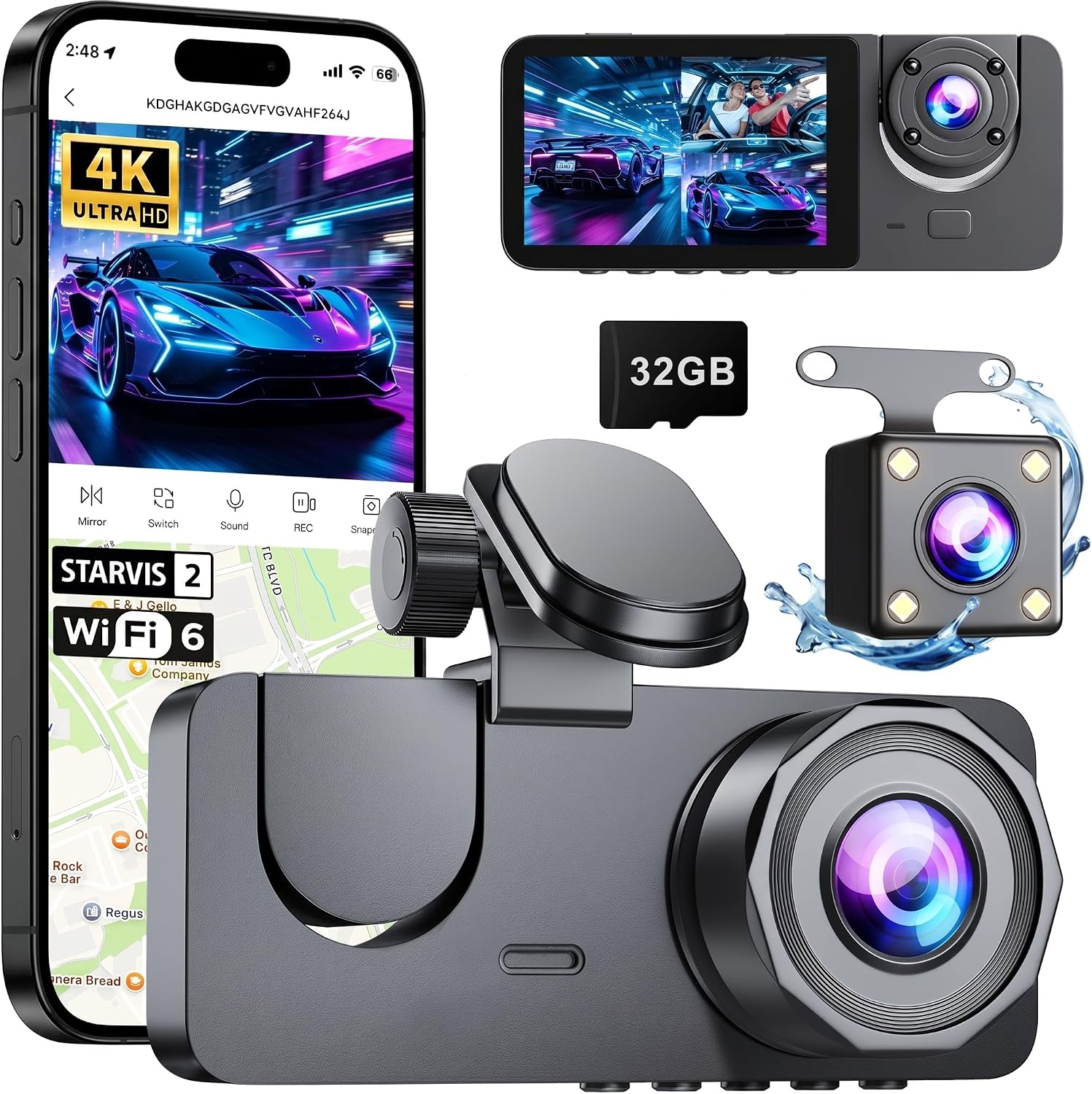
Best Budget Three Channel: Dash Cam Front and Rear Inside 4K
Three channels, front, rear, and inside, in one system. This is what I would buy if I wanted the most coverage for the least money and I understood what I was trading away. You get 4K in the front and a view of the cabin and the road behind you at the same time, which is more angles than most drivers ever have.
The honest trade off at this end of the market is heat tolerance and card quality. A three channel camera writes three streams at once, which means the card works harder and the processor runs hotter. In Phoenix that matters. My rules do not change because the price is low. A camera marketed for hot climates should not be packing a lithium battery, and the card needs a high endurance rating, verified on the card itself rather than on the listing. When a system like this fails, it fails quietly, and you find out when you need the clip.
What it does well is coverage per dollar. Rear and cabin footage together answer most of the questions an adjuster asks, and the front channel is the one that proves fault. If you can stretch, the REDTIGER bundle is the safer bet on night footage. If you cannot, this gives you three angles instead of one. Check current Amazon price.
How I test dash cams
I run every camera the same way: night driving, day driving, and heat. The night clip at 40 mph is the first thing I check, because that is where plates either resolve or turn into smudges. Then the parking lot test with headlights behind me, because glare from an oncoming car is the most common way a clip becomes useless.
Then heat. I have cooked more cameras on a dashboard in July than I have lost in any other way. Heat kills more cams than crashes do. If a camera shuts down on a hot dashboard, the recording stops, and the camera does not tell you. I also test parking mode properly, which means hardwiring to the fuse box and watching what it does to the battery, because parking mode through a cigarette lighter dies the moment the ignition does.
And I check the card. Every card gets verified for the high endurance rating, because a normal card corrupts at exactly the moment you need the footage.
What actually matters in the footage
Resolution is the number printed on the box. Bitrate is the number that decides whether a plate is readable. A 4K camera with a low bitrate looks worse than a good 1080p camera, and almost nobody checks. When I compare two clips, I am comparing how many characters I can read on a plate at 40 mph, not how many pixels the spec sheet claims.
Field of view is the second trap. 140 degrees is the sweet spot. Narrower misses the side of your car in a side impact. Wider turns plates into smudges and adds distortion at the edges. That is why a 180 degree lens needs a strong sensor behind it, and why I would rather have a clean 140 degree clip than a warped 180 degree one.
Power source is the third. Capacitors survive heat. Lithium batteries swell in a Phoenix summer, and a swollen battery is a dead camera. If a camera marketed for hot climates packs a lithium battery, the spec sheet was written for a warehouse, not a windshield.
The last thing is parking mode, and it is the most oversold feature in the category. It only works if the camera is hardwired to the fuse box. Otherwise the cigarette lighter kills it when the ignition dies, and you own a very expensive camera that records nothing while you are inside a store. Buy the camera, then spend the hour wiring it right.
Dash cam reference table
This is the short version I keep in my phone when someone asks which camera to buy. The image links go to the listing, and the notes are the reasons, not the marketing copy.
| Setup | Channels | What it records | Best for | Price |
|---|---|---|---|---|
 Visit on Amazon → Garmin Dash Cam 67W |
1 | Front, 1440p, 180 degree FOV | Least friction, voice control, card included | $149.95 |
 Visit on Amazon → REDTIGER F7NP |
2 | Front 4K plus rear, STARVIS 2 sensor | Best value front and rear, best night sensor | $149.99 |
 Visit on Amazon → 360° Dash Cam Front and Inside |
2 | Front 4K plus cabin 2.5K | Rideshare and passenger disputes | Check current Amazon price |
 Visit on Amazon → Dash Cam Front and Rear Inside 4K |
3 | Front 4K plus rear plus cabin | Most coverage per dollar | Check current Amazon price |
Should you buy the Garmin Dash Cam 67W?
Yes, if you want one camera and no fuss. It is compact, it is discreet, it records 1440p with a very wide lens, and the connected features let you keep an eye on the vehicle while you are away from it. The included card is a detail I appreciate, because the card is the part people forget. The reason it is not the pick for everyone is simple: one camera sees one direction, and half of my own incidents came from behind the car.
Should you buy the REDTIGER F7NP?
Yes, if you want front and rear coverage without overthinking it. The STARVIS 2 sensor is the selling point for me, because it is the part that decides how the clip looks at night, and the front and rear channels give an adjuster two views of the same event. Just plan the install properly, route the rear cable out of the sun where you can, and pair it with a high endurance card.
Should you buy the 360° Dash Cam Front and Inside?
Yes, if you carry passengers. The cabin channel is the whole argument. Front and inside coverage at 4K and 2.5K answers the behavior questions that a front only camera cannot, and that is what protects a driver from complaints and disputes. Check the heat rating and the mount, because cabin facing glass gets the worst of a Phoenix afternoon.
Should you buy the three channel Dash Cam Front and Rear Inside 4K?
Yes, if maximum angles matter more than polish. Front, rear, and cabin in one system is the most coverage you can put on a car for the money, and the front channel is still the one that proves fault. Buy the good card, keep the camera out of direct sun when you park, and check the clips every couple of weeks so you know the system is still recording.