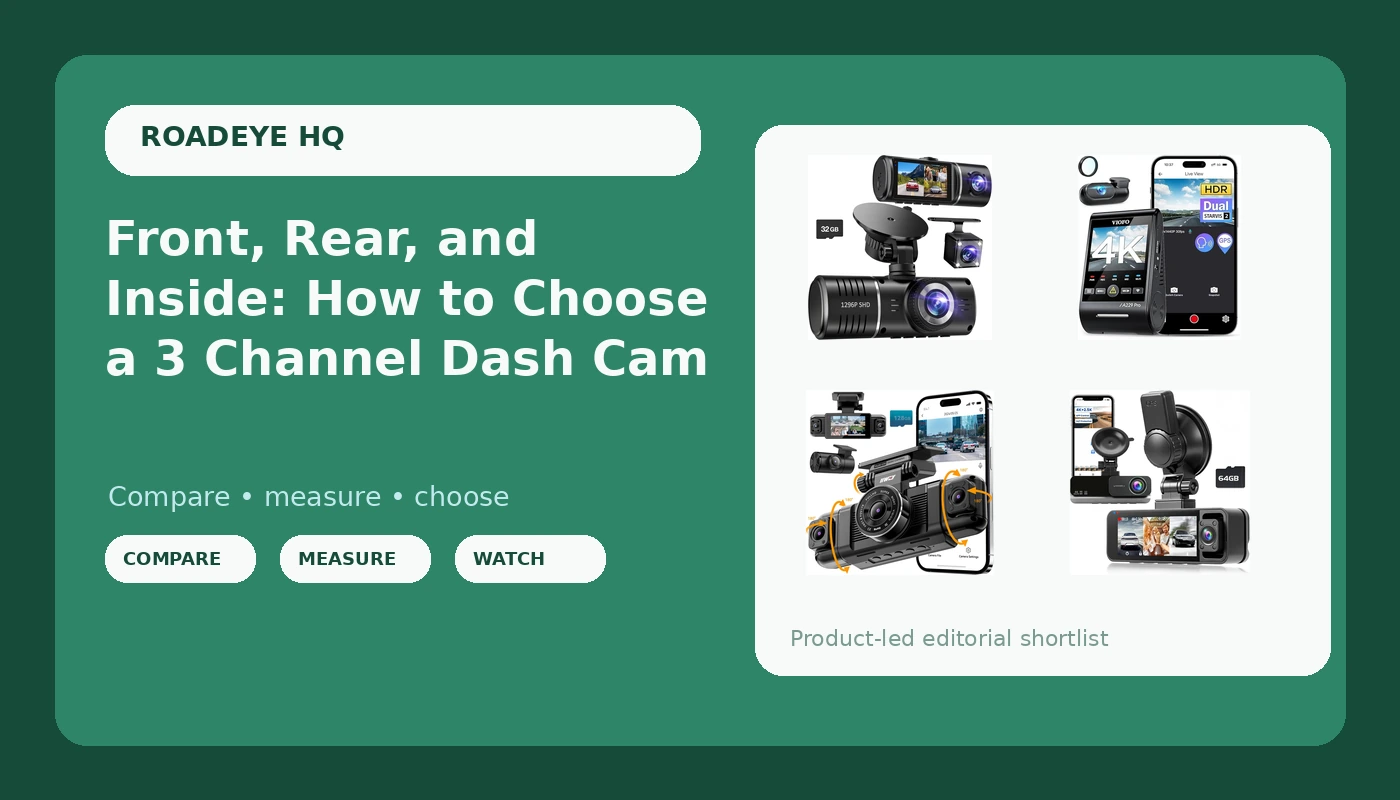
Most people start shopping for a dash cam the week after something happens, which means the decision gets made in a hurry and usually around the wrong question. The question is not how many megapixels are printed on the box. It is how many directions a 3 channel dash cam actually covers, what the footage looks like at night when a plate is moving, what happens to the recording when the memory card fills up, and whether the thing stuck to your windshield will still be recording after a summer of parked-dashboard heat.
This guide walks through four listings that take four different approaches to that problem: a dual-channel setup built around large image sensors, a four-camera system that adds cabin and side angles, a three-channel package that ships with a card in the box, and a low-cost three-channel unit aimed at first-time buyers. No prices are quoted here because listings move. What matters is matching coverage and hardware to the way you actually drive.
Related: Hardwiring a Dash Cam for Parking Mode Without Draining the Battery →
Quick answer
If you want the highest-spec sensor hardware in this group and you mainly need the road ahead and the road behind, the VIOFO A229 Pro 4K HDR is the dual-channel option to look at first. If you need the cabin and the sides as well as front and rear, the IIWEY N5 covers four angles. If you want front, rear, and inside coverage with a card already in the package, the 4K 3 Channel Dash Cam includes 64GB. If you are buying your first cam and want three directions of coverage without adding a card separately, the 1296P three-channel unit is the entry point. Each one is a different answer to a different problem, and none of them is the right answer for everybody.
Four useful options
| Model | Best fit | What stands out |
|---|---|---|
| VIOFO A229 Pro 4K HDR Dash Cam Front and Rear, Dual STARVIS 2 Sensors | Drivers who want front and rear coverage with the highest-spec sensor hardware in this group | Dual STARVIS 2 sensors with 4K HDR front recording |
| IIWEY N5 4 Channel Dash Cam for Cars, 360° View 2K Front 1080P Rear Inside | Drivers who need cabin and side angles in addition to front and rear | Four channels with a 2K front camera |
| 4K 3 Channel Dash Cam 360° View, 1080P Front and Rear Inside, 64G | Buyers who want three directions of coverage with a card included | Three channels plus a 64GB card in the box |
| Dash Cam Front and Rear, 1296P Dash Camera for Cars, 3 Channel Car Camera Front Rear and Inside with 32GB Card, Loop Recording, Night Vision, HDR, 24Hr Parking, G-Sensor | First-time buyers who want front, rear, and inside coverage without shopping for a card separately | Three channels, a 32GB card, and a G-sensor listed |
The high-spec dual-channel option: VIOFO A229 Pro 4K HDR Dash Cam Front and Rear, Dual STARVIS 2 Sensors
The trade-off here is coverage versus resolution. Two channels means no view of the cabin and no view of your own side windows, which matters if you drive for a living and want a record of what happened inside the car. What you get in exchange is more processing headroom per channel, which is the honest reason dual-channel systems tend to produce cleaner night footage than four-channel ones at the same price point. If your priority is a legible plate at night in front of you, fewer channels is usually the better trade.
The four-camera option: IIWEY N5 4 Channel Dash Cam for Cars, 360° View 2K Front 1080P Rear Inside
More cameras means more data, and more data means the memory card and the recording bitrate matter more than they do on a two-channel setup. A four-channel system is the right tool when the story you need to tell includes who was beside you, not just who was in front of you. The honest limitation is that every added channel takes a share of the processor and the storage, so the front footage on a four-camera system is not automatically going to match a dedicated two-camera unit with a larger sensor. Decide which view you would actually need in a dispute before you decide how many you want on the box.
The three-channel option with a card included: 4K 3 Channel Dash Cam 360° View, 1080P Front and Rear Inside, 64G
The included card is the detail worth pausing on, and not for the reason you would expect. Bundled cards are frequently standard cards rather than high-endurance cards, and constant recording plus a hot dashboard is exactly the workload that kills a standard card. Use the included card to get running, then treat it as a placeholder. Verify the endurance rating printed on whatever card ends up doing the real work, because a card that silently corrupts gives you a camera that appears to be recording and is not.
The first-cam option: Dash Cam Front and Rear, 1296P Dash Camera for Cars, 3 Channel Car Camera Front Rear and Inside with 32GB Card, Loop Recording, Night Vision, HDR, 24Hr Parking, G-Sensor
Read the parking mode claim carefully on any budget cam, including this one. Parking mode is only as good as its power source. If the camera is plugged into a cigarette lighter socket, it stops recording the moment the ignition does, and the parking feature is decoration. If it runs on an internal lithium battery, a hot parked car is the worst environment that battery will ever see. Capacitor-powered cameras are the ones that survive heat, and hardwiring to a fuse box with a voltage cutoff is what makes a 24-hour parking claim real.
Prices and availability may change. Product images, names, and retailer links are matched to verified listings. No current price, rating, stock status, or measured result is stated here without current evidence.
What the channel count actually tells you
A channel is one camera and one recording stream. Two channels usually means front and rear. Three channels usually means front, rear, and cabin. Four channels adds the sides or a second interior angle. That is the entire meaning of the number, and it says nothing about image quality.
Resolution is listed per channel, and the numbers are not interchangeable. A system advertising 4K front and 1080P rear is not a 4K system; it is a 4K front camera attached to a 1080P rear camera. When you compare listings, compare like for like: the front channel against the front channel, the interior channel against the interior channel. A four-channel unit at a low price is spreading its processing budget four ways, and the per-channel result reflects that.
Two more numbers matter more than most shoppers expect. Field of view tells you how much of the scene is captured, and something in the 140 degree range is the usual sweet spot: too narrow and you miss the side of your own car in a lane-change dispute, too wide and the edges of the frame distort enough that plates become smudges. Bitrate tells you how much data per second is actually being recorded, and a 4K label on a low-bitrate stream produces mushier footage than a well-implemented 1080P camera.
The parts that fail first
Cameras rarely die of old age. They die of heat, power, and storage.
Heat is the one people underestimate. A parked car in direct sun can push the interior and anything on the dashboard far past the temperature a lithium battery tolerates, and swollen batteries are a common end state for battery-powered cams in hot climates. Capacitors are the heat-tolerant alternative and the safer bet anywhere summers are brutal.
Power is the second failure point. Parking mode without a hardwire connection is a feature on paper only. A proper install runs to the fuse box with a voltage cutoff so the camera stops before it strands you.
Storage is the third, and the most common. Cards wear out. Constant recording, heat cycling, and rewriting the same sectors will eventually corrupt a card, and the camera usually gives you no warning. A high-endurance card rated for continuous recording is not an upgrade, it is a requirement.
A five-step way to choose
- Write down the view you would actually need in a dispute. Front only, front and rear, or front, rear, and cabin.
- Check the resolution per channel, not the headline number on the listing.
- Confirm the power source. Capacitor beats lithium in any hot climate.
- Decide whether you will hardwire the camera. If not, cross parking mode off your list of reasons to buy.
- Budget for a high-endurance card, even when a card comes in the box.
Practical guidance before you buy
- Check that the rear camera cable is long enough for your vehicle before mounting anything.
- Format the card in the camera, not on your computer, and reformat it on a schedule.
- Test playback on your phone or computer the same day you install, so you know the files open.
- Point the interior camera at the cabin, not at the headliner, and check the framing on a screen.
- Reformat or replace the card every few months, and never assume a full card is still recording.
Which option should you choose?
Choose the VIOFO A229 Pro 4K HDR Dash Cam Front and Rear, Dual STARVIS 2 Sensors when you want the strongest sensor hardware here and your disputes are almost always about what happened in front of or behind the car. Choose the IIWEY N5 4 Channel Dash Cam for Cars, 360° View 2K Front 1080P Rear Inside when you need the cabin and the sides on record, which is common for rideshare and delivery drivers. Choose the 4K 3 Channel Dash Cam 360° View, 1080P Front and Rear Inside, 64G when front, rear, and interior coverage plus an included card is the combination you want. Choose the Dash Cam Front and Rear, 1296P Dash Camera for Cars, 3 Channel Car Camera Front Rear and Inside with 32GB Card, Loop Recording, Night Vision, HDR, 24Hr Parking, G-Sensor when three channels at the lowest entry cost is the priority and you accept that a budget camera is a budget camera.
One caveat applies to all four: the listed features are the manufacturer's description, not an independent measurement. Night performance, heat tolerance, and plate legibility vary by install, by card, and by climate, and no listing can tell you how a camera will behave on your windshield at 2 a.m. in August. Verify the return window before you commit, and test the footage yourself in the first week.
The bottom line
Coverage is a decision about angles, and image quality is a decision about sensors, processing, and storage. Those are separate choices, and the four listings here sit at different points on both. Buy the number of channels you would actually need in a claim, check the per-channel resolution instead of the headline number, insist on capacitor power if your summers are hot, and spend real money on the card. A dash cam is an insurance witness. Everything else about it is decoration.