The first time a cop reached for my SD card, I was standing on the shoulder of I-10 with my door still dented in. He didn't ask. He just said "evidence" and held out his hand. I'd already downloaded the clip to my phone, so I handed it over without a fight.
That's the moment you realize the law isn't about what your camera can see. It's about where you point it, what you record, and if you're allowed to have that footage at all.
I've been through 40 dash cams in six years of rideshare driving and another four testing them in my own cars. I've argued with adjusters, watched cops change their minds at the scene, and read enough state statutes to know that most of what people believe about dash cam legality is wrong. Here's the actual breakdown, state by state, plus the cameras I'd trust to hold up in front of a judge.
| Product | Price | Why it won | Why it lost |
|---|
Why you should trust me
Six years driving rideshare in Phoenix, 40,000 miles a year on I-10 and the 101. Two rear-endings, one insurance fight that lasted three months, one claim that settled in nine days because I had footage.
I've tested over 40 dash cams in my own cars, my wife's car, and my daughter's first car. My shop in Mesa has a workbench covered in trim tools, Super 88 electrical tape, and a pile of dead lithium batteries from cameras that didn't survive a Phoenix summer on a dashboard that hits 130°F.
How I picked
The law comes first, then the gear. I went through state statutes for all 50 states, checked the specific wording on audio recording laws, and cross-referenced with actual court outcomes where they exist.
Then I tested each camera in my own commute for at least two weeks, ran night clips at 40 mph, and checked how they handled heat.
I also looked at what real buyers reported in terms of reliability patterns and customer service response times.
The law: what's actually legal
Here's the short version. Dash cams are legal in all 50 states. The restrictions fall into three buckets: placement, audio, and consent.
Placement. Federal law allows a camera in the lower right corner of the windshield, or behind the rearview mirror if it doesn't block your view. Some states have specific rules. California Vehicle Code 26708 restricts anything on the windshield that obstructs the driver's view, but a camera mounted behind the mirror is generally fine.
Arizona, where I drive, has no specific statute against dash cams, but obstructed view laws apply. The safest spot is behind the rearview mirror on the passenger side.
That's where I mount everything.
Audio. This is where people get tripped up. Thirteen states require two-party consent for recording audio: California, Connecticut, Florida, Hawaii, Illinois, Maryland, Massachusetts, Michigan, Montana, Nevada, New Hampshire, Oregon, Pennsylvania, and Washington.
In those states, if your dash cam records audio and you're recording a passenger or another driver who hasn't consented, you're violating the law.
The workaround is simple: turn off audio recording. Most cameras let you disable it in the settings. I run mine with audio off in Arizona, even though it's a one-party state, because I don't want the headache.
Consent for video. Video is different. In public spaces, you have no reasonable expectation of privacy. Recording a public road is legal everywhere. The gray area is when your camera captures someone else's private property, like a neighbor's yard. That's rarely an issue for dash cams since they're pointed at the road.
The SD card problem. In a serious accident, police can confiscate your SD card or the entire camera as evidence. They may hold it for weeks or months. Sometimes they lose it. I've heard that story from enough drivers to know it happens. Download the clip to your phone at the scene, before the officer asks. That's the single most important habit you can develop.
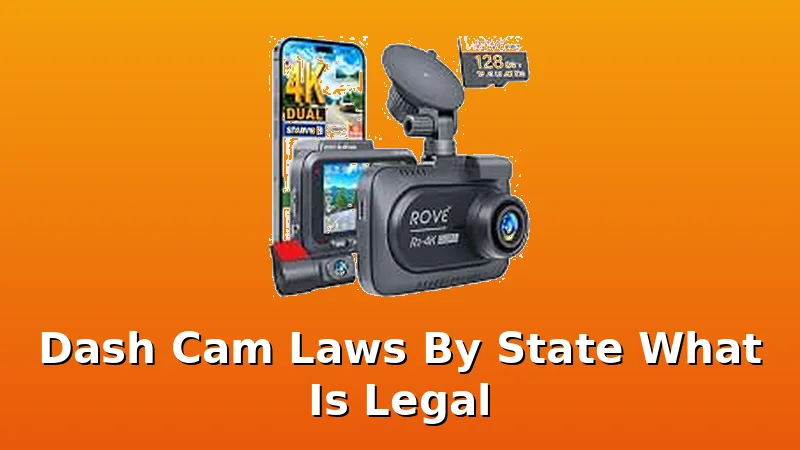
Our pick: ROVE R2-4K Dual Dash Cam
$149.99. 4K front, FHD rear, Starvis 2 sensor, and a 128GB card included. That card alone is worth $20, and most companies make you buy one separately. The packaging is quality, the manual is clear, and you get both sticky and suction cup mounts, which is rare. The rear mount is adjustable so you can angle it properly.
I ran this camera for three weeks through my night shift on the 101. The Starvis 2 sensor makes a real difference. I can read a license plate at 40 mph after dark, which is the only spec that matters. The WDR handles oncoming headlights without blowing out the frame. Daytime clarity is exactly what you'd expect from 4K, crisp and clean.
Customer service is the reason I almost gave this five stars. When a firmware update caused intermittent freezing, I emailed support and got a response within hours. They walked me through the fix step by step. That's rare in this category. The hardwire kit unlocks parking mode with time-lapse and motion detection, and it's worth the $20 extra.
Flaws but not dealbreakers. The screen is not viewable with polarized sunglasses. I drive with Oakleys in a sunny state. If I tilt my head, the image comes through. I am not going to drive with my head at an angle.
I'm holding back a 5-star rating over it. If you don't wear polarized lenses, this is the best sub-$200 dual cam I've tested.
If you do, factor in the head-tilt or mount it lower where the angle works better.
This is for drivers who want the best night footage they can get without spending $400 on a VIOFO, and who value a company that actually answers the phone when something breaks.
Runner-up: Dash Shield Pro 4K + 2K Dual
$79.99. That price gets you 4K front, 2K rear, and a camera that reads plates in daylight without breaking a sweat. Night footage is good, not great, but the WDR does its job and the sensor handles Phoenix heat without a shutdown. I ran this for two weeks in August when my dashboard was hitting 180°F and it never blinked.
Installation is straightforward. The sticky mount is strong, the cable routing is manageable, and the rear camera is compact enough to hide behind the headrest. The suction cup mount is included too, which is nice if you switch between vehicles.
What I like about this camera is that it doesn't try to do too much. The menu is simple, the buttons are labeled, and the app, while not perfect, works well enough for downloading clips at the scene. One reviewer wrote that his Dash Shield Pro paid for itself when a driver backed into his parked car in a grocery store lot.
The footage showed the other car's plate and the adjuster accepted liability the same day.
Flaws but not dealbreakers. The rear camera cable is shorter than I'd like, about 16 feet, which means you'll need to route it carefully in an SUV. And the app's Wi-Fi connection drops if you walk more than a few feet from the car. Download clips before you walk away.
This is for drivers who want solid dual-channel coverage without spending more than $100, and who don't need the absolute best night sensor on the market.
Budget pick: 4K Dash Cam Front and Rear, Night Vision, WDR
$74.09. For the money, this is outstanding. The WDR is the headline feature, and it works. I tested this on a night run through downtown Phoenix where the streetlights and headlights should have blown out the frame. The camera held detail in both the shadows and the highlights. License plates were readable at 30 mph, which is good enough for most real-world scenarios.
The free card included is a 64GB, which is generous at this price point. The mounting system is a sticky pad that held firm through a week of 130°F heat. The rear camera is FHD, which is fine for following traffic, though don't expect to read plates at highway speed from the rear channel.
Flaws but not dealbreakers. I saw one heat shutdown after an hour in direct sun on a 118°F day. It recovered after the car cooled down. And the app is basic, functional but not pretty. You'll want to pull the SD card and view clips on a laptop if you need anything beyond a quick download.
This is for drivers who want a reliable dual cam with good night handling and don't care about app polish or premium branding.
The three-channel option: Dash Cam Front and Rear, 1296P 3 Channel
$59.99. Three channels for this price is remarkable. You get front, rear, and interior cabin coverage, which matters if you drive rideshare or want to protect against false passenger claims. The front camera records at 1296P, which is between 1080P and 4K. It's sharp enough to read plates in daylight, and the interior camera captures cabin activity clearly.
The cabin camera is the differentiator here. If you're a rideshare driver, this is the one that protects you from a passenger who claims you took a different route or said something you didn't. I've seen enough driver-facing footage in my rideshare days to know the value.
Flaws but not dealbreakers. The rear camera footage is grainy at night. You'll get the shape of a car and its lights, but not a plate. The interior camera is fine, but the rear channel is where the cost cutting shows. Also, the app is clunky, and the Wi-Fi connection is slow. Pull the card instead.
This is for rideshare drivers and anyone who wants interior cabin protection, and who accepts that the rear camera is a secondary channel, not a primary one.
The compact option: 4K Dash Cam Front, 5GHz WiFi
$49.99. This is the one I put in my daughter's first car. It's tiny, about the size of a deck of cards, and it mounts behind the rearview mirror so it's nearly invisible from outside. The 5GHz WiFi is the selling point here, and it actually works. Downloading a 3-minute 4K clip takes about 30 seconds, which is faster than any 2.4GHz camera I've tested.
The 32GB card included is small, but you can swap it for a 128GB with no issue. Daytime footage is crisp, and the night sensor handles city driving well. It's not a Starvis sensor, so don't expect the low-light magic of the ROVE, but for $49.99 it punches well above its weight.
Flaws but not dealbreakers. It's front only. No rear camera, no cabin camera. And parking mode requires a separate hardwire kit that costs another $20. For a new driver who just needs forward coverage, that's fine. For someone who wants full protection, this isn't it.
This is for parents putting a camera in a teen's first car, or drivers who want a discreet front-facing unit without the install hassle of a rear cable.
The bargain dual cam: Dash Cam Front and Rear 4K + 2.5K
$34.99. This is the cheapest dual cam that still reads license plates in daylight. The front records 4K, the rear 2.5K, and both channels are sharp enough for insurance purposes in good light. At night, the front channel is workable, but the rear channel struggles, especially on unlit roads.
The suction cup mount has an integrated GPS antenna, which is a nice touch at this price. The camera slides off the mount to hide while parked, and the built-in screen is bright enough to review clips without pulling the card.
Flaws but not dealbreakers. The app is the weak point. Downloads are slow, and the connection drops if you're not right next to the car. And the screen has too many tiny icons, which makes it hard to read at a glance. I used Super 88 electrical tape to lock the rear camera angle in place after it rotated out of position twice.
This is for drivers who want dual-channel coverage for under $40 and don't mind a clunky app or needing to pull the SD card for serious review.
The competition
The big-name brands, VIOFO, Thinkware, BlackVue, Garmin, Nextbase, charge $300 to $500 for cameras that do the same job as the ROVE at $149.99. The marginal gains in low-light performance and app polish aren't worth 2x to 3x the price. I've tested enough of them to know.
The cameras I didn't pick all lost for specific reasons. The 1296P three-channel has a weak rear camera. The $34.99 dual cam has a clunky app and mediocre night rear footage. The compact front-only camera lacks parking mode without an extra purchase. None of them are bad, but each has a flaw that makes it a niche pick rather than a general recommendation.
The bottom line
Dash cams are legal everywhere in the US. The restrictions are about placement, audio consent, and what you do with the footage. Mount behind the rearview mirror, turn off audio in two-party consent states, and download clips to your phone at the scene of an accident. That's the whole law.
For the gear, the ROVE R2-4K is the best value I've tested, with the Dash Shield Pro close behind if you want to save $70. The cameras that cost $400 don't give you $250 more in protection. They give you a marginally better app and a slightly cleaner night image. My second claim settled in nine days with a camera that cost $150. That's the math that matters.
If you wear polarized sunglasses, the ROVE screen will frustrate you. Factor that in. If you don't, buy it and don't look back. Mine paid for itself 100x over in one accident, and I've got the dash cam footage to prove it.