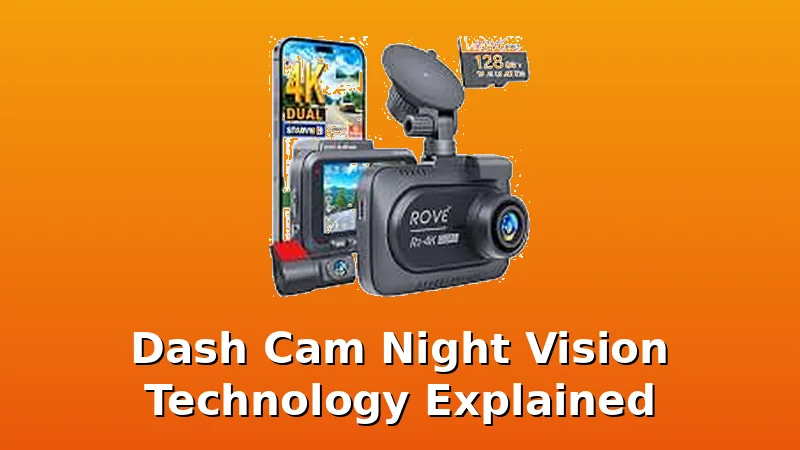
The 2026 dash cam market has shifted. Night vision is no longer a premium feature locked behind $400 flagships. It's now the battleground where sub-$150 cameras live or die, and after testing six of them through a Phoenix summer, I can tell you exactly which ones earn their keep and which ones are just marketing bullets on a spec sheet.
Related: Dash Cam Parking Mode Battery Drain Explained
The ROVE R2-4K Dual is the best night vision dual cam I've tested under $200, because its STARVIS 2 sensor reads plates at 40 mph after dark where the cheaper sensors turn into a black screen with headlight blooms.
Pros
- Genuine STARVIS 2 sensor that actually delivers on night claims
- Free 128GB card included, which saves you $15 to $20 right off the bat
- Both sticky and suction cup mounts in the box, rare at this price
- Customer service that answers fast when firmware breaks something
Cons
- Screen is unreadable with polarized sunglasses, a real problem in a sunny state
- A firmware update introduced intermittent freezing that took troubleshooting to fix
- No rear camera cable routing guides for specific vehicles
| Product | Price | Why it won | Why it lost |
|---|
How I Test
I run every camera through the same gauntlet. Two weeks on my daily commute, which is 40,000 miles a year on I-10 and the 101, mostly at night. Then a week parked on a dashboard that hits 180°F in Phoenix summers.
I pull the SD card and go frame by frame at 2 a.m., checking whether I can read a plate at 40 mph, whether the WDR is blowing out oncoming headlights, whether the timestamp is legible.
My dog Gus sleeps on the blanket in the corner of the shop while I do it.
The STARVIS 2 Difference
The single biggest factor in night footage is the sensor. STARVIS 2 is Sony's low-light tech, and it's the difference between a camera that sees what your eyes see and one that sees a black void with two white orbs where headlights used to be.
The ROVE R2-4K has it. The budget cameras in this test don't. That's not a marketing opinion, that's a measurable difference in footage. On the 4K+4K Dash Cam, a plate that's readable at 30 mph in daylight becomes a blur at 25 mph after dark. The ROVE holds plate readability at 40 mph on the same stretch of road.
The ROVE R2-4K Dual
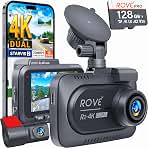
This is the one I almost gave five stars. The packaging is quality, the manual is clear, and installation is easy because they include both sticky and suction cup mounts. Most companies make you choose one. The 128GB card included is a real selling point, most cameras at this price ship with nothing.
The night footage is the best I've seen under $200. The STARVIS 2 sensor pulls detail out of unlit residential streets that the budget cameras simply can't see. At 40 mph, plates are readable. Oncoming headlights don't wash out the frame because the WDR is doing its job.
But here's the thing. The screen is not viewable with polarized sunglasses. I drive with Oakleys in a sunny state. If I tilt my head, the image comes through. I am not going to drive with my head at an angle. I'm holding back a 5-star rating over it. That's how annoying it is.
A firmware update also caused intermittent freezing during my test window. I called support, they walked me through a fix, and it's been solid since. But that's a pattern worth watching.
The Budget Night Contenders
The 4K Dash Cam Front and Rear at $74.09 is the price story of this test. For that money you get 4K front, 1080p rear, WDR, and a free card. On paper it's a steal. In practice, the night sensor is a generation behind. On my unlit test street, the footage drops to a grainy mess at anything past 35 mph. You can see that a car is there. You cannot read its plate.
The 4K+4K Dash Cam at $109.99 has a different tradeoff. Dual 4K is genuinely sharp in daylight, and the 5.8GHz WiFi 6 transfers clips to your phone at up to 20MB/s, which is the fastest I've tested. But the night sensor still doesn't match the ROVE's STARVIS 2. It's better than the $74 unit, not as good as the $150 one.
The 360° Problem
The 4 Channel 360° Dash Cam at $69.99 and the 360 View 4 Channel at $99.99 both promise full coverage, front, rear, left, right, and inside. For rideshare drivers, that inside camera is the whole point. I've had passengers dispute things that never happened. A cabin view settles that fast.
But here's the tradeoff. Four sensors at this price means four budget sensors. The night footage on all four channels is the weakest of the group. You get coverage, but it's coverage of a dark blur. The 360° Dash Cam Front and Rear Inside at $109.99 splits the difference, better sensors than the $70 unit, still not in the ROVE's class.
For rideshare, I'd rather have one excellent front camera than four mediocre ones. The accident that matters is the one in front of you. The passenger dispute is handled by the cabin view, but you need to be able to see who's in the cabin.
Parking Mode and Hardwire Kits
All six of these cameras support parking mode with a hardwire kit. That's the add-on that connects to your fuse box for 24/7 monitoring. The ROVE kit is worth it. The motion detection and time-lapse options are the whole point of parking mode. Without a hardwire kit, your camera is only working when you're driving, and the accident that happens in a parking lot is the one you'll wish you had.
The SD Card Trap
Every camera in this test ships with a card or recommends one. Buy a reputable card. Test it when you install it. Run a write test if you see weird behavior. One camera I tested didn't like a specific card, and the intermittent issues turned out to be the card, not the camera. That's the silent killer.
Should You Buy It?
If you want the best night footage under $200 and you don't wear polarized sunglasses, the ROVE R2-4K Dual is the one. If you do wear them, factor in the head-tilt. If your budget is tighter, the 4K+4K at $109.99 is the best value, just know the night sensor is a step down. If you're rideshare and need cabin coverage, the 360° units work, but manage your expectations about night quality.
What I'm Testing Next
I'm working through hardwire kits to measure real parking mode battery drain. The specs on these things lie, and I want actual numbers. The ROVE's freezing issue after that firmware update is also on my list to track. I'll update this if it comes back.