I got rear-ended on the 101 at 11 p.m. by a red-light runner who told the responding officer that I ran the light. No camera in the car that night. Three months of he-said-she-said, a premium increase I am still paying, and a lesson I have been working out ever since. My second rear-ender, a distracted driver at 45 mph, happened with a cheap cam stuck to the glass. That claim settled in nine days.
That contrast is the entire argument for thinking about dash cam setup essentials as a system instead of a shopping list. There is the witness on the windshield, the adhesive that keeps the witness on duty through a Phoenix summer, and then there is the body that spends 40,000 miles a year folded into a driver's seat with its neck cranked toward the mirror.
This comparison covers the four pieces I would put on a shortlist for a working driver: a four-channel 4K kit, heat-resistant mounting tape, and two recovery tools for the shoulders and low back that take the real beating. Two of these are not cameras, and I am not going to pretend otherwise.
Related: Dash Cam Heat Survival Guide: What Melts, What Survives
If you only buy one thing here, buy the camera. The Icesky 4K front, rear, left, and right kit is the only product on this list that can win an insurance argument. Everything else is support equipment, and support equipment is worth exactly what it protects.
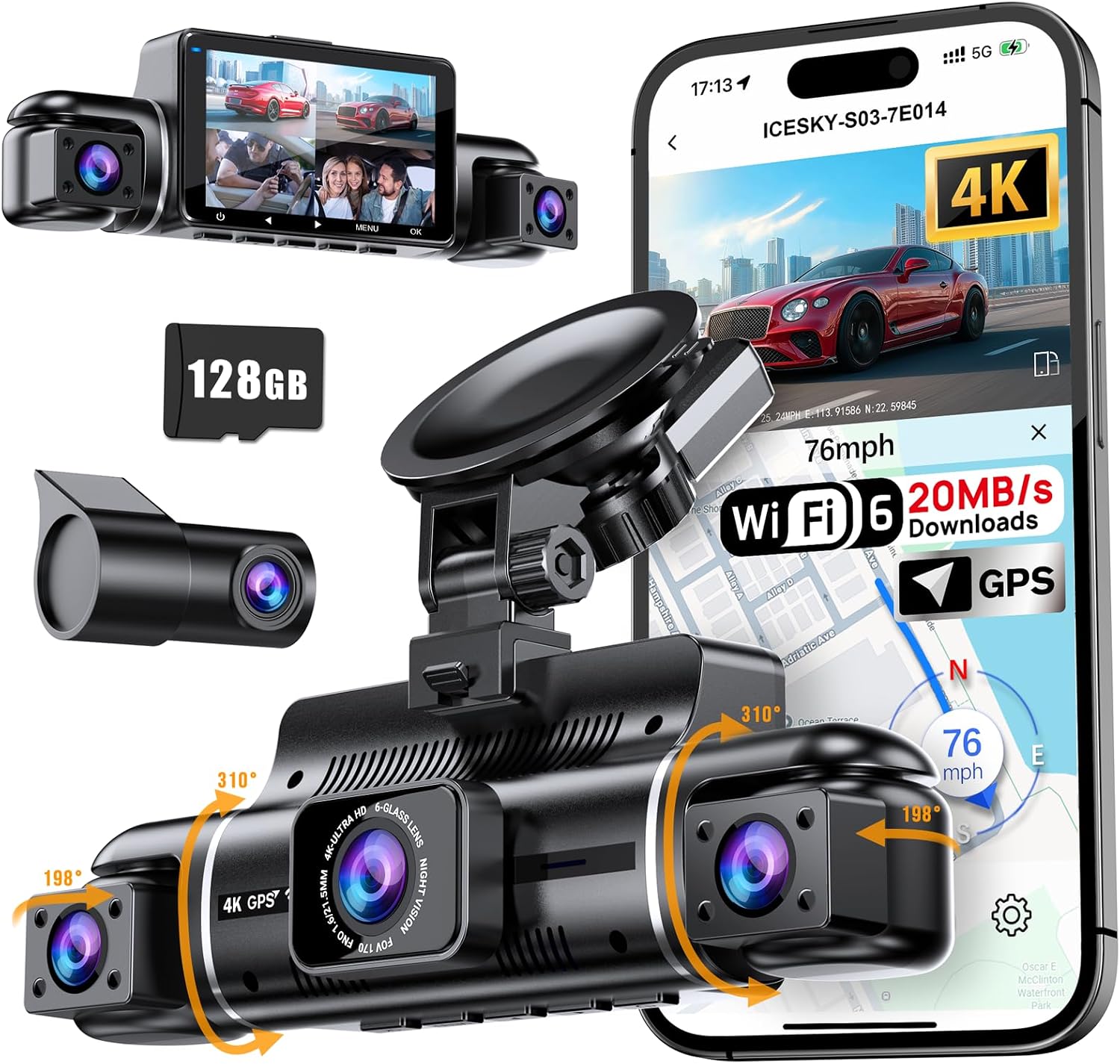
Icesky 4K Dash Cam Front and Rear Left Right with GPS, 20MB/s WiFi 6
Four camera positions in one kit, GPS for location and speed stamps, WiFi 6 at 20MB/s for pulling a clip fast
A 4K label means nothing without a bitrate and sensor check, and left and right channels take real routing time
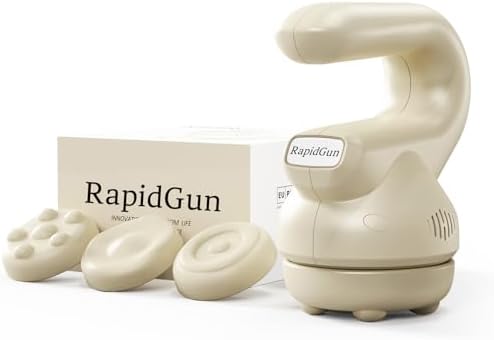
Prime Handheld Mini Orbital Therapy Massager - Rotating & Vibrating Deep Tissue Massager, Adjustable Multi-Speed Trigger Point Massage Tool for Body Pain Relief, Portable Muscle Recovery Gift
Rotating plus vibrating action reaches trigger points a flat pad misses, and it fits in a door pocket
Not a substitute for a full-size gun on large muscle groups

Double Sided Sticker Heat Resistance Tape for Pruveeo D90/A6/D88 Dash Cam
Heat-resistant adhesive targets the number one mount failure in a hot climate, and it costs less than lunch
Cut for specific Pruveeo mounts, so you have to verify your own footprint first
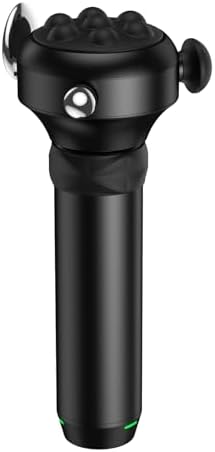
Pro Max Vibration Therapy Massage Gun, 6500RPM Handheld Deep Tissue Muscle Massager, Fascia Release Massage & Neck, Back & Full Body Pain Relief
6500RPM and full-body reach for post-shift recovery, with gift-friendly packaging
Bulkier than the mini, and more tool than you need if your only complaint is a stiff neck
Prices and availability were captured from Amazon Creators API and may change.
Why these four products sit in one conversation
A dash cam does not exist in isolation. It exists on a piece of glass that reaches 180°F on a Phoenix afternoon, held by an adhesive that was probably chosen to hit a price point. If the mount lets go, the camera keeps existing and stops witnessing. That is the failure nobody plans for, and it is why a strip of heat-rated tape belongs in the same cart as a four-channel camera.
The massage tools are here for a less technical reason. I drove rideshare full time for six years. Forty thousand miles a year, most of it at night, is a physical job disguised as sitting down. Your neck is rotated toward the mirror, your right shoulder is forward, your low back is locked against a seat that was designed for a crash test, not a 12-hour shift. I have watched drivers spend $400 on camera gear and zero dollars on the body that has to keep driving to pay for it.
So this list is deliberately mixed. One witness, one mount, two recovery tools. Buy the witness first. Everything after that is about keeping the witness recording and the driver in the seat.
The camera: the only piece that can win an argument
The Icesky kit is the one product on this list that changes the outcome of an accident. The listing describes a 4K dash cam with front, rear, left, and right coverage, GPS, and WiFi 6 at 20MB/s.
What each of those actually buys you:
Four camera positions is the headline. Most dual-channel cams see forward and back. Side coverage is what catches the lane-change swipe and the parking lot scrape that a front camera misses entirely. If you have ever had a driver deny a merge into your quarter panel, you know exactly what that angle is worth.
GPS is not a gadget feature, it is evidence. A timestamp that also records where you were and how fast you were moving is the difference between "I was not speeding" and a file that shows you were not speeding. Adjusters respond to data.
WiFi 6 at 20MB/s matters more than people think. It is the difference between standing next to your car for 30 seconds pulling a clip onto your phone and standing there for five minutes while the other driver's story hardens. Fast transfer is a real-world feature, not a spec sheet flex.
What I would verify before trusting it, because I do not trust a 4K sticker:
- The bitrate. A 4K file with a low bitrate looks worse than a good 1080p file. Nobody checks this number, and it is the number that decides whether you can read a plate at 20 feet.
- Night footage at 40 mph. Accidents do not happen at noon in perfect light. If the clip turns license plates into smudges after dark, the rest of the spec sheet is decoration.
- The sensor behind the lens. Pixels are marketing. Sensor size and light gathering are physics.
- Heat behavior. A week on a hot dashboard tells you more than any launch review.
The honest trade-off: four channels means four times the footage to review and a bigger card to budget for. Routing cameras to the left and right takes an afternoon of pulling trim. And 4K files eat storage fast, so plan on a high-endurance card and check the loop recording actually loops when the card fills.
The mount tape: the cheapest failure point on the glass
I keep every melted suction cup and every adhesive pad that let go in a drawer. It is a small museum of avoidable failures.
The Double Sided Sticker Heat Resistance Tape is the least glamorous product here and possibly the most useful per dollar. It is replacement mounting adhesive cut for the Pruveeo D90, A6, and D88 dash cams. Check current Amazon price, and compare that to the cost of a camera that slid off the windshield at 2 a.m. and recorded nine hours of your floor mats.
Heat is what kills adhesive. A suction cup that holds fine in March is a projectile in July. The heat-resistant rating is the whole point of this tape, and it is the reason I would rather buy a purpose-made pad than cut a square off a roll from the hardware store.
Two caveats, and they are real. First, this is a model-specific fit. If you drive something else, measure your mount plate before ordering, because a pad that is 3mm off will not hold a camera. Second, adhesive is only half the job. Clean the glass with isopropyl alcohol, let it flash off completely, mount out of direct sun, press and hold for a full 30 seconds, and let it cure overnight before you hang the camera on it. Do that and most mount failures never happen.
The recovery tools: two ways to undo a long shift
Neither of these is a dash cam. I am not going to dress them up as one. They are here because the driver is part of the system, and because a stiff neck at mile 300 makes for worse decisions than a clean windshield.
The Prime Handheld Mini Orbital Therapy Massager is the glovebox option. It rotates and vibrates, with adjustable multi-speed settings, and it is small enough to live in a door pocket. The rotating action is what separates it from a plain vibration pad: it works into a specific trigger point instead of just buzzing the surface. For the spot at the base of your neck that seizes after four hours of mirror-checking, or the forearm that cramps from gripping the wheel in traffic, it is the tool I would reach for first. The trade-off is power. On a big muscle group like a low back or a quad, it is a warm-up, not a finish.
The Pro Max Vibration Therapy Massage Gun is the opposite trade. It runs up to 6500RPM and is built for deep tissue work and fascia release across the neck, back, and full body. If your post-shift routine is 10 minutes on the couch working through your whole back, this is the tool that does it in one pass, and the packaging makes it an easy gift for the driver in your life. What it costs you is size and noise. It does not live in a door pocket, and if your only issue is a knot behind one shoulder blade, the mini gets you there for less.
One thing I will say plainly, because I have made this mistake: no massage tool fixes a bad seat position. Set your seat so your wrists rest on top of the wheel with a slight bend, bring the mirror to you instead of craning to it, and then use the tool. Otherwise you are treating a symptom every night.
Trade-offs worth naming before you spend
Coverage versus effort. Four channels is the most complete record you can buy, and it is also the most install work. If you are not willing to route cables, a two-channel setup installed properly beats a four-channel kit with a camera dangling by its wire.
Cost versus protection. The camera is the expensive line item and the tape is nearly free. Skipping the cheap item to save money is how people end up with an expensive camera that spends August on the passenger seat.
Power source. If a camera you are considering packs a lithium battery instead of a capacitor, think hard about a hot climate. Batteries swell, and a swollen battery is a camera that stops working without warning.
Storage. The card is the most important part of the system and the one people spend the least on. A normal card in a constant-recording camera corrupts eventually, and it will corrupt at the moment you need the file. Buy high endurance, verify the rating on the card itself, and replace it on a schedule.
What I verify before I trust any windshield setup
Night footage at 40 mph, because that is when it matters.
Plate readability, not resolution numbers.
Bitrate, not the pixel count on the box.
A week of heat soak on a hot dashboard, watching for shutdowns.
Whether the camera keeps looping when the card fills, because silent loop failure is a real and common problem.
Whether GPS data lands accurately on the clip.
Whether the app needs an account to hand you your own footage. It should not.
Who should buy what
If you drive for a living, buy the camera first, and buy it before you need it. Add the heat-resistant mounting tape if you run a Pruveeo D90, A6, or D88 and your current pad has already softened. Add the Pro Max massage gun if your recovery routine is a full-back session after long shifts. Add the mini orbital if you want something small, adjustable, and portable that lives in the car for the spot that seizes mid-shift.
If you are a weekend driver who parks in a garage and drives 20 minutes to work, you need less than this. A solid single-channel cam and a good card will cover you.
Bottom line
The camera is the witness. The tape is what keeps the witness on duty. The recovery tools are what keep the witness driving. Buy them in that order, verify the bitrate and the night footage before you trust any camera with your insurance claim, and do not let a $6 piece of adhesive be the reason your footage does not exist.