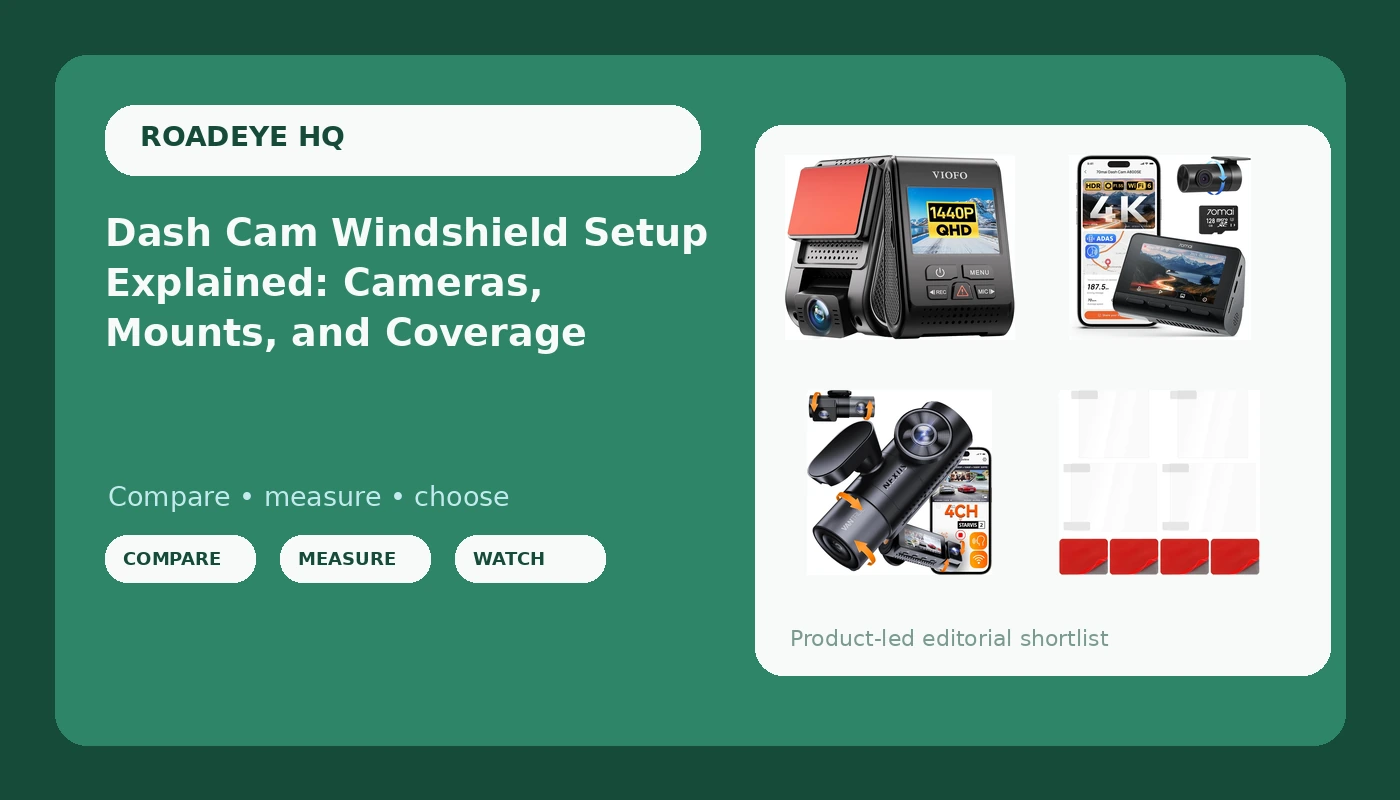
A dash cam windshield setup fails in pieces, and the piece that fails is rarely the one people researched. The camera takes the credit and the blame, but the clip you need six months from now depends on four things working together: how many directions the camera can see, whether it survives a parked car in summer heat, whether the memory card can keep writing without corrupting, and whether the mount still holds the lens where you aimed it. Most buyers shop the resolution printed on the box and never think about the other three. That is the gap this explainer is built to close.
Related: Dash Cam Night Footage: What to Look For Before You Buy →
Quick answer
Match the camera to the coverage you actually need, then spend the leftover attention on heat tolerance, a high-endurance memory card, and a mount that can come off the glass without damage. A single-channel 2K camera with GPS covers the front of the car for most drivers. A front-and-rear kit adds the view behind you. A four-channel system covers all sides, at the cost of more wiring, more storage pressure, and more footage to review after an incident. An electrostatic film sits between the mount and the windshield so the whole setup can be repositioned or removed cleanly.
Four useful options
| Model | Best fit | What stands out |
|---|---|---|
| Vantrue N5 4 Channel WiFi 360° All Sides Dash Cam | Drivers who want every side of the car covered | Four channels in one system with Wi-Fi and all-sides positioning |
| 70mai 4K Dash Cam Front and Rear (A800SE) | Front and rear coverage from a single kit | 4K front recording, Wi-Fi 6, GPS, ADAS, 3 inch IPS screen, 24H parking mode, time-lapse, loop recording, and a 128GB card included |
| VIOFO A119 V3 Dash Cam | A simple, single-view front camera | 2K front recording, GPS, and True HDR |
| Thinp 4 Pcs Electrostatic Film for Dash Cam | Anyone mounting, moving, or removing a camera | Four clear electrostatic films, double-sided sticky pads, and an adhesion promoter |
Most coverage: Vantrue N5 4 Channel WiFi 360° All Sides Dash Cam
The trade-off with a four-channel camera is not the hardware, it is the workload. Four streams mean four files per incident, four angles to scrub through, and roughly four times the storage demand of a single-channel camera, which shortens how far back your card reaches before it starts overwriting the oldest footage. Installation is also more involved, because a system covering all sides has to route more cable. If you want the fullest picture of what happened around the car, this is the category that delivers it. If you mostly need to prove who hit whom from the front, you are paying for angles you will never open.
Front and rear: 70mai 4K Dash Cam Front and Rear (A800SE)
Rear coverage is the upgrade most drivers skip and later regret, because rear-end and parking-lot incidents are exactly the ones where a forward camera sees nothing useful. Two things to weigh here. First, the included 128GB card is convenient, but any card doing constant loop recording in a hot car lives and dies by its endurance rating, so confirm what is printed on the card itself rather than assuming. Second, 24H parking mode only works if the camera is hardwired to a fuse that stays live with the ignition off; plugged into a cigarette lighter, it stops when the car does. The 4K front channel also produces larger files than a 2K camera, which matters when you are deciding how many hours of history you want on the card.
Simple front view: VIOFO A119 V3 Dash Cam
The argument for a single-channel camera is that it does the job most drivers actually need with the fewest failure points. One lens, one card, one power connection, no rear cable to snag on a seat bracket. GPS matters more than people expect, because a clip with a timestamp and a speed reading is harder to argue with than a clip without one. HDR matters at night, where headlights, streetlights, and reflective plates blow out a normal exposure. The obvious limit is that a front camera proves what happened in front of you and nothing else, so if you regularly carry passengers or park in crowded lots, this is a partial answer rather than a complete one.
Mounting layer: Thinp 4 Pcs Electrostatic Film for Dash Cam
The reason this accessory exists is that dash cam adhesive is permanent in the wrong way. It holds fine until you want the camera gone, at which point you are scraping residue off glass with a razor blade, or discovering that a suction cup let go on a hot afternoon and the camera is now dangling by its power cable. A film layer gives you a clean interface: the pad sticks to the film, the film clings to the glass, and repositioning means peeling the film instead of fighting the mount. The adhesion promoter is there to help the pad hold in the first place. It is a few dollars of insurance against a messy windshield, not a substitute for a mount that was already failing.
Prices and availability may change. Product images, names, and retailer links must be matched by verified ASIN. Do not state a current price, rating, stock status, or measured result without current evidence.
Why the mounting layer fails before the camera does
Dash cams rarely die of electronics. They die of heat, gravity, and vibration, and all three attack the mount first. A parked car in a Phoenix summer turns the dashboard into an oven, and every material in the chain reacts differently: suction cups soften and lose grip, pressure-sensitive adhesive creeps, and cheap plastic brackets go brittle. The camera itself may be perfectly healthy while the lens is pointed three inches lower than it was last week, which is the worst outcome, because you will not notice until you need the clip.
Glass preparation decides most of this. Windshield glass carries a film of interior plasticizer and dust that adhesive does not like, so a wipe with isopropyl alcohol and a minute of drying does more for mount longevity than any upgrade you can buy. Placement matters too: the black dotted frit band around the edge of most windshields is a poor bonding surface, and mounting there is a common reason a camera drops in month two. A film layer between pad and glass gives you a removable interface, so a failed pad means replacing a film instead of scraping cured adhesive off the windshield. If the camera has to come out for a lease return, a rental, or a trade-in, that difference is the entire job.
Coverage, resolution, and what footage actually proves
The number on the box is not the number that matters. A 4K label describes pixel count, not how much detail survives compression, and a high-resolution camera with a low bitrate can look worse than a well-tuned 2K camera when you freeze a frame on a plate at 40 mph. Field of view works the same way in reverse: a very wide lens takes in more of the scene but shrinks every plate and face in it, which is why something in the 140 degree range is the usual compromise between seeing the side of your car and being able to read a tag.
Coverage is a separate decision from image quality, and it is the one people get wrong. Front-only proves what happened ahead of you. Front and rear proves the rear-end collision that a forward camera cannot see. All-sides coverage proves the lane change and the parking lot scrape. Every channel you add costs storage, because loop recording overwrites the oldest footage first and more streams means less history on the same card. That is why the card is not an afterthought: a high-endurance card rated for constant recording and heat is the difference between a clip that exists and a clip that is corrupt.
- Decide what you need to prove: front only, front and rear, or every side of the car.
- Match the channel count to that answer instead of buying the largest number available.
- Check how the camera handles heat, and prefer a design that is not dependent on a lithium battery sitting on a hot dashboard.
- Budget for a high-endurance memory card, and verify that rating on the card itself.
- Plan the mount before the install: clean glass, avoid the dotted frit band, and use a film layer if you may ever remove the camera.
Practical guidance
- Wipe the mounting area with isopropyl alcohol and let it dry completely before any pad touches glass.
- Avoid the black dotted frit band at the edge of the windshield, which is a poor surface for adhesive.
- Confirm the card's high-endurance rating on the card, not on the listing, before trusting it with months of loop recording.
- Hardwire to a fuse that stays live with the ignition off if you want parking mode; the cigarette lighter socket cuts power with the car.
- Pull a random clip every few weeks and watch it, so you find out about a corrupted card or a shifted lens before you need the footage.
Which option should you choose?
Choose the Vantrue N5 4 Channel WiFi 360° All Sides Dash Cam when you want every side of the vehicle recorded and you are willing to handle the extra wiring and the larger storage demand. Choose the 70mai 4K Dash Cam Front and Rear (A800SE) when front and rear coverage is enough and you want a dual-channel kit that arrives with a card and a screen. Choose the VIOFO A119 V3 Dash Cam when you want a straightforward front camera with GPS and HDR and no rear cable to run. Add the Thinp 4 Pcs Electrostatic Film for Dash Cam when the camera will be mounted, moved, or removed, and you would rather peel a film than scrape adhesive.
None of these choices fixes a weak card or a lazy install, and no camera here should be described as the best at anything without evidence from your own windshield. Night footage at speed, heat behavior in a parked car, and real battery drain in parking mode are the questions that decide whether a setup works, and they can only be answered by watching your own clips and checking your own car.
The bottom line
A dash cam windshield setup is a chain, and the camera is only one link. Decide how many directions you need to record, pick the camera that matches, then treat the card, the power source, and the mounting layer as part of the purchase rather than accessories you will get to later. The driver with a modest single-channel camera, a high-endurance card, and a mount that has not moved in a year is better protected than the driver with four channels, a cheap card, and a lens aimed at the hood.