A dual-channel dash cam records the road ahead and the road behind on two separate cameras feeding one system. The reason that matters has nothing to do with the spec sheet and everything to do with the claim. A rear-end hit, a lane-change sideswipe, or a red-light argument turns on what happened behind or beside your bumper, and a single forward-facing lens can only tell half of that story. Shopping for a dual-channel dash cam setup also raises questions a single camera never asks: how much resolution the rear camera really needs, how two channels share one memory card, whether the rear cable will fit through your trim, and whether the whole system survives a car parked in summer heat.
Related: How to Hardwire a Dash Cam for Parking Mode →
Quick answer
A dual-channel dash cam is worth the extra cost when you want one recording that documents both ends of the car. The resolution split matters less than the sensor behind it and the night footage it produces. A 4K front camera paired with a 2K rear camera captures the most detail for reading plates, while a 4K front and 1080p rear arrangement costs less and still documents the scene. If you also want the cabin in frame, a three-channel unit covers front, rear, and interior from one housing. Whatever you pick, budget for a high endurance memory card and a mount that holds, because the camera is only as dependable as the parts feeding and holding it.
Four useful options
| Model | Best fit | What stands out |
|---|---|---|
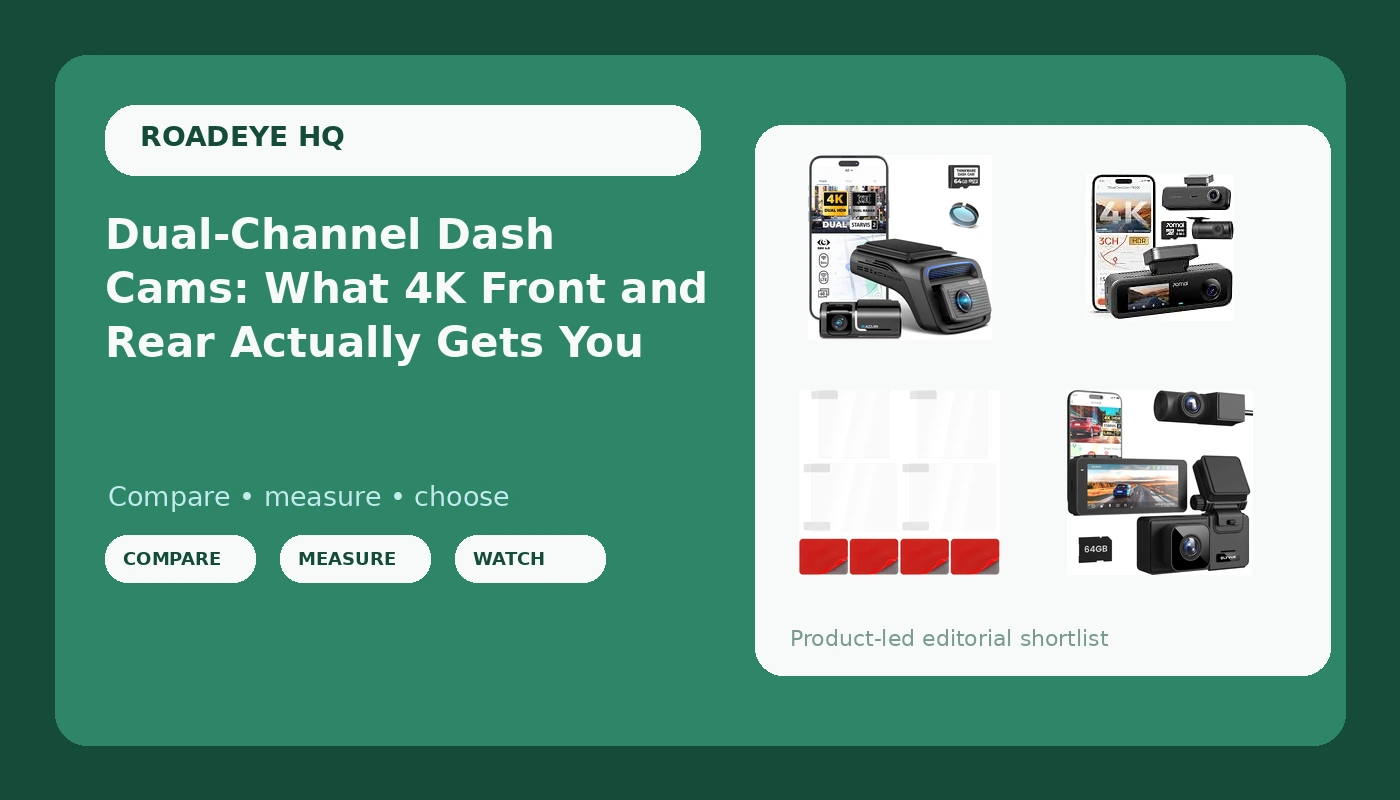
| THINKWARE U3000 PRO Dash Cam 4K Front and 2K Rear, Dual STARVIS 2 | Drivers who want a flagship two-channel system | 4K front and 2K rear recording with a dual STARVIS 2 sensor specification |
| Dash Cam Front 4K Rear 2K Dual STARVIS 2 Sensors Car Camera | Drivers who want dual STARVIS 2 sensors in a small housing | Front 4K and rear 2K, 5.8G Wi-Fi, 24H parking mode, and a 64GB card included |
| 70mai 4K Dash Cam Front and Rear Inside (T800E) | Drivers who want the cabin covered as well | Three channels, GPS, Wi-Fi 6, voice control, parking monitor, and a 64GB card included |
| Thinp 4 Pcs Electrostatic Film for Dash Cam | Anyone mounting or moving a camera between windshields | Four electrostatic film pads plus an adhesion promoter |
Flagship dual-channel option: THINKWARE U3000 PRO Dash Cam 4K Front and 2K Rear, Dual STARVIS 2
The trade-off here is straightforward: this is the most capable recording arrangement in the group, and it is also the one that asks the most of your install and your memory card. Two high-resolution streams mean more data written per minute, which shortens the loop before the card overwrites the oldest clip and puts more pressure on card endurance. Plan on a high endurance card sized for the recording time you actually want, not the largest card on the shelf. If you intend to use parking mode, the camera needs a hardwired power source rather than a cigarette lighter that dies with the ignition.
Midrange dual-sensor option: Dash Cam Front 4K Rear 2K Dual STARVIS 2 Sensors Car Camera
This one sits in the middle of the group and makes its case on footprint. A small housing is easier to tuck behind the mirror where it does not block your view or advertise itself to a passenger, and the included card means you can test the system the day it arrives instead of waiting on a separate order. The things to verify before you commit are the ones the listing cannot settle for you: how the night footage reads at highway speed, whether the rear cable is long enough for your vehicle, and whether the parking mode behavior matches how you park. Treat the bundled card as a starting point and replace it with a high endurance card once you know the camera is a keeper.
Three-channel option: 70mai 4K Dash Cam Front and Rear Inside (T800E)
The interior channel is the reason to look at this one. Rideshare and delivery drivers have a different evidence problem than commuters: the dispute is often about what happened in the back seat, who was in the car, or how a fare or delivery was handled, and a forward lens is useless for that. Three channels also mean three streams sharing one card, so loop time shrinks further and the card becomes the most disposable part of the whole system. Voice control and Wi-Fi 6 are conveniences that matter more than they sound like they do when the camera is mounted out of easy reach.
Prices and availability may change. Product images, names, and retailer links must be matched by verified product code. Do not state a current price, rating, stock status, or measured result without current evidence.
Mounting accessory: Thinp 4 Pcs Electrostatic Film for Dash Cam
This is the least glamorous item here and the one that solves a problem every dash cam owner eventually runs into. Adhesive mounts bond to glass, and when you remove the camera you either fight the residue or risk the tint and defroster lines. An electrostatic film pad gives you a removable layer between the adhesive and the windshield, so you can reposition the camera, move it to another car, or swap cameras without scraping the glass. It is also cheap insurance for anyone who changes cameras often or lives somewhere the dashboard bakes in the sun.
Channels, sensors, and the numbers that decide your footage
Two channels means two cameras and two video streams written to the same card. The front camera is the one that reads plates and traffic signals. The rear camera is the one that proves who hit whom from behind. Resolution is the number buyers notice first, but sensor size and bitrate decide whether a 4K frame is actually usable. A 4K stream with a low bitrate can look softer than a well-implemented 1080p stream, and a small sensor pushed into 4K produces noise in low light that no amount of processing cleans up.
STARVIS 2 is a sensor family built for low-light sensitivity, and HDR processing helps hold detail when headlights and dark road share the same frame. Field of view matters too. Around 140 degrees is a practical balance, because a wider lens stretches the edges of the frame and turns distant plates into smudges, while a narrower lens misses the side of your own car. When you compare two cameras, compare the night clip at speed. If a plate is not readable at 40 mph in the dark, the daytime footage will not save the purchase.
Heat, power, and mounting: the parts that fail first
Most dash cams do not die in a collision. They die parked in the sun. A camera that runs on a lithium battery is the wrong design for a hot climate, because the battery sits on a dashboard that can reach temperatures far above what it was built for, and heat damage shows up as swelling, shutdowns, or a camera that quietly stops recording. Capacitors are the heat-tolerant power design, and they are the reason a camera can keep working through a summer.
Parking mode is a separate promise with a separate cost. A camera watching the car while the ignition is off has to be powered from a source that stays live, which means a hardwire kit and a fuse tap rather than the cigarette lighter. That setup also draws from the car battery, so the camera's voltage cutoff setting is what keeps a parked car from becoming a jump start. Suction cups and cheap adhesive let go in heat, which is where a film-backed mount earns its place. And the card is the component people spend the least on and blame the most: loop recording only protects you if the card is still writing when the clip you need happens.
How to choose in five steps
- Decide what you need the footage to prove. Rear-end and lane-change disputes need a rear channel. Rideshare and delivery work often needs a cabin channel.
- Pick the channel count before the resolution. Two channels cover the car. Three channels cover the car and the people in it.
- Check the sensor and HDR specification, not the resolution sticker, and compare night footage at highway speed.
- Plan the power. Cigarette lighter for driving only, hardwire kit with a voltage cutoff if you want parking mode.
- Budget for the card and the mount. A high endurance card and a mount that survives heat protect the whole investment.
Practical guidance before you order
- Mount the camera high, behind the mirror, inside the wiper sweep, and aim it slightly down so the horizon sits in the upper third of the frame.
- Buy a high endurance card rated for constant recording and heat, then format it in the camera rather than on a computer.
- Run the rear cable along the headliner and down the trim, and leave slack at the hatch or trunk hinge so the cable does not flex and break.
- Test the night footage yourself within the return window: a plate at 40 mph in the dark is the only spec that matters.
- Check the card every month. If the newest clip is not from today, the loop stopped and you are driving without a witness.
Which option should you choose?
Choose the THINKWARE U3000 PRO Dash Cam 4K Front and 2K Rear, Dual STARVIS 2 when you want the highest resolution split on both channels and you are willing to install it properly and feed it a high endurance card. Choose the Dash Cam Front 4K Rear 2K Dual STARVIS 2 Sensors Car Camera when you want the same front 4K and rear 2K layout in a small housing that disappears behind the mirror. Choose the 70mai 4K Dash Cam Front and Rear Inside (T800E) when the cabin matters as much as the road, which is usually the case for rideshare and delivery drivers. Add the Thinp 4 Pcs Electrostatic Film for Dash Cam when you move cameras between vehicles, rent, or want to pull a mount off the glass without scraping adhesive.
No camera in this group can be called the best choice for everyone, because the right answer depends on your parking situation, your climate, and what you need the footage to prove. Verify the current specifications, included accessories, and compatibility with your vehicle on the product page before you buy.
The bottom line
A dual-channel dash cam exists to settle arguments you cannot settle with your memory. The front channel shows what you did, the rear channel shows what was done to you, and the sensor and card quality decide whether either clip is worth handing to an adjuster. Buy the channel count that matches your actual risk, mount it where it holds through summer, and treat the memory card as a wear item rather than an afterthought. That combination is what turns a windshield gadget into an insurance witness.