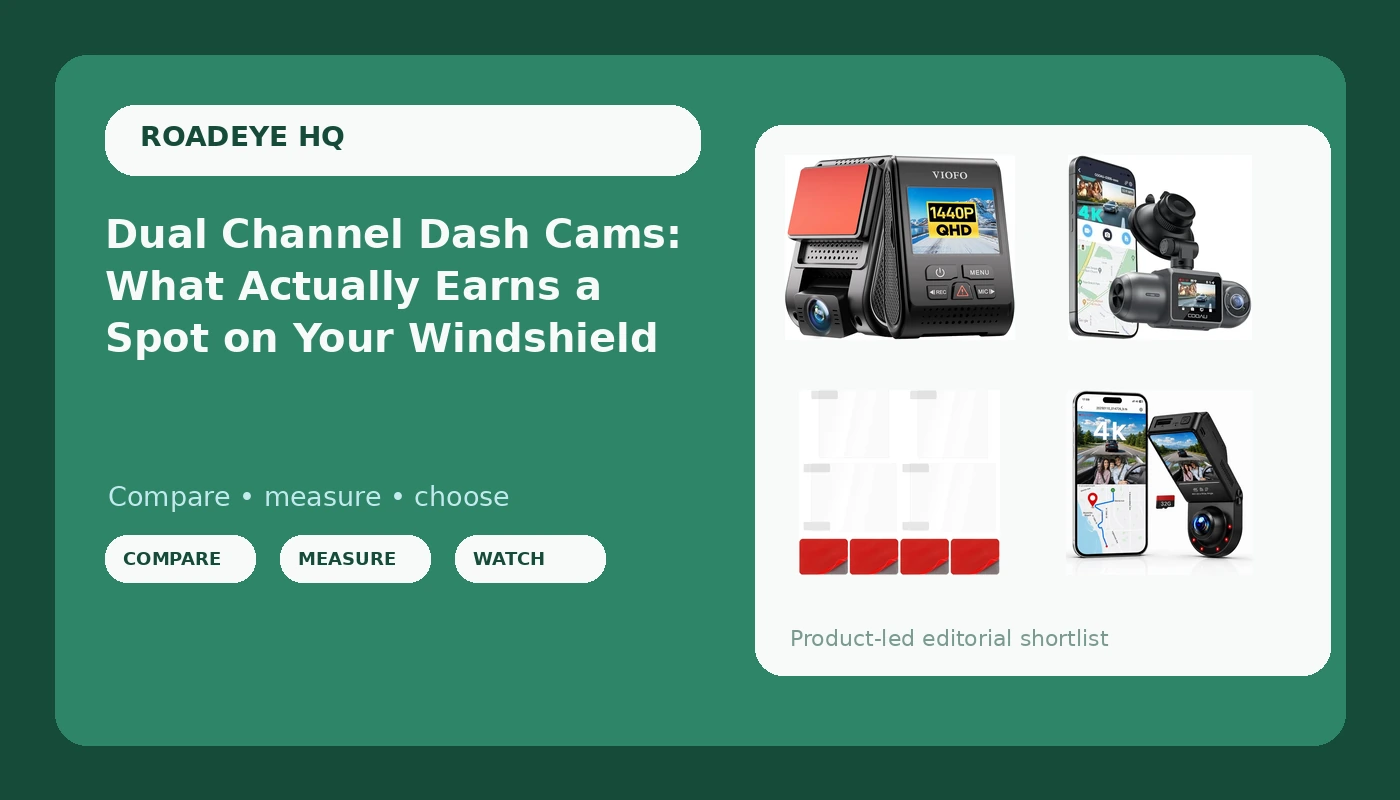
Most people shop for a dash cam by comparing resolution numbers, then find out after the first close call that resolution was never the deciding factor. The spec that changes what your footage can actually prove is channel count. A single-channel camera watches the road ahead. A dual channel dash cam watches the road and the cabin at the same time, and for anyone who carries passengers, that second view is the one that settles an argument about what was said or done inside the car. The four products below cover the realistic range of that decision: a front-only camera built around image quality, two front-and-inside cameras with very different documented feature sets, and the small piece of mounting hardware that keeps any of them stuck to a windshield in July.
Related: How to Hardwire a Dash Cam for Parking Mode Without Draining Your Battery →
Quick answer
If your priority is the clearest possible view of the road ahead and you do not carry passengers, a single-channel camera such as the VIOFO A119 V3 is the simpler path, since all of its recording capacity goes to one feed. If you drive for a rideshare platform, carry family members, or just want a record of the cabin, choose a two-channel camera: the COOAU D30S documents a supercapacitor and infrared cabin lighting, while the 360° Dash Cam lists front and inside coverage in a single 2-channel body. Neither two-channel camera is automatically the right one for you, because they differ in which features their listings actually document. The Thinp electrostatic films are not a camera at all; they are the mounting layer you buy when factory adhesive fails or when you want to move a camera between vehicles without leaving residue behind.
Four useful options
| Model | Best fit | What stands out |
|---|---|---|
| VIOFO A119 V3 Dash Cam | Front-only evidence capture | 2K front recording with GPS and True HDR |
| COOAU D30S 4K Dash Cam | Front and cabin coverage in one unit | Supercapacitor power, 4 IR LEDs, parking mode |
| 360° Dash Cam Front and Inside 4K+2.5K | Budget two-channel setup | Marketed as 4K front plus 2.5K cabin in one 2-channel unit |
| Thinp 4 Pcs Electrostatic Film for Dash Cam | Protecting or replacing windshield adhesive | Four electrostatic films plus an adhesion promoter |
The front-only reference: VIOFO A119 V3 Dash Cam
A single-channel camera makes a trade you should make on purpose. Everything it records goes into one video file, so nothing is split between a front lens and a cabin lens. When the only question that matters is what happened in front of your bumper, that simplicity is the whole point: there is no second view to check, no second file to hand over, and no ambiguity about which clip covers the moment of impact. HDR matters here more than the resolution figure does. A camera that holds detail in a bright sky and a shadowed license plate at the same time gives an adjuster something readable, while a camera that clips the highlights gives you a white rectangle where the plate should be. The cost of the trade is cabin coverage. If a passenger dispute, a traffic stop, or an incident behind your seat is a realistic scenario for you, this camera cannot help with it, no matter how good the front footage looks.
The cabin-facing option: COOAU D30S 4K Dash Cam
The detail worth reading twice on this listing is the power source. A supercapacitor stores charge without the lithium chemistry that swells and fails when a parked car turns into an oven, which is the failure mode that quietly kills cameras in hot states long before the footage ever matters. Infrared cabin lighting is the second meaningful item, because a cabin lens with no IR illumination records a black rectangle at night, which is exactly when most rideshare incidents happen. Parking mode is listed as well, and that is the feature people misunderstand most: it only functions if the camera keeps receiving power while the ignition is off, which usually means a hardwire kit rather than the cigarette lighter. GPS and Wi-Fi cover the practical side, giving the file a location and speed reference and letting you pull a clip to your phone without removing the card.
The budget two-channel: 360° Dash Cam Front and Inside 4K+2.5K
This is the camera to consider when you want two views and the listing's headline numbers are the main thing you have to go on. Treat the resolution figure as a starting point rather than a conclusion, because a 4K label describes pixel dimensions and says nothing about how much data the camera writes per second. Two cameras can both say 4K and produce very different footage, and the one that looks sharper is often the one with the higher bitrate, not the one with the bigger number on the box. What this unit does offer is structural: a single body holding both lenses means one mount, one power cable, and one card, which removes a surprising amount of installation friction compared with running two separate cameras. If cabin coverage is the requirement and you want the least complicated hardware path to it, that packaging is the argument in its favor.
The mounting fix: Thinp 4 Pcs Electrostatic Film for Dash Cam
Nobody adds a mounting film to a wishlist, and it is the part that decides whether the camera is still on the glass when you need it. A clear film goes on the windshield first, and the camera's adhesive pad sticks to the film rather than to the glass itself, which does two useful things. It gives the adhesive a clean, consistent surface, and it means the day you remove or relocate the camera you peel the film instead of scraping cured adhesive off your windshield with a razor. The adhesion promoter matters more than the film on a dusty or treated windshield, since it is what makes the first bond reliable. A four-pack also gives you spares, which is realistic, because a pad that has been pulled off once rarely holds as well the second time.
Prices and availability may change. Product images, names, and retailer links must be matched by verified ASIN. Do not state a current price, rating, stock status, or measured result without current evidence.
What channel count actually changes
Channel count is not a quality upgrade, it is a coverage decision, and it comes with a real cost. A two-channel camera has to process, compress, and write two video streams at once, so the second view is usually the one that gives ground. Look at the listings above and you can see the pattern: the COOAU D30S pairs its front camera with a lower-resolution inside view, and the 360° unit does the same with its cabin lens. That is normal engineering rather than a flaw, but it means you should not expect the cabin footage to look like the front footage.
The second consequence is storage. Two streams fill a memory card roughly twice as fast, which turns loop recording from a background detail into something you actually have to think about. A card that has been overwritten thousands of times in a hot car is the most common single point of failure in a dash cam system, and it fails silently: the camera keeps showing a recording light while writing corrupted files. The fix is a high endurance card, which is rated specifically for constant write cycles and heat, and formatting it in the camera rather than on a computer.
Field of view is the third variable, and wider is not better. A 140-degree lens is the usual sweet spot, because it covers the lanes beside you without pushing everything so far away that a plate becomes an unreadable smear at the edges of the frame. The camera with the widest lens on paper is often the one with the least useful evidence in practice.
Heat, power, and the windshield: a five-step decision method
- Decide whether you need cabin coverage at all. If you never carry passengers and never drive for a platform, a single-channel camera such as the VIOFO A119 V3 puts all of its resources into the one view that matters.
- Check the power source in the listing. A supercapacitor, like the one the COOAU D30S documents, is the specification that survives a dashboard that sits at oven temperature all afternoon.
- Match the camera to your climate and parking situation. A camera that lives in a garage in a mild climate has a much easier life than one parked in full sun in the Southwest.
- Plan parking mode before you buy, not after. If you want the camera recording while parked, budget for a hardwire kit and a fuse tap, and accept that it draws from the battery.
- Budget for the parts nobody advertises. A high endurance memory card and a mounting film like the Thinp pack cost far less than the camera and are the two items most likely to determine whether your footage exists.
Before you buy: practical checks
- Confirm the mount type. Suction cups release in heat; adhesive mounts hold but are semi-permanent, which is where an electrostatic film earns its place.
- Buy the card with the camera, not later. Get one rated high endurance and format it inside the camera on first install.
- Test the app before you rely on it. Download a clip over Wi-Fi in your driveway and see how long it takes and whether it demands an account.
- Verify loop recording is actually looping. Check the oldest file on the card every few weeks; if it is not from the last day or two, recording has stopped.
- Aim the camera with the car parked and the ignition on. Use the live view, confirm the hood line sits low in the frame, and tighten the mount down properly.
Which option should you choose?
Choose the VIOFO A119 V3 Dash Cam when you want a front-only camera and your priority is a clear, GPS-tagged record of the road ahead. Choose the COOAU D30S 4K Dash Cam when you carry passengers and want the cabin covered, with infrared lighting for night and a supercapacitor for heat. Choose the 360° Dash Cam Front and Inside 4K+2.5K when you want front and cabin coverage from a single unit and the documented 4K and 2.5K figures match what you are looking for. Add the Thinp 4 Pcs Electrostatic Film for Dash Cam whichever camera you pick, so the adhesive has a proper surface and removal does not mean scraping glass.
One caveat applies to all four. Spec sheets and listing text tell you what a product is designed to do, not how it performs in your car, in your climate, with your card. Verify the numbers that matter to you, keep your expectations tied to what the listing documents, and treat any resolution claim as a question to investigate rather than an answer.
The bottom line
The decision comes down to one question: do you need a record of the cabin, or only of the road? Answer that first and the field narrows immediately. A front-only camera gives everything to one view and keeps the system simple, while a two-channel camera buys cabin coverage by splitting processing, storage, and resolution between two lenses. Whichever way you go, the supporting parts deserve the same attention as the camera, because a high endurance card and a reliable mounting layer are what stand between a camera on your windshield and footage you can actually hand to an insurance adjuster.