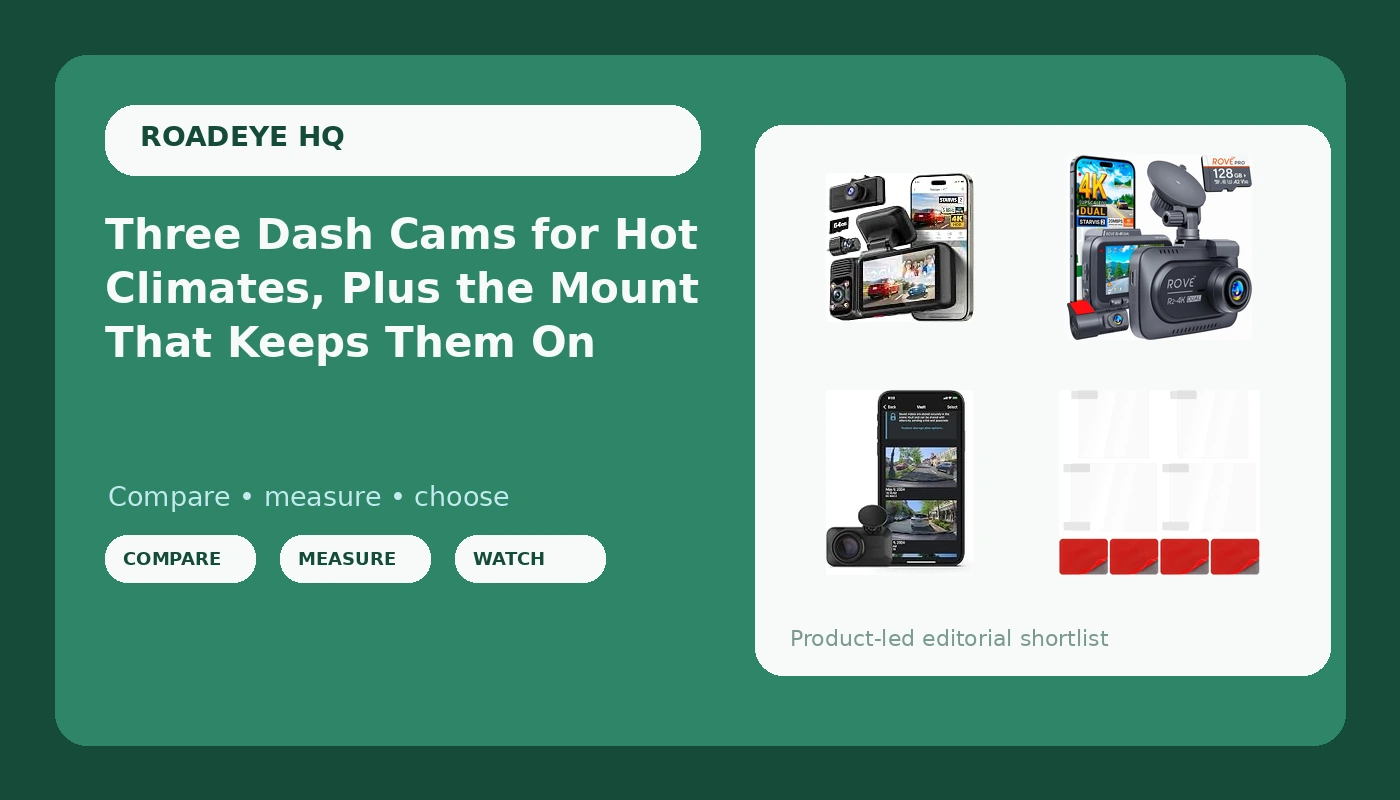
Most dash cam shoppers compare resolution and stop there. Then August arrives, the windshield turns into a hot plate, and the camera that looked excellent on paper stops recording without telling anyone. If you drive anywhere with a real summer, the useful question is not which box has the biggest number printed on it. It is which dash cams for hot climates will still be running the day a red-light runner tells the officer you ran the light, and what you do about the mount holding the thing to the glass. This explainer covers three cameras and one inexpensive accessory that solve different parts of that problem, and it is clear about what each one does not do.
Related: How to Hardwire a Dash Cam Without Draining Your Car Battery →
Quick answer
There is no single camera that is right for every hot-climate driver, because the answer depends on how much of the car you want covered and how much windshield space you are willing to give up. A dual-channel camera with a STARVIS 2 sensor and a bundled memory card covers the most common need: front and rear footage from one install. A three-channel camera adds a cabin view for rideshare and delivery work. An ultracompact 1080p camera is the least intrusive way to keep a witness on the glass. And a pack of heat-resistant electrostatic films is the cheap insurance that keeps any of those mounts from dropping off the windshield in July.
Four useful options
| Model | Best fit | What stands out |
|---|---|---|
| ROVE R2-4K Dual Dash Cam Front and Rear, STARVIS 2 Sensor, Free 128GB Card | Front and rear coverage from one install | Dual-channel recording, STARVIS 2 sensor, 4K front resolution, 128GB card included |
| REDTIGER F17 4K 3CH Dash Cam, STARVIS 2 Sensor HDR, 64GB Card, 5.8GHz WiFi | Drivers who also want a cabin view | Three channels, STARVIS 2 sensor with HDR, 5.8GHz WiFi, 64GB card included |
| Garmin Dash Cam™ Mini 3, Ultracompact 1080p HD Dash Cam | The smallest possible footprint on the glass | Ultracompact body, 1080p HD recording, single front channel |
| Thinp 4 Pcs Electrostatic Film for Dash Cam, Double Sided Dash Cam Sticky Pads Clear Sticker Shield for Windshields Heat-Resistant Electrostatic Stickers for Dashcam, with Adhesion Promoter | Keeping a mount attached through summer heat | Four films, double sided adhesion, clear windshield shield, adhesion promoter included |
The dual-channel pick: ROVE R2-4K Dual Dash Cam Front and Rear, STARVIS 2 Sensor, Free 128GB Card
Rear coverage is the part of a dash cam purchase that actually changes outcomes, because rear-end collisions and parking lot taps are exactly the claims where a single front-facing camera proves nothing about who hit whom. The trade-off is installation: a rear camera means routing a cable along the headliner and through the tailgate or rear deck, which is an afternoon job if you want it to look like it came from the factory. Note also that the front resolution is the number advertised. The listing does not state a rear resolution, so do not assume the rear channel matches the front. STARVIS 2 describes a sensor family, not a guarantee about night footage; lens quality, bitrate, and firmware all feed into whether a plate is readable at speed.
The three-channel option: REDTIGER F17 4K 3CH Dash Cam, STARVIS 2 Sensor HDR, 64GB Card, 5.8GHz WiFi
The cabin channel is what settles the disputes that otherwise become one person's word against another's, and it is the reason rideshare and delivery drivers tend to want three channels rather than two. HDR helps in the specific situation where a bright sky sits behind a dark car, which is most of a Phoenix commute. The trade-offs are real, though. Three simultaneous streams write three times the data, so a 64GB card fills faster and cycles more often, which shortens its life. More recording channels also means more heat inside the housing on a hot dashboard. The 5.8GHz WiFi is genuinely useful for pulling a clip to a phone at the roadside, but it is a convenience, not a feature that improves the footage. Nothing in the supplied listing claims parking mode or includes a hardwire kit, so treat those as separate purchases until you verify them.
The compact pick: Garmin Dash Cam™ Mini 3, Ultracompact 1080p HD Dash Cam
Discretion is a legitimate buying criterion, not a compromise. A small camera hides behind the rearview mirror, does not invite a break-in the way a screen-lit box does, and does not become a conversation piece every time someone gets in the car. The honest limitation is coverage: there is no rear channel and no cabin channel, so a rear-end collision or an incident inside the car produces nothing. If you want both discretion and rear footage, plan on two cameras or accept that this one documents only what happens in front of you. Resolution here is 1080p rather than 4K, which is a real difference in how much detail survives at highway speed, and no bitrate figure is published, so the resolution number alone tells you less than the marketing suggests.
The mounting accessory: Thinp 4 Pcs Electrostatic Film for Dash Cam, Double Sided Dash Cam Sticky Pads Clear Sticker Shield for Windshields Heat-Resistant Electrostatic Stickers for Dashcam, with Adhesion Promoter
Two practical reasons to use a film instead of sticking a pad straight onto the glass. First, removal: adhesive pads leave residue, and scraping cured adhesive off a windshield is how people scratch glass or damage a tinted strip. A film peels away instead. Second, repositioning: if the camera ends up pointing at the hood or too far into the mirror's shadow, you can move the film rather than fight the pad. The trade-off is that a film adds one more layer that can let go, so surface preparation matters more, not less. The heat-resistance description comes from the seller's listing, and no temperature figure is published, so treat it as a design intent rather than a tested limit.
Prices and availability may change. Verify the current listing, included accessories, and specifications before you buy.
Why heat is the spec nobody prints
A dash cam spends its life in one of the worst environments you can put consumer electronics into: a closed car in direct sun, with the device pressed against glass. Cabin temperatures on a hot day climb far beyond the outside air temperature, and a camera that is already recording is generating its own heat on top of that. Heat does not usually kill a camera dramatically. It kills it quietly, in stages.
The first failure is usually the power source. Cameras that use a lithium battery are more vulnerable to heat than cameras that use a capacitor, because lithium cells degrade and can swell when they are cooked repeatedly. This is why the power source is worth checking before anything else on the box, especially if you live somewhere with brutal summers. The catch is that this detail is rarely printed on the front of the package.
The second failure is the memory card. Continuous recording writes and rewrites the card constantly, and heat accelerates the wear. A standard card that works fine in a phone can fail in a dash cam, and the failure mode is often silent corruption rather than a clean error. That is why cards rated for high endurance exist, and why reformatting the card inside the camera on a regular schedule is worth the two minutes.
The third failure is the mount. Adhesive softens as the glass heats, and a camera that slides down the windshield mid-drive is worse than useless, because you will not notice the new angle until you review footage. Cleaning the glass, using a film, and giving the adhesive time to cure before you drive all reduce the odds.
The fourth issue is not a failure at all, it is a misreading of the spec sheet. Resolution is the number everyone compares, and bitrate is the number nobody checks. A high-resolution camera with a low bitrate produces mushy footage where plates are unreadable. Sensor size and lens quality matter too. So does field of view: too narrow and you miss the side of your own car, too wide and the edges of the frame turn into a fisheye smear where a plate should be.
How to choose a camera for a hot climate
- Decide how many channels you actually need. Front only covers the most common collision. Front and rear covers rear-end claims and parking taps. Front, rear, and cabin covers rideshare and delivery disputes. Every added channel means more data, more heat, and more cable.
- Check the power source before the resolution. A camera that uses a capacitor rather than a lithium battery is the safer bet for a dashboard that bakes. If the listing does not say, ask before you buy.
- Look past the resolution sticker. A 4K label means nothing without knowing the sensor and the bitrate. Look for a named sensor family and any published recording detail, and be skeptical of a big number with no supporting specification.
- Budget for the memory card on purpose. If a card is included, confirm its capacity and plan to replace it eventually with a high endurance card sized for your recording load. Three channels chew through capacity faster than one.
- Plan the mount and the wiring before the camera arrives. Decide whether you are using adhesive or suction, whether the windshield is tinted or coated, and whether you need a hardwire kit for anything that has to run while the ignition is off.
Habits that decide whether the clip exists when you need it
- Clean the mounting area with isopropyl alcohol and let it dry fully, then attach the film or pad and let the adhesive cure before hanging the camera on it.
- Use an electrostatic film on leased cars and coated or tinted windshields, so removal does not become a damage charge.
- Reformat the memory card in the camera every few weeks, and replace it on a schedule rather than waiting for a failure.
- Test the footage monthly. Pull one night clip and one daytime clip and try to read a plate at highway speed. If you cannot, the camera is not doing its job.
- Park with a sunshade where you can. Lower cabin temperatures help every component in the system, including the card you cannot see.
Which option should you choose?
Choose the ROVE R2-4K Dual Dash Cam Front and Rear, STARVIS 2 Sensor, Free 128GB Card when you want front and rear coverage from one purchase and a memory card that arrives with the camera. Choose the REDTIGER F17 4K 3CH Dash Cam, STARVIS 2 Sensor HDR, 64GB Card, 5.8GHz WiFi when you carry passengers or deliveries and need a cabin view, plus the faster WiFi transfer that makes pulling a clip at the roadside less painful. Choose the Garmin Dash Cam™ Mini 3, Ultracompact 1080p HD Dash Cam when discretion matters most and front-only 1080p coverage is an acceptable trade for a camera nobody notices. And add the Thinp 4 Pcs Electrostatic Film for Dash Cam whichever camera you pick, if you want the option to remove or reposition the mount without scraping your windshield.
One caveat applies to all of it. None of these listings, as supplied, state a power source type, a bitrate, a field of view, or parking mode support, and the film's heat resistance is a seller description rather than a published temperature rating. Verify those specifics in the current listing before you commit, and treat any heat claim you cannot trace to a specification as marketing until proven otherwise.
The bottom line
A dash cam is an insurance witness, and the only thing that matters is whether it is still recording on the day you need the clip. In a hot climate, that means thinking about the whole system rather than the headline resolution: a camera with a sensor you can trust, a power source that tolerates heat, a memory card rated for constant writing, and a mount that stays exactly where you aimed it. The dual-channel ROVE covers the most common claim with front and rear footage. The three-channel REDTIGER adds the cabin view that rideshare and delivery drivers end up needing. The Garmin Mini 3 trades coverage for the smallest possible footprint on the glass. The electrostatic films cost almost nothing and protect the one surface you cannot replace cheaply. Pick the coverage you need, then spend your remaining attention on the card and the mount, because those are the parts that quietly decide whether the footage exists at all.